

When it comes to settling vs. going to trial Ontario personal injury claims, one path does not automatically pay more than the other. The right decision depends on the facts of your case, the offer on the table, the strength of your injuries, and a set of Ontario-specific legal rules that change the financial calculation for many claimants in ways they never expect.
For anyone asking should I settle or go to trial Ontario, the honest answer requires understanding both paths and the province’s own legal framework. Ontario’s Insurance Act, the Minor Injury Guideline, and the statutory deductible on non-pecuniary damages all affect whether a trial produces more money than the insurer’s offer, or less. These are rules that apply specifically to Ontario claimants and are absent from most general guides on this topic.
At Maana Law, we work with personal injury clients across Mississauga and Ontario every day. Our team has seen the financial consequences of both paths, and we help clients make this decision with real information. Many serious claims, including those involving crashes that produce injuries lasting months or years, require this exact analysis before any offer should be accepted or rejected.
Getting this decision right matters more than most people realize. The difference between a well-timed settlement and a trial that should have been avoided, or a settlement that should have been refused, can be significant in both financial and personal terms. This guide lays out both paths with the Ontario-specific legal context that most online resources leave out.
Here is what this guide covers:
- The core differences between settlement and trial in Ontario
- How Ontario’s unique legal rules affect your compensation potential
- Why most personal injury cases settle before reaching court
- The specific financial and legal risks of going to trial
- How to tell which path fits your specific case
Ontario’s $47,000 statutory deductible can turn a $65,000 pain and suffering award into $18,000. Know this before you decide.
Maana Law runs the Ontario-specific numbers for your case before you accept or reject any offer. Free consultation.
Is It Better to Settle or Go to Trial in Ontario?
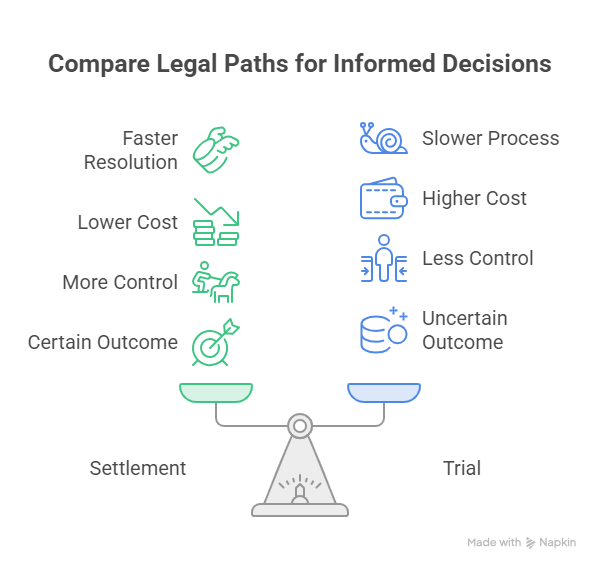
Settling is the better outcome for most Ontario personal injury claimants. It provides guaranteed compensation, faster resolution, and lower legal costs. Trials carry real financial risk, unpredictable timelines, and no guaranteed outcome.
That said, “better” depends entirely on your situation. If the insurer’s offer falls significantly below your actual damages, a trial may be the right move. If the offer reflects fair value for your injuries and your legal position, settling removes the uncertainty of a courtroom outcome.
The Law Society of Ontario acknowledges that most civil disputes, including personal injury claims, resolve through negotiated settlements before trial. This pattern exists not because injured people lack the right to a trial, but because settlement, when handled properly, often produces a reliable outcome at a fraction of the time and cost.
One thing most general guides miss: the settle-vs-trial decision in Ontario is not the same for every injury type. Ontario law treats soft tissue injuries, threshold injuries, and catastrophic injuries under different rules, and the initial assess-and-decide process that shapes most Ontario personal injury claims reflects that distinction in ways that matter long before any offer is evaluated.
What Are the Key Differences Between Settlement and Trial in Ontario?
A settlement is a private, binding agreement between you and the at-fault party’s insurer. A trial is a formal court process where a judge or jury decides your compensation after hearing all evidence from both sides.
| Factor | Settlement | Trial |
| Timeline | 6 months to 2 years | 2 to 5+ years |
| Legal Costs | Lower | Higher (experts, transcripts, filings) |
| Outcome Certainty | Guaranteed agreed amount | No guarantee |
| Privacy | Confidential agreement | Public court record |
| Emotional Burden | Lower | Higher (testimony, cross-examination) |
| Your Control | You approve the final amount | Judge or jury decides |
| Post-Decision Options | Final and binding | Subject to appeal by either side |
For a broader picture of what civil litigation outcomes look like in Ontario, our guide on civil litigation settlement amounts in Ontario provides useful context alongside this comparison.
In Ontario, the Rules of Civil Procedure require mandatory mediation before most personal injury matters proceed to trial. Alternative dispute resolution, including mediation, must be attempted first. Many cases that appear headed for court resolve during this stage.
The discovery phase adds significant time as well. Both parties exchange documents, conduct examinations under oath, and build their evidentiary records before the matter is ready for a judge or jury. This process alone can take one to two years.
Why Do People Settle Instead of Going to Trial?
Most personal injury settlement vs trial Ontario decisions favour settlement because it offers certainty, speed, and a defined financial outcome that a trial simply cannot match.
A trial in Ontario Superior Court takes time. During that period, you are living without final compensation while legal costs continue to accumulate. For someone managing an injury, lost wages, and medical expenses at the same time, waiting years for a verdict is often not realistic. Our guide on how much a car accident settlement pays in Ontario outlines the typical compensation ranges that inform those early negotiation positions.
There is also the financial logic of a known outcome. When you settle, you walk away with a confirmed amount. When you go to trial, you might win significantly more, or you might receive a defense verdict. Based on Ontario civil court utilization data tracked by the Ministry of the Attorney General, the overwhelming majority of personal injury claims filed in Ontario resolve before trial. Practitioners across the province consistently estimate that fewer than 5% of filed claims actually reach a courtroom.
Emotional factors also shape the decision. Testifying in court, being cross-examined by defense counsel, and publicly revisiting your injuries is mentally taxing. Many clients prioritize recovery over the uncertainty of prolonged litigation.
None of this means you should accept any offer. It means understanding why the pattern exists so you can evaluate your own position clearly.
If you are weighing whether to settle or push toward trial, Maana Law will give you an honest assessment of where your case actually stands before you decide.
How Do Ontario’s Laws Affect the Settlement vs. Trial Decision?
Ontario’s legal framework for personal injury claims is more restrictive than most people realize, and it directly affects how much you can recover at trial depending on your injury type.
Three provisions under the Insurance Act and the Statutory Accident Benefits Schedule (SABS) are particularly important for auto accident claimants.
The Minor Injury Guideline (MIG)- For injuries classified as minor under SABS, including most soft tissue injuries, sprains, and strains, accident benefits for medical and rehabilitation treatment are capped at $3,500. Insurers routinely classify injuries as minor to limit their exposure. If your injury has been placed under the MIG, your overall claim is already framed as lower-value, which affects what a settlement offer looks like and what a trial is likely to produce.
The tort threshold test- To claim general damages for pain and suffering in a car accident tort action in Ontario, you must establish that your injury constitutes a serious and permanent impairment of an important physical, mental, or psychological function. This is a legal threshold, not a medical one. Injuries that do not meet it cannot recover non-pecuniary damages at trial at all, regardless of who was at fault. If your injuries fall below this threshold, going to trial for general damages may produce nothing on that component.
The statutory deductible on non-pecuniary damages- Even when a plaintiff clears the threshold test, Ontario applies a statutory deductible to pain and suffering awards below a certain level. As of recent regulatory updates, this deductible is approximately $47,000 on awards below approximately $157,000. This deductible is indexed annually under O. Reg. 461/96. In practical terms, a jury award of $65,000 for pain and suffering could result in a net recovery of roughly $18,000 on that component alone after the deductible is applied. This is precisely the kind of outcome that makes a settlement look different once the math is done properly. For a full breakdown of how this deductible compounds with contingency fees and disbursements on a real settlement figure, our guide on personal injury lawyer cost in Ontario walks through the complete deduction sequence.
Finally, accident benefits claims under SABS and tort claims against the at-fault driver are two separate legal streams. If your injuries have resulted in an ongoing long-term disability, understanding how those accident benefit streams interact with your tort claim is critical before any offer is signed. Settling your tort claim does not resolve your accident benefits matter, and many claimants do not realize this until well into the process.
Under Rule 49, if you reject a settlement offer and don’t beat it at trial — you may owe the other side’s legal costs.
This is why the trial decision needs Ontario-specific legal analysis — not a general guide. Let Maana Law assess your position.
How Much More Money Can You Get by Going to Trial in Ontario?
Going to trial does not automatically mean more money. The answer to how much more money do you get going to trial Ontario depends on your injury type, how Ontario’s legal framework applies to your specific case, and the strength of your evidence.
For soft tissue injuries, whiplash, and cervical strain, trials carry meaningful risk. Even in what initially appears to be a minor car accident, insurers may invoke the MIG to frame the claim as low-value from the outset. When an injury falls under the Minor Injury Guideline, the insurer’s litigation position is reinforced by statute. If the injury also fails to meet the tort threshold, non-pecuniary damages at trial are blocked entirely. Even where the threshold is met, the statutory deductible significantly reduces the actual take-home amount on pain and suffering awards below $157,000. Insurers understand this, and they sometimes take soft tissue cases to trial willingly because Ontario’s framework works in their favour.
For catastrophic injuries, traumatic brain injuries, serious disc herniations such as L4-L5, and wrongful death cases, the calculation is different. These cases are not subject to the minor injury cap. Where damages are high enough, the statutory deductible does not apply. These matters involve life care plans, future medical cost projections, lost earning capacity, household services damages, and loss of enjoyment of life. A well-documented catastrophic injury case, handled by lawyers who understand what those long-term care costs actually look like in practice, can produce a trial verdict that far exceeds the insurer’s pre-trial offer.
The personal injury trial compensation Ontario pattern is consistent: cases that clear the threshold test, involve serious permanent injury, and carry strong expert evidence tend to produce better trial outcomes. Cases that fall within the MIG, sit near the threshold boundary, or involve disputed liability often settle more effectively than they perform before a jury.
What Are the Risks of Going to Trial for a Personal Injury Case in Ontario?
The risks of going to trial personal injury Ontario claimants face are significant, and every client should understand them before deciding to reject a settlement offer. Reviewing our guide on common car accident claim mistakes in Ontario before proceeding can help you avoid compounding the situation with avoidable errors at this stage.
First, there is no guaranteed outcome. A judge or jury can award less than the settlement offer, reduce your damages based on contributory negligence under the Negligence Act, or issue a defense verdict. If you are found 25% at fault, your award is reduced by 25%.
Second, Rule 49 of the Rules of Civil Procedure creates a cost risk that catches many claimants off guard. If the defendant makes a formal offer to settle and you reject it, then fail to beat that offer at trial, the court can order you to pay a portion of the defendant’s legal costs from the date the offer was made. This rule changes the financial math of going to trial in a direct and significant way.
Third, costs continue to accumulate throughout the process. Expert witnesses, court filing fees, transcript costs, and additional lawyer hours all add up. If the final award is lower than the pre-trial offer, those accumulated costs come directly out of your recovery.
Fourth, either party can file post-trial motions or launch an appeal after a verdict is delivered. A judgment in your favour is not necessarily final on the day it is issued.
Fifth, the emotional weight of a trial is real and sustained. Voir dire, opening statements, plaintiff’s case-in-chief, cross-examination, and jury deliberations all require active participation over an extended period, often while you are still managing your injury and its effects on your daily life.
What Are the Disadvantages of Settling a Personal Injury Claim?
Settling too early or for the wrong amount is one of the most costly mistakes in Ontario personal injury law. The core disadvantage of settlement is finality: once you sign, the case is permanently closed.
If your condition worsens after settling, if new medical evidence emerges, or if your long-term care costs turn out to be far higher than expected, you have no legal recourse. You cannot reopen the claim.
This is why reaching maximum medical improvement (MMI) before settling matters. MMI is the point where your medical team confirms your condition has stabilized and can project your future needs accurately. Settling before MMI means you may not know the true scope of your injury, and you risk accepting a number that does not reflect what your recovery will actually cost.
This is especially true in claims that start as soft tissue cases but develop into longer-lasting conditions. What appears to be a minor sprain in the first three months can look very different at the one-year mark, and the financial gap between those two timelines is something many claimants only discover too late. Settling before that picture is clear is a risk that cannot be undone. For context on where these negotiations typically break down when attempted without representation, our guide on how to settle a car accident claim without a lawyer outlines the specific points where unrepresented claimants most often leave money behind.
Other disadvantages include:
- Insurer pressure to close the file quickly before you understand your full damages
- Undervaluation of non-economic damages including emotional distress and loss of enjoyment of life
- Losing the ability to pursue punitive damages if the defendant’s conduct was particularly negligent
- Confidentiality clauses that restrict what you can say about the outcome
- Pre-judgment interest under the Courts of Justice Act, which accrues from the date of injury, is forfeited at settlement; for cases that run several years, that figure is worth calculating before any offer is signed
How Long Does a Personal Injury Trial Take in Ontario?
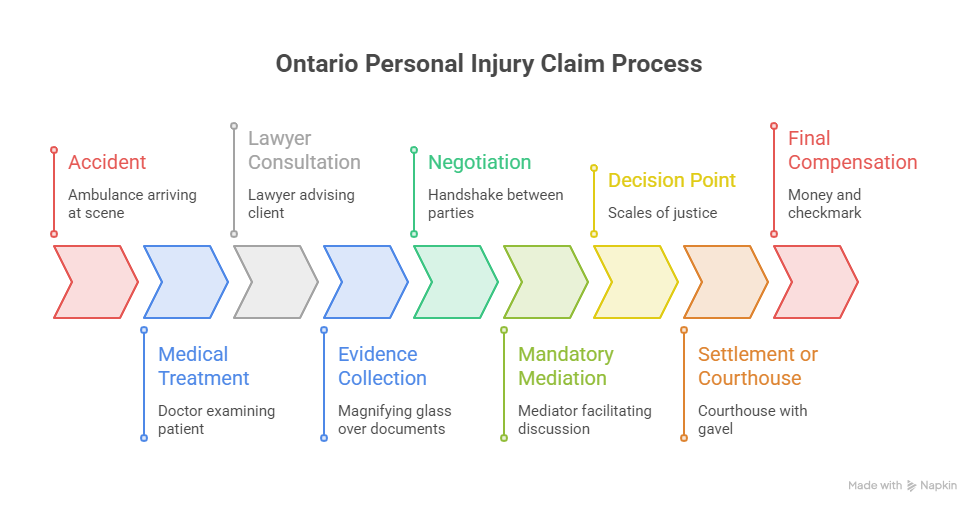
The personal injury lawsuit timeline Ontario from initial claim to final verdict typically spans two to five years when a case goes to trial. Settlement can often be reached in six months to two years, depending on insurer cooperation and injury complexity.
Here is how the key stages typically sequence in an Ontario personal injury trial:
- Filing the claim: Must happen within two years of the accident date under Ontario’s Limitations Act, 2002
- Statement of Defence: Filed by the defendant, typically within 20 days of service
- Discovery phase: Document exchange and examinations under oath; commonly takes one to two years
- Mandatory mediation: Required before trial in most Ontario personal injury matters
- Pre-trial conference: A judge reviews the case and actively encourages settlement
- Trial: Can run from several days to several weeks depending on complexity and witnesses
- Verdict: Delivered after judge or jury deliberations
- Post-trial motions and potential appeals: Can add additional months or years
Going to court for a personal injury claim Ontario is a long-term commitment. The timeline alone is a legitimate factor in deciding whether trial is the right path. That said, it is also one of the reasons Rule 49 offers carry real weight: both sides understand what proceeding to verdict actually costs in time and resources.
When Does Going to Trial Make Sense for Your Personal Injury Case?
Going to trial makes sense when the insurer’s offer falls well below the true value of your claim, your injuries meet Ontario’s tort threshold, and you have strong evidence to support a higher award.
Specific circumstances where trial may be the right path:
- The insurer is disputing liability entirely and your evidence clearly establishes fault
- Your injuries are catastrophic, permanent, or threshold-meeting and the offer does not account for your long-term care costs
- You suffered a traumatic brain injury, serious disc herniation, or have been left with a permanent functional impairment, and the offer is far below comparable Ontario court awards
- The insurer is acting in bad faith, using delay tactics, or refusing meaningful settlement discussions
- Your injuries clearly exceed the statutory deductible range, removing that financial barrier at trial
- Punitive damages may apply due to particularly reckless conduct
In wrongful death cases, the legal and financial stakes are different from injury claims, and the specific way Ontario calculates damages for surviving family members affects the trial-vs-settlement analysis in ways that require separate consideration.
Settlement negotiation personal injury lawyer Ontario experience and courtroom experience are not separate skills. The lawyer who negotiates your settlement is the same one who takes you to trial if needed. Their track record on both sides of that line directly affects the offers you receive and the outcomes you achieve.
Settlement or trial — the right answer depends on the MIG, the threshold test, and the deductible applied to your specific case.
Maana Law provides Ontario-specific case analysis before you make this decision. Free consultation — no win, no fee.
Why Maana Law Is the Right Choice for Settling vs. Going to Trial
Choosing between settlement and trial is one of the most consequential decisions in your personal injury case. You need a legal team that understands both paths and has the experience to pursue whichever one genuinely serves you.
Maana Law has guided clients in Mississauga and across Ontario through settlement negotiations and trial proceedings for over a decade. Our approach is direct: we analyze your case against Ontario’s actual legal framework, not generic settlement patterns, and tell you what your case is realistically worth before any decision is made.
- Over a Decade of Ontario Personal Injury Representation Aman Kalra and the Maana Law team have handled car accidents, slip and fall claims, catastrophic injuries, and wrongful death matters across Ontario. We know how the MIG, the tort threshold, and the statutory deductible affect what your case can realistically produce at trial versus at the negotiating table.
- Trial-Ready Negotiation from the First Demand Letter Insurers respond differently to lawyers with a genuine trial record. At Maana Law, every case is built from the start with trial preparation in mind, and that preparation changes what insurers put on the table before you ever decide whether to accept.
- No Win, No Fee Representation We work on a contingency fee basis, so you pay nothing upfront and nothing unless we recover compensation for you.
- Honest Case Assessments with Ontario-Specific Analysis Your first consultation includes a full review of your injuries and your realistic range given Ontario’s legal framework. We account for the MIG, the threshold test, and the deductible in every assessment.
- Accessible Representation for Every Client We offer virtual consultations, phone meetings, and home or hospital visits. If your injury limits your mobility, we come to you.
- Hindi and English Representation Aman Kalra serves clients in both Hindi and English, removing language barriers that often prevent accident victims from accessing the legal guidance they need.
Maana Law clients walk into every settlement negotiation knowing their lawyer is fully prepared to take the case to trial if the number on the table is not right.
Frequently Asked Questions
At what point do most personal injury cases settle in Ontario?
Most personal injury cases in Ontario settle after the discovery phase and mandatory mediation are complete, once both sides have a clear picture of the evidence and the realistic trial range. Cases with disputed liability or high-value injuries sometimes continue negotiating right up to the scheduled trial date, with the strength of any Rule 49 offer on the table shaping how late those discussions extend.
What percent of personal injury cases actually go to trial in Ontario?
Based on civil court data tracked by the Ontario Ministry of the Attorney General, the overwhelming majority of personal injury claims resolve before trial. Personal injury practitioners across the province consistently estimate fewer than 5% of filed claims proceed to a full hearing, with mandatory mediation and Rule 49 cost exposure driving both parties toward settlement well before a judge or jury is needed.
Does the Minor Injury Guideline affect whether I should go to trial?
Yes, significantly. If the insurer has classified your injury as minor under the MIG, your accident benefits are capped and your tort damages may be limited by Ontario’s statutory deductible even if you win at trial. Before rejecting a settlement offer, you need to know whether your injuries meet the tort threshold for non-pecuniary damages, because that determination changes the financial value of a trial outcome in a direct and calculable way.
Can I still negotiate after rejecting a settlement offer in Ontario?
Yes. Rejecting one offer does not close negotiations. Insurers routinely make multiple offers as the case moves through discovery and mediation, and your legal team can counter at any stage before the trial concludes. Settlement remains possible even after a trial date is scheduled.
What happens if I go to trial and the verdict is lower than the settlement offer?
If you receive a judgment lower than the defendant’s formal Rule 49 offer to settle, the court may order you to pay a portion of the defendant’s legal costs from the date that offer was made. You would also typically remain responsible for your own legal fees under the terms of your contingency agreement. Your lawyer should walk you through the full cost exposure of a below-offer outcome before you commit to trial.
Conclusion
The decision between settling and going to trial is not about which option generally pays more in Ontario. It is about which option produces the best outcome given your specific injuries, your specific legal position under Ontario’s framework, and your specific life situation right now.
Settlement gives you certainty, speed, and a confirmed amount. Trial gives you the opportunity to pursue full compensation when an insurer’s offer falls genuinely short, but it comes with cost exposure, a long timeline, and legal rules that can significantly reduce the actual take-home amount if your case does not meet Ontario’s threshold requirements. Knowing where your injuries sit within Ontario’s framework, including the Minor Injury Guideline, the tort threshold, and the statutory deductible, is the difference between making an informed decision and guessing.
The most protected position is one where your lawyer understands Ontario’s legal framework in full and is prepared to take your case to trial if the offer on the table does not reflect its real value. Accepting an early offer without that analysis often means leaving money behind. Going to trial without that preparation means taking on risk without the tools to manage it.
Maana Law, located at 90 Matheson Blvd W Suite 101, Mississauga, ON, offers free consultations for personal injury claimants across Ontario. Call us today to get an honest, Ontario-specific assessment of your settlement versus trial options and find out what your case is truly worth.
References
- Law Society of Ontario. Public Resources on Civil Cases. https://lso.ca/public-resources/legal-issues/civil-cases
- Ontario Government. Rules of Civil Procedure, R.R.O. 1990, Reg. 194. https://www.ontario.ca/laws/regulation/900194
- Ontario Ministry of the Attorney General. Civil Court Services. https://www.ontario.ca/page/ministry-attorney-general
- Ontario Superior Court of Justice. Civil Decisions. https://www.ontariocourts.ca/scj/
- Ontario Government. Insurance Act, R.S.O. 1990, c. I.8. https://www.ontario.ca/laws/statute/90i08
- Ontario Government. Negligence Act, R.S.O. 1990, c. N.1. https://www.ontario.ca/laws/statute/90n01
- Ontario Government. Courts of Justice Act, R.S.O. 1990, c. C.43. https://www.ontario.ca/laws/statute/90c43
- Ontario Government. Limitations Act, 2002, S.O. 2002, c. 24, Sched. B. https://www.ontario.ca/laws/statute/02l24
- The Advocates’ Society. Trial Advocacy Resources in Ontario. https://www.advocates.ca/
- Financial Services Regulatory Authority of Ontario (FSRA). Auto Insurance. https://www.fsrao.ca/industry/auto-insurance