

If you are dealing with a civil lawsuit in Ontario, one of the first questions on your mind is: how much can you actually recover?
Civil litigation settlement amounts in Ontario vary widely. A minor dispute in Small Claims Court might resolve for a few thousand dollars. A serious personal injury case in the Ontario Superior Court of Justice can result in hundreds of thousands, or more. What you receive depends on the type of damages, how strong your evidence is, and whether you and the other side can agree before trial. An experienced Civil Litigation Lawyer in Mississauga can assess these factors and help you understand your potential recovery.
Here is what this guide covers:
- The difference between general and special damages in Ontario civil cases
- How courts calculate compensation
- How Rule 49 offers to settle affect your final payout
- What costs awards mean for winners and losers
- How settlement amounts differ across case types
Share Your Requirements via WhatsApp!
What Are Civil Litigation Settlement Amounts in Ontario?
An Ontario civil lawsuit payout is the total compensation a plaintiff receives, either through a court judgment or a negotiated settlement. It is not a single fixed number. Courts look at what losses you actually suffered and what the law allows you to claim.
Settlements happen outside the courtroom. The parties agree on a number, sign minutes of settlement, and the case ends. Most civil cases in Ontario settle before trial because litigation is expensive and uncertain for both sides.
The amount you receive reflects what you could reasonably expect to win at trial, minus the risk, delay, and cost of getting there. Before you decide whether to pursue a claim or accept an offer, it helps to understand how civil litigation in Mississauga actually works from the inside, not just the numbers on paper.
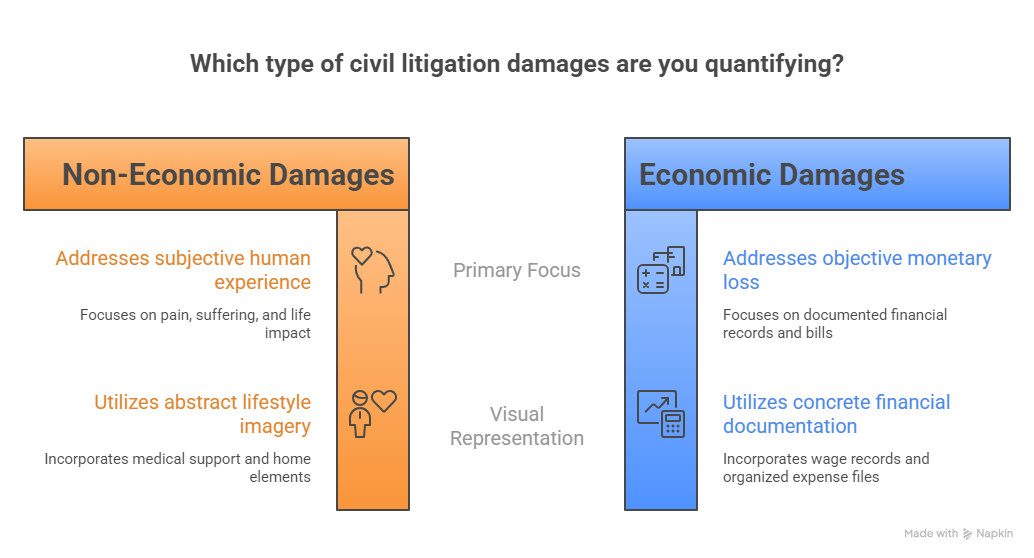
What Types of Damages Can You Claim in an Ontario Civil Case?
Ontario civil courts recognize two main categories of damages.
General damages civil case Ontario refers to losses that are harder to put an exact number on. Pain and suffering, loss of enjoyment of life, and loss of future earning capacity fall into this category. A judge or jury assigns a dollar value based on the severity of the injury and how it has affected your life.
Special damages personal injury Ontario are your actual, documented out-of-pocket losses. These include:
- Medical and rehabilitation expenses
- Lost income to date
- Cost of future care
- Property damage
- Out-of-pocket expenses tied directly to the injury
Special damages require proof. You need receipts, wage records, medical reports, and expert evidence. Without documentation, these amounts are difficult to recover.
In serious injury cases, both categories combine. The total can be substantial when a person faces permanent disability, chronic pain injury claims, or a reduced ability to work long-term.
How Much Can You Sue For in Ontario?
How much can you sue for in Ontario depends on which court you use and what your claim is worth.
Small Claims Court handles claims up to $35,000. The process is simpler and less expensive, but the maximum award is capped.
Ontario Superior Court of Justice handles larger claims with no dollar ceiling. This is where serious personal injury cases, wrongful death claims, and complex civil disputes are heard.
There is no universal average settlement. A slip and fall with minor injuries may settle for $20,000 to $50,000. A catastrophic injury case can result in a settlement worth $1 million or more, particularly when future care costs and income loss are significant.
The strength of your claim, the quality of your evidence, and the skill of your legal representation all affect where your settlement lands within that range.
What Is Rule 49 and How Does It Affect Your Settlement?
Rule 49 offer to settle Ontario is one of the most important rules in civil litigation. Understanding it can mean the difference between keeping most of your settlement and losing a significant portion to costs.
Under Rule 49, either party can make a formal offer to settle at any point before trial. If you make an offer and the other side refuses, then you do better at trial than your offer, the court can award you substantial indemnity costs from the date of the offer forward. This is a significant penalty for the party who refused a reasonable deal.
The reverse also applies. If a defendant makes an offer and the plaintiff refuses, then the plaintiff wins at trial but gets less than the offer, the plaintiff may be ordered to pay the defendant’s costs from the date of the offer.
This rule pushes both sides toward realistic settlement discussions. It rewards early, reasonable offers and penalizes parties who hold out unreasonably.
Better result at trial is the threshold that triggers enhanced cost consequences. If your result at trial beats your Rule 49 offer, costs shift in your favor. This is the costs consequences rule in practice, and it is one reason why having experienced legal guidance before making or responding to any offer matters so much.
What Are Costs Awards and Who Pays Them?
Civil court compensation Ontario does not stop at damages. Ontario follows the loser pays rule, meaning the losing party is usually ordered to contribute to the winner’s legal costs.
There are three levels of costs awards:
Partial indemnity costs are the default after a trial win. They cover roughly 50 to 60 percent of a party’s actual legal fees. The winner recovers something, but not everything spent.
Substantial indemnity costs are awarded when a party’s conduct warrants a higher penalty. Refusing a reasonable Rule 49 offer is one trigger. Misleading the court or acting in bad faith can also lead to substantial indemnity costs.
Full indemnity costs are rare. They apply when conduct is reprehensible, scandalous, or outrageous.
Costs also include disbursements: court filing fees, process server fees, expert witness fees, transcript costs, and other out-of-pocket expenses. These are added to the costs award on top of legal fees.
When calculating your expected net recovery, you have to account for your own legal costs and the potential costs exposure you face. A large judgment can be reduced significantly by an unfavorable costs award. This is exactly why understanding the fee structure before you begin prevents surprises at the end.
How Does the Settlement Process Work in Ontario Civil Litigation?
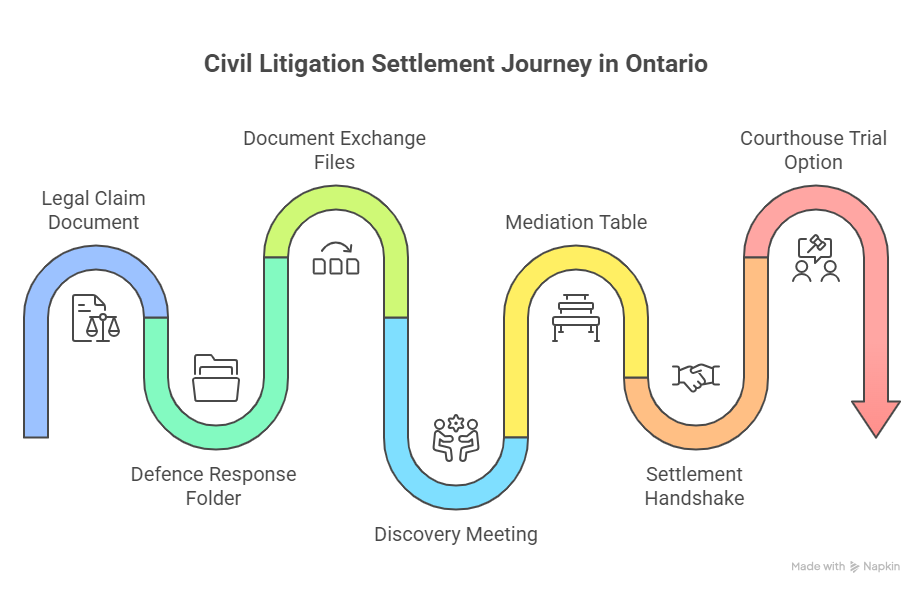
Most cases do not go straight from a Statement of Claim to trial. There is a structured process in between.
After a Statement of Claim and Statement of Defence are filed, the parties exchange an Affidavit of Documents, complete examinations for discovery, and follow a discovery plan for documentary discovery.
Ontario also requires mandatory mediation in Toronto, Ottawa, and Windsor. A mediator helps the parties explore settlement without the court deciding anything. Many cases resolve at this stage.
If mediation does not produce a settlement, the case moves toward a pretrial conference or settlement conference. A judge reviews the case, identifies issues, and often applies pressure on both sides to settle.
Only cases that cannot settle proceed to trial. By the time a case reaches trial, both sides have spent significant money. That cost pressure is itself a driver of settlement.
If your case follows the Simplified Procedure, which applies to claims between $35,000 and $200,000, the process is faster and a summary trial may be available. If your civil claim arises from a road accident, it also helps to see how motor vehicle accident claims run alongside the litigation process in Ontario, since insurance and court timelines often intersect.
Start your journey to smart investing.
How Does Your Conduct Affect the Settlement Amount?
Courts have discretion in awarding costs. They look at whether each party took reasonable positions throughout the litigation.
If you exaggerated your injuries, refused reasonable settlement offers, or conducted the case in a manner that ran up unnecessary costs, a court can reduce or shift costs against you even if you win on the merits.
The proportionality rule means the court expects costs to be reasonable relative to the amount at stake. Spending $200,000 litigating a $50,000 claim raises questions about whether the litigation was conducted reasonably.
Reprehensible conduct, deliberate misrepresentation, or using litigation to harass the other side can all result in elevated costs awards against the offending party. In wrongful death situations, where emotions run high and the stakes are significant, this discipline matters even more. Families pursuing those claims often benefit from reading about how wrongful death cases work in Mississauga before deciding on a legal strategy.
Why Maana Law Is the Right Choice for Civil Litigation in Ontario
Maana Law serves accident victims and civil claimants across Mississauga and surrounding communities. The firm has over a decade of experience securing compensation through settlements and trial results.
No Win, No Fee representation. You pay nothing unless your case succeeds. There is no financial barrier to pursuing your claim.
Experienced civil litigation team. Led by Aman Kalra, a personal injury and civil litigation lawyer fluent in Hindi and English, the team handles cases from investigation through resolution with clear, consistent communication.
Accessible consultations. Free consultations are available in person, virtually, or at your home or hospital if you cannot travel.
Thorough case preparation. The firm uses police reports, expert opinions, and witness statements to build the strongest possible record for settlement or trial.
Mississauga-focused. Maana Law understands the local courts, insurance landscape, and community, which matters when navigating Ontario civil litigation.
If you are considering a civil claim and want a clear picture of what your case may be worth, speaking with Maana Law’s civil litigation team early puts you in the strongest position to make an informed decision.
Frequently Asked Questions
How long does a civil lawsuit take to settle in Ontario?
Most civil cases settle within one to three years. Straightforward cases may resolve faster through mandatory mediation or early discussions. Complex cases, especially those involving serious injuries and disputed liability, can take longer. According to the Ontario Court of Justice, understanding court procedures can help set realistic timelines for your case.
What is the difference between a settlement and a court judgment?
A settlement is a private agreement between the parties, usually with confidential terms. A court judgment is a decision made by a judge after trial. Both are legally binding, but settlements are typically faster and less costly to reach.
Can I settle a civil case without a lawyer?
You can, but it carries significant risk. Insurance companies and opposing parties have experienced legal teams. An unrepresented claimant often accepts far less than their claim is worth, particularly in cases involving serious injury or complex costs issues.
What happens if the other side ignores a Rule 49 offer?
If the party who rejected the offer then does worse at trial than the offer proposed, the court will usually award substantial indemnity costs from the date of the offer. This can add significantly to the losing party’s total financial exposure. The Rules of Civil Procedure outline the full framework for offers to settle.
Does a settlement include costs and disbursements?
It depends on how the offer is structured. A Rule 49 offer can be made with or without costs included. Your lawyer should clarify this before you sign anything, because the difference affects your net recovery.
Conclusion
Civil litigation settlement amounts in Ontario depend on what damages you can prove, how both sides manage the process, and whether Rule 49 offers are used strategically. General damages cover pain and suffering. Special damages cover your documented losses. Costs awards under the loser pays rule affect your final net recovery.
If you were injured and want to understand what your civil claim may be worth, Maana Law in Mississauga is ready to help. Contact the team at 90 Matheson Blvd W Suite 101, Mississauga, ON for a free consultation. Virtual meetings and home visits are available. You pay nothing unless you win.