

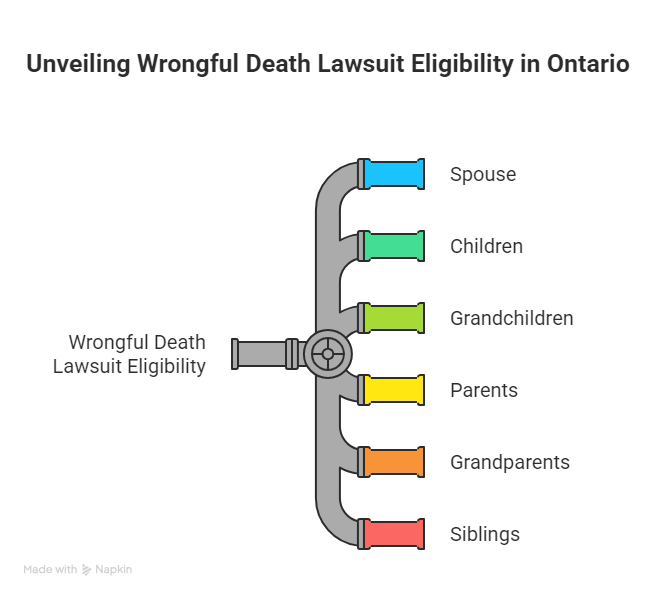
Not every family member who loses someone to negligence has the right to sue. In Ontario, who can sue for wrongful death is governed by Section 61(1) of the Family Law Act (FLA). The law names six eligible categories: spouses, children, grandchildren, parents, grandparents, and siblings. Each category carries its own legal definition, and some require additional proof before a claim can move forward.
This guide breaks down who qualifies, what they can recover, how the estate claim differs from a family claim, and what time limits apply.
By reading this, you will understand:
- Which family members qualify as Family Law Act claimants under Section 61
- How Ontario defines “spouse,” “child,” and “parent” for wrongful death purposes
- What wrongful death eligible family members can recover in damages
- How an estate claim differs from a family FLA claim
- Time limits and the minor claimant postponement rule
Not sure if you qualify to file? Spouses, children, parents, siblings, and grandparents all may have a claim.
Ontario’s Family Law Act defines exactly who can sue — and what each person can recover. Let us walk you through it.
Ontario’s Family Law Act defines exactly who can sue and what each person can recover. Let us walk you through it. Call 437-979-4878
If your family has lost a loved one due to negligence in Mississauga or the surrounding area, speak with a wrongful death lawyer in Mississauga who can help you understand your rights under the Family Law Act.
What Legal Framework Governs Wrongful Death Claims in Ontario?
Ontario does not have a standalone wrongful death statute. Claims arising from a death caused by someone else’s negligence fall under Part V of the Family Law Act, R.S.O. 1990, c. F.3, which you can read at the Ontario e-Laws portal.
Section 61(1) creates a right to sue that belongs personally to surviving family members, not to the deceased’s estate. For the claim to stand, the deceased must have had the right to sue the defendant themselves had they survived. The family’s right flows from that original right.
Wrongful death claims arise from situations including motor vehicle accidents, drunk driving, workplace accidents, construction site fatalities, defective products, unsafe property conditions, and criminal acts such as assault or homicide. What each situation has in common: someone owed the deceased a duty of care, breached it, and caused a death that left family members with real, measurable losses.
Who Are the Primary Claimants Under the Family Law Act?
Section 61(1) of the Family Law Act lists eligible claimants as: the spouse; children and grandchildren; parents and grandparents; and siblings of the deceased. These six categories reflect the family relationships Ontario law treats as having compensable losses after a negligent death.
A biological connection is not always required. What matters is the legal or functional relationship at the time of the incident.
How the FLA Defines “Spouse”
A legally married partner qualifies without any additional conditions. An unmarried partner qualifies as a common law spouse only if they cohabited continuously with the deceased for at least three years. If the couple had a child together in a relationship of some permanence, the three-year threshold may not apply, but cohabitation still must be established.
Courts look at shared lease agreements, joint accounts, shared household expenses, and how the couple presented themselves publicly. Two years of living together does not meet the statutory threshold for an unmarried partner.
How the FLA Defines “Child” and “Parent”
The FLA’s definition goes beyond biology. A person qualifies as the “child” of the deceased if the deceased showed a “settled intention” to treat that person as their own. This covers step-children and children raised under a long-standing parental arrangement. Foster children are explicitly excluded.
The same logic applies in reverse for parents: a non-biological parent who acted in a genuinely parental role toward the deceased may qualify, provided that settled intention can be shown. Courts have examined conduct, financial support, and day-to-day involvement in deciding these cases.
Grandparents and Siblings
Both grandparents and siblings are listed in Section 61(1), but their claims are assessed by the strength of what they can prove. Courts look at financial dependency, regular emotional support, and care the deceased provided. A sibling who had no meaningful contact with the deceased will have a harder time establishing compensable damages than one who relied on the deceased for regular support or guidance.
What Is the Difference Between an Estate Claim and an FLA Claim?
The estate trustee wrongful death claim and the family’s FLA claim are legally distinct. The FLA claim belongs to surviving relatives personally and compensates them for their own losses going forward from the date of death.
The estate claim runs under the Trustee Act, R.S.O. 1990, c. T.23, and covers what the deceased themselves would have claimed had they survived: pre-death medical expenses, pain and suffering between injury and death, and in some cases, lost income up to the date of death. Ontario’s civil court procedures are outlined at the Ministry of the Attorney General.
Both claims are often pursued in the same lawsuit, but they must be carefully structured to avoid double-recovery. Medical expenses incurred before death, for instance, appear in both statutes. Counsel must allocate each head of loss to the correct legal vehicle.
We see this coordination issue regularly with clients who come to us after losing a family member in a serious accident. When both the estate and multiple family members have standing to claim, organizing the pleadings correctly from the start protects the full recovery available to the family.
The family claim and the estate claim are separate — and both can run at the same time for maximum recovery.
Limitation periods can be as short as 2 years. Maana Law ensures your family doesn’t miss any critical deadlines.
What Damages Can Family Members Recover in a Wrongful Death Claim?
Wrongful death eligible family members may pursue both economic and non-economic losses. Ontario courts assess each claimant individually based on their relationship to the deceased and the losses they can prove.
Section 61(2) of the FLA identifies the recoverable heads of loss:
- Funeral, burial, and cremation expenses: Reasonable costs related to laying the deceased to rest
- Pre-death medical expenses: Hospital, treatment, and prescription costs incurred before death
- Loss of financial support: Past and projected future income and pension the deceased would have contributed
- Loss of household services: The market value of cooking, cleaning, childcare, and home maintenance the deceased provided
- Actual expenses: Costs paid by family members for the deceased’s benefit before death
- Loss of guidance, care, and companionship: Non-economic compensation for the relationship itself
Loss of guidance and companionship is the most litigated head of non-economic damages in Ontario wrongful death cases. Section 61(2)(e) exists because earlier case law systematically undervalued the death of a child or a non-income-earning family member. Courts now recognize that a parent’s mentorship, a spouse’s companionship, or a sibling’s support has real compensable value even when no paycheck was lost.
One protection families often miss: Section 63 of the FLA prohibits courts from reducing a wrongful death award because the family received life insurance proceeds. The at-fault party cannot use a life insurance payout to reduce what they owe.
For a clear picture of realistic settlement ranges in Ontario wrongful death cases, read our detailed guide: Wrongful Death Lawsuit Settlements Average Ontario.
Punitive damages are not automatic. They require proof of particularly malicious or high-handed conduct and are assessed separately from compensatory losses.
If your family has lost a loved one due to negligence in Mississauga or the surrounding area, Maana Law provides free, no-obligation consultations to help you understand what your family may be entitled to under the Family Law Act.
What Time Limits Apply to Wrongful Death Claims in Ontario?
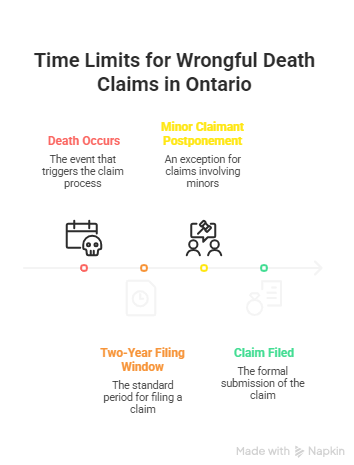
Adult claimants have two years from the date of death to file a wrongful death lawsuit under the Limitations Act, 2002. The Ontario Limitations Act is available here. Missing this deadline generally extinguishes the right to sue, regardless of how strong the claim may be.
Two exceptions apply:
- Minor claimant postponement: If a child was a minor at the time of the parent’s death, the two-year period does not begin until they turn 18. A child who loses a parent at age six may still file independently at age 20 if no action was started on their behalf during childhood.
- Discoverability: If the cause of death was not reasonably known at the time of death, the limitation period may begin from when the family knew or should have known negligence caused it. This matters most in delayed-onset illness cases.
Despite these exceptions, waiting is never a good strategy. Evidence fades, witnesses become harder to locate, and experts need time to build a proper damages assessment. Families who act promptly are in a far better position than those who wait.

Why Maana Law Is the Right Choice for Wrongful Death Families in Mississauga
Maana Law has spent over 10 years representing accident victims and bereaved families across Mississauga. Our wrongful death practice is built around clear legal guidance, accessible support, and a fee structure that removes financial pressure from families who are already under strain.
No Win, No Fee: You pay nothing unless your claim succeeds. There are no upfront retainer costs.
Free consultations: Get clear answers about your eligibility before making any commitment.
Home and hospital visits: If you cannot come to our office at 90 Matheson Blvd W, Suite 101, Mississauga, we come to you.
Over a decade of personal injury experience: Our team has secured millions in compensation through settlements and verdicts for Ontario families.
Hindi and English support: Aman Kalra and the Maana Law team can advise you in the language you are most comfortable with.
5-star rated on Google: 15 reviews from real clients who faced situations much like yours.
Our team includes Aman Kalra as lead personal injury lawyer, supported by Gaganjot Kaur (Law Clerk and licensing candidate) and Kuber Singh (Lawyer Licensing Candidate), all affiliated with the Law Society of Ontario. Your file receives consistent, professional attention from intake to resolution.
Frequently Asked Questions About Wrongful Death Claims in Ontario
Can a common law partner file a wrongful death claim after two years of living together?
No. Ontario’s Family Law Act requires at least three years of continuous cohabitation for an unmarried partner to qualify as a spouse, unless they share a child with the deceased in a relationship of some permanence.
Can siblings file even if they did not depend financially on the deceased?
Yes, but their recovery depends on what losses they can prove. Siblings without documented financial or emotional dependency on the deceased will receive a more limited award than those who can show regular support or close reliance.
Does a life insurance payout reduce the wrongful death settlement?
No. Section 63 of the Family Law Act explicitly prevents courts from reducing the family’s damages award because of any insurance proceeds received.
Can we file a civil claim while criminal charges are also pending?
Yes. A civil wrongful death claim runs independently of any criminal proceedings. You do not need to wait for a criminal trial to conclude before filing under the FLA.
What if the deceased had no income at the time of death?
The family may still recover the value of household services the deceased provided, loss of guidance, care, and companionship, and other documented expenses. Income is not a requirement for a claim.
Your family’s grief is real. So is your right to compensation. Let Maana Law guide you through every step.
Free, compassionate consultation. No win, no fee. Serving families across Mississauga and the Peel Region.
Take Action Before the Two-Year Window Closes
Your family’s legal rights under the Family Law Act are real, but they are time-limited. The two-year period runs from the date of death for adult claimants, and that window does not pause while you grieve, gather documents, or wait to feel ready.
Three things to carry away from this article: eligibility is specific and depends on how the FLA defines your relationship to the deceased; the two-year limitation period is absolute for adults; and estate claims and FLA claims are separate but must be coordinated to protect the full recovery available to your family.
Maana Law serves families across Mississauga and surrounding communities including Erin Mills, Cooksville, Churchill Meadows, and Meadowvale. Call us at 437-979-4878, visit us at 90 Matheson Blvd W, Suite 101, Mississauga. Your first consultation is free, and you pay nothing unless we win.