

The personal injury lawyer cost in Ontario is almost always zero upfront. This is not a marketing promise. It is the standard fee model that governs personal injury law across the province. Lawyers take your case on a contingency basis, charging no hourly rate, no retainer deposit, and no fees at all unless your claim results in a recovery.
That said, understanding legal costs means more than knowing you will not get a bill today. The contingency fee percentage your lawyer charges, the Harmonized Sales Tax (HST) applied to that fee, and a separate category of costs called disbursements all affect how much money you actually take home. Many injury victims in Ontario receive their payout and find the number far lower than expected. That surprise is avoidable.
Whether you were hurt in a slip and fall, a pedestrian accident, or you want to understand [what the total cost breakdown looks like after a motor vehicle collision claim is resolved in Ontario], the same fee principles apply across every personal injury file. Knowing the full picture before you sign a fee agreement puts you in a stronger position to protect your recovery.
At Maana Law, a personal injury law firm based in Mississauga with over a decade of experience representing accident victims across the Greater Toronto Area, every client receives a clear cost breakdown before they commit to anything. The numbers referenced throughout this guide reflect 2025/2026 Ontario fee schedules and regulatory standards.
Here is what this guide covers:
- How personal injury lawyers in Ontario structure their fees and why
- Typical contingency fee percentages and how sliding scales work
- What disbursements are, who pays them, and how large they can grow
- The Ontario statutory deductible on pain and suffering that most articles do not mention
- Red flags to watch for in a fee agreement before you sign
On a $100,000 settlement, the fee, HST, and disbursements can reduce your net to $59,000. Know what you’ll actually keep.
Maana Law walks through the complete cost breakdown with every client before anything is signed. No surprises.
How Do Personal Injury Lawyers Charge Fees in Ontario?
Personal injury lawyers in Ontario charge using a contingency fee model, not an hourly rate. You owe no legal fees unless your case produces a settlement or a court award. The fee is a percentage of the money recovered on your behalf.
If you are unsure whether you even need legal representation, understanding when to hire a car accident attorney can help you make that decision before committing to a fee arrangement.
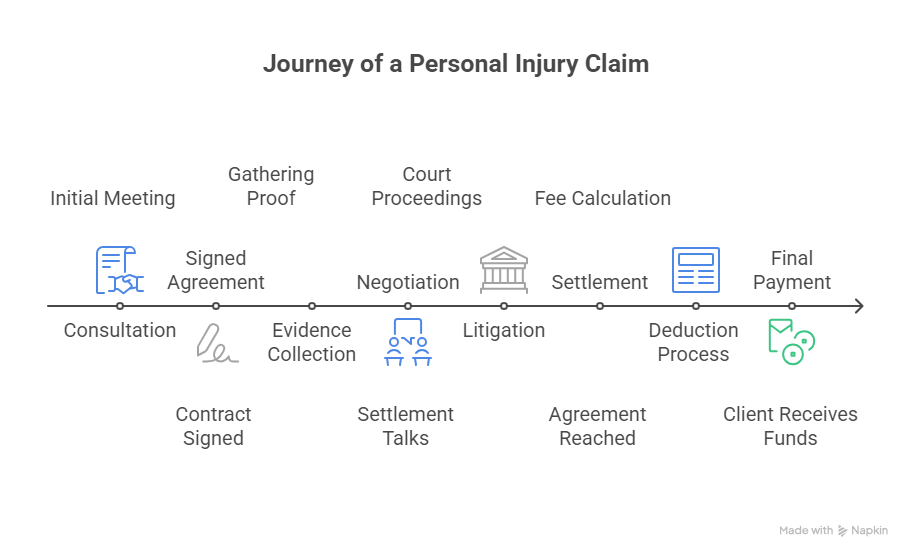
Here is how the process works from first contact to final payment:
- You attend a free initial consultation where the lawyer assesses whether your case qualifies
- If they accept the file, you both sign a written fee agreement before any legal work begins
- That agreement sets the contingency percentage, how disbursements are handled, and what you owe if you end the arrangement early
- As the case progresses, the firm advances out-of-pocket costs on your behalf
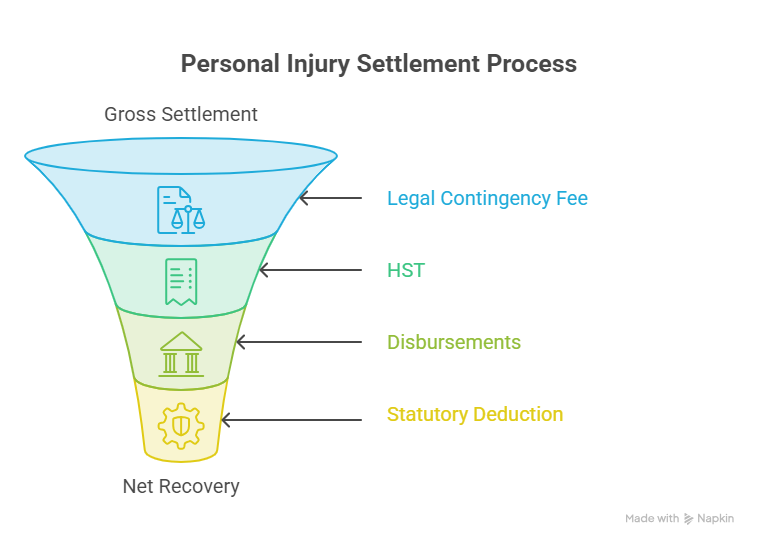
- When the case settles or wins at trial, the lawyer deducts their fee, HST on that fee, and disbursements from the gross recovery
- You receive the net balance remaining
This model exists because accident victims are rarely in a position to pay hundreds of dollars per hour while managing medical appointments, missed income, and recovery. The contingency arrangement shifts financial risk onto the lawyer. If the case fails, the lawyer earns nothing for their time.
The Law Society of Ontario (LSO) requires that every contingency fee agreement be written, clearly worded, and signed by both parties before the file opens. Verbal arrangements are not permitted. Fees must also be fair and reasonable given the complexity and outcome of the case. Law Society of Ontario, Contingency Fee Rules.
What Is a Contingency Fee and How Does It Work in Ontario?
A contingency fee personal injury Ontario arrangement is a payment structure where the lawyer’s compensation depends entirely on a successful outcome. No recovery means no legal fee.
Ontario’s Solicitors Act and its governing regulations require that every contingency fee agreement disclose specific details in writing. Your signed agreement must state:
- The percentage the lawyer will charge
- Whether that percentage increases at different stages of litigation
- How disbursements are handled and who bears them if the case is lost
- What you owe if you terminate the lawyer before the case ends
Here is a worked example showing what the math looks like on a $100,000 settlement:
| Settlement Item | Amount |
| Gross Settlement | $100,000 |
| Contingency Fee (33%) | $33,000 |
| HST on Legal Fee (13%) | $4,290 |
| Disbursements | $3,500 |
| Your Net Recovery | $59,210 |
Three numbers from this table are worth understanding. HST of 13% applies to the lawyer’s fee amount, not to the full settlement. Disbursements are a separate line item from the fee. In this scenario, the client keeps just under 60 cents of every dollar recovered, and that is before the Ontario statutory deductible discussed further below.
HST applies to legal services, but compensation received by the client for pain and suffering, medical expenses, and lost income is generally not subject to income tax under Canadian tax rules.
Firms using a sliding scale increase the percentage at each litigation stage to reflect growing time and risk. A file that settles before anyone files a Statement of Claim might cost 25%, while a file that proceeds through trial might reach 40%. Ontario law permits this, but it must be disclosed in the signed agreement from day one.
What Percentage Do Personal Injury Lawyers Take in Ontario?
The typical personal injury lawyer contingency fee percentage Ontario ranges from 25% to 40% of the gross settlement amount. Most cases that resolve before trial fall in the 30% to 33% range.
The percentage depends on two main factors: the stage at which the case resolves and how complex the file is. Here is how the rate typically moves with case progression:
| Case Stage | Typical Contingency Fee |
| Pre-litigation settlement | 25% to 30% |
| After Statement of Claim is filed | 30% to 33% |
| After examination for discovery | 33% to 35% |
| Trial | 35% to 40% |
Ontario has no statutory cap on contingency fee percentages. The LSO does not set a maximum rate. What it does require is that the fee be fair and reasonable in light of the work done, the risk assumed, and the result achieved. Clients have the right under the Solicitors Act to apply for a court assessment of their bill if they believe the fee charged is excessive.
How much do lawyers take from settlement in Ontario? On a $200,000 settlement at 33%, the legal fee alone is $66,000 before HST and disbursements. On a $50,000 settlement at the same rate, it is $16,500. Knowing these figures before you sign matters because the stage at which your case resolves determines your fee tier. Understanding the financial implications of settling your claim versus going to trial in Ontario is one of the most important decisions you will make in the process.
Even in a minor car accident, retaining a lawyer on contingency costs nothing upfront and ensures someone is actively protecting your recovery from the start.
The personal injury lawyer fees Ontario market is competitive, particularly in the Greater Toronto Area and Mississauga. Rates are not fixed by law, and most lawyers are open to discussing the percentage before anything is signed.
If you want to know what your specific claim might look like after all fees and deductions are applied,Maana Law offers a free, no-obligation consultation where we run through the actual numbers with you before you sign anything.
Disbursements, the statutory deductible, and HST all reduce what you keep. Most clients learn this after — not before.
Maana Law gives you a complete net recovery estimate before you commit to anything. Total transparency from day one.
What Are Disbursements and Who Pays Them?
Disbursements are the real out-of-pocket costs your lawyer spends to build and advance your case. They are separate from the contingency fee and are charged directly to you, recovered from your settlement at the end of the file.
In a typical soft-tissue injury settlement case, disbursements might stay under $2,000. In a catastrophic injury claim that goes to trial, they can reach $50,000 or more. Understanding what falls into this category before you sign matters as much as understanding the percentage.
Common disbursements in a personal injury case in Ontario include:
- Medical record and clinical note fees from hospitals and treating practitioners
- Police report fees
- Expert witness fees, including medical specialists, occupational therapists, and accident reconstruction experts
- Court filing fees
- Examination for discovery transcript costs
- Process server fees for serving legal documents
- Accident scene investigation and photography costs
Most law firms advance disbursements on your behalf as the case progresses, meaning you pay nothing out of pocket during the file. The full amount is then deducted from your settlement before you receive your net share.
Ask your lawyer two specific questions before signing: What is the estimated range of disbursements in a case like mine? And am I responsible for disbursements if the case is not successful?
Some firms operate under a true no win no fee personal injury lawyer Ontario model where disbursements are also absorbed on a loss. Others do not. Your signed agreement must spell this out.
Slip and fall lawyer cost Ontario cases often require expert evidence on building codes, maintenance standards, or property conditions. That expert work pushes disbursements higher than in a standard motor vehicle accident file, so it is worth raising during your initial consultation.
What Is the Statutory Deductible on Pain and Suffering in Ontario?
Ontario applies a mandatory deductible to non-catastrophic pain and suffering awards, and most accident victims do not know it exists until after their case resolves. This is not a deduction taken by your lawyer. It is a legislated reduction set by the Insurance Act (Ontario), Section 267.5, and it comes directly off your non-economic damages before the net recovery is calculated.
For 2025, that statutory deductible is approximately $46,053.29. The deductible is indexed annually to inflation. If a jury awards you $60,000 for pain and suffering in a non-catastrophic motor vehicle injury case, you receive $13,946.71 on that head of damages, not $60,000. The deductible disappears only when the non-economic loss award exceeds a threshold of approximately $184,213.17, which is also indexed each year. Catastrophic injury designations are fully exempt from the deductible.
This is one of the most impactful numbers in Ontario personal injury law, and it directly affects what you keep from a car accident injury settlement. It also affects how your lawyer values your claim and advises you on settlement offers from the insurer.
Two additional Ontario-specific factors reduce net recovery in motor vehicle cases:
- OHIP subrogation. If the Ontario Health Insurance Plan covered your medical treatment after the accident, OHIP has a right to recover those costs from your settlement. Your lawyer should account for this when making demands to the insurer and structuring any final agreement.
- Statutory Accident Benefits (SABS). Ontario runs a no-fault accident benefits system alongside the tort claim. Benefits received under the Statutory Accident Benefits Schedule, including income replacement, medical and rehabilitation benefits, and attendant care, may be offset against a corresponding tort award in certain circumstances. A competent personal injury lawyer manages this interaction from the start of the file.
These are Ontario-specific rules that do not exist in most other provinces. Every realistic case valuation for a motor vehicle injury in Ontario must account for all three factors: the contingency fee, disbursements, and the statutory deductible.
Who Pays Legal Fees in a Personal Injury Claim?
In a personal injury claim, legal fees come out of the settlement or court award, not from your pocket. Your lawyer deducts the contingency fee, HST on that fee, and disbursements from the gross recovery before transferring the balance to you.
This structure removes the financial barrier that would otherwise prevent most injured people from accessing experienced legal help. The lawyer takes on the financial exposure of the file alongside you. If the case is unsuccessful, the lawyer recovers nothing for their time.
Here is how the payment process works once your case resolves:
- The gross settlement amount is confirmed in writing
- Your lawyer prepares a Statement of Account listing every deduction
- You review and approve the account before any funds are released
- The firm deducts the fee, HST, and disbursements from the settlement funds held in trust
- The net balance is transferred to you
Something that catches some clients off guard: if the opposing party is ordered to pay partial legal costs as part of a judgment, that costs award goes to your lawyer to offset a portion of your fees. It rarely covers them entirely.
If you were injured in an accident where the other driver was responsible, understanding your rights as a not-at-fault accident victim in Ontario is essential before you enter any fee arrangement with a lawyer.
For personal injury legal fees Canada-wide, the contingency model applies across most provinces. Ontario’s framework is governed specifically by the Solicitors Act and O. Reg. 040/95, which set out how agreements must be drafted, what must be disclosed, and how disputes are resolved. Ontario also requires that you receive a signed copy of the fee agreement before work begins, a step that is sometimes skipped at less rigorous firms.
Zero upfront. Zero risk. Free consultation that includes your full net recovery estimate across different scenarios.
You pay nothing unless Maana Law wins. Book a free consultation and know the real numbers before you sign anything.
What’s the Most a Lawyer Can Take from a Settlement?
There is no statutory cap on what a personal injury lawyer can take from a settlement in Ontario. Unlike several American states that fix a maximum percentage by law, Ontario has not legislated a ceiling.
The Law Society of Ontario fills this gap by requiring that all fees be fair and reasonable. If a client believes a fee is excessive, two review mechanisms exist. First, a client can apply for a bill assessment through the courts under the Solicitors Act, Part III. Second, a client can file a complaint with the Law Society directly.
Courts have scrutinized fees above 40% in non-catastrophic cases. Judges conducting assessments consider the complexity of the case, the time and skill involved, the result achieved, and what a competent lawyer would reasonably charge for similar work. A fee above 40% on a soft-tissue injury file with early settlement is unlikely to survive that review without strong justification.
For catastrophic injury files involving years of litigation and complex expert evidence, higher percentages may be defensible. These cases demand enormous time investment and carry real financial exposure for the firm if lost.
If a fee agreement you are reviewing shows a percentage above 40% without a clear written explanation tied to specific case factors, ask for that justification before signing. You also have the right to negotiate the percentage at the retainer stage, before any work begins.
What If I Can’t Afford a Lawyer in Ontario?
If you cannot afford a lawyer, the contingency fee model already solves that problem for personal injury cases. You pay nothing until the case is won. The personal injury lawyer free consultation Ontario is also standard across reputable firms, meaning your first meeting costs you nothing.
Some accident victims wonder whether they can manage the claims process on their own. Before making that decision, it is worth reading about what is involved when you attempt tosettle a car accident claim without a lawyer including where those attempts most commonly run into problems with insurers.
For legal matters outside personal injury, where contingency arrangements are not used, Ontario offers several other options:
- Legal Aid Ontario provides funded legal assistance for qualifying individuals in criminal, family, and immigration matters
- Community Legal Clinics across Ontario offer free legal advice for low-income residents in specific practice areas
- Law school clinics at institutions like Osgoode Hall and the University of Toronto run supervised clinics offering free consultations
For personal injury claims specifically, income level should never prevent someone from retaining qualified legal help. The contingency structure is built for exactly this situation. Any reputable firm will tell you directly during a free consultation whether your case has sufficient merit and value to pursue.
The real question is not whether you can afford a lawyer. It is whether your claim is worth enough, after all fees, disbursements, and the statutory deductible, to justify the process. A good lawyer answers that question clearly at the first meeting.
How Much Does It Cost to Sue Someone in Ontario?
Filing a personal injury lawsuit in Ontario carries real costs, but court filing fees are among the smaller expenses in a typical case. In the Superior Court of Justice, which handles most significant personal injury claims, filing a Statement of Claim for a case valued over $25,000 costs several hundred dollars. Additional fees apply when a case reaches trial or when other procedural steps require court involvement.
These filing fees are treated as disbursements and are almost always advanced by the law firm on the client’s behalf. The larger cost driver is expert evidence.
Expert witnesses are the single largest expense in most litigated personal injury files. A medical-legal report from a specialist can cost between $2,500 and $7,500 on its own. Accident reconstruction reports, occupational therapy assessments, and economic loss reports add further. A file that proceeds through examinations for discovery and into trial can accumulate $20,000 to $60,000 in disbursements.
Car accident and other personal injury files are structured on contingency because the costs of litigation would otherwise be unworkable for most individuals. The contingency model makes that access possible.
The choice between settling early and proceeding to trial has significant cost implications. A case that settles before discoveries keeps disbursements low and the contingency percentage at the lower end of the scale. A case that reaches trial increases both. Your lawyer should present the financial comparison clearly when advising you on any settlement offer from the insurer.
Red Flags in Personal Injury Fee Agreements to Avoid
Not every fee agreement is written with the client’s best interests in mind. Knowing what to watch for before you sign can prevent significant financial harm later. Reviewing our guide on common car accident claim mistakes in Ontario is a useful first step before you enter any legal arrangement.
No written fee agreement- The Law Society of Ontario requires a written and signed agreement for every contingency fee file. Proceeding without one is a regulatory violation by the lawyer and leaves you with no documented protection.
A contingency fee above 40% with no explanation- High-complexity, high-risk files may justify higher fees. But if an agreement shows a percentage significantly above market rate without a written explanation tied to specific factors in your case, ask for that justification in writing before signing.
Client bears disbursements regardless of outcome- Some agreements require you to repay advanced disbursements even if you lose. This is a significant financial risk, particularly in complex cases where disbursements grow large. Clarify this provision clearly before signing.
Vague disbursement language- If the agreement does not define what counts as a disbursement, does not cap the amount, or uses broad language that gives the firm open discretion over what to charge, you have limited protection against unexpected deductions at settlement time.
Pressure to sign before you have read the agreement- No reputable personal injury lawyer will pressure a client into signing without adequate time to read and understand it. Take the document home. Ask questions. Consult a second lawyer if anything is unclear.
Sliding scale not disclosed in advance- If the fee percentage changes at different stages of litigation, that must be spelled out from day one. You should know before the case starts that proceeding to trial will increase the percentage charged.
Understanding what to expect from your car accident lawyer including how they communicate fee agreements, case progress, and settlement options helps you identify firms that operate with transparency from day one.
The Ontario Trial Lawyers Association (OTLA) recommends that clients ask their lawyer to walk through the full fee agreement line by line during the initial consultation. That is exactly the process we follow at Maana Law.
Why Maana Law Is the Right Choice for Personal Injury Cases in Mississauga
Maana Law has built its reputation across Mississauga and the Greater Toronto Area on one principle: clients who understand their case make better decisions and get better outcomes. For over a decade, our team has helped accident victims pursue fair compensation without ever asking them to pay a dollar before a recovery is made.
- True No Win, No Fee model- You pay zero legal fees unless we recover compensation on your behalf. Our free initial consultation includes a frank breakdown of what your claim is likely worth and what you should expect to keep after all fees and deductions.
- Transparent fee agreements- Before you sign anything at Maana Law, we walk through the fee agreement line by line. You will know the exact percentage, how disbursements are handled, how the statutory deductible applies to your case, and what your estimated net recovery looks like across different settlement scenarios.
- Experience across all personal injury case types- Our team handles car accidents, slip and falls, pedestrian injuries, catastrophic injuries, wrongful death claims, motorcycle accidents, and bicycle accidents. We have the depth to handle files at every level of complexity.
- Fully accessible to every client- We offer virtual consultations, home visits, and hospital visits for clients who cannot travel. Lead lawyer Aman Kalra is fluent in both English and Hindi, making legal guidance more accessible for Mississauga’s diverse communities.
- Proven results across Mississauga- Maana Law has secured millions of dollars in compensation through settlements and court awards. Our 5-star Google rating reflects a client-first approach to every file we take on.
We serve clients across Mississauga, including Erin Mills, Cooksville, Churchill Meadows, Meadowvale, and City Centre.
Frequently Asked Questions
How much does a personal injury settlement pay in Ontario?
Settlement amounts in Ontario vary widely based on the severity of the injury, its impact on the victim’s daily life, and the evidence available to support the claim. Soft-tissue injuries often settle in the range of $20,000 to $50,000. Serious orthopedic injuries, brain injuries, or permanent disability cases can reach several hundred thousand dollars or more. Catastrophic injury claims involving significant future care needs and income loss can reach into the millions.
Is it better to sue or settle a personal injury claim in Ontario?
Settling is faster and keeps total legal costs lower. Going to trial increases both disbursements and the contingency fee percentage while adding years to the timeline. That said, not every settlement offer reflects the true value of a claim. If the insurer’s offer does not account for your pain and suffering, medical expenses, and lost income fairly, proceeding to litigation may be the right call. A good personal injury lawyer presents the financial comparison between both paths clearly before you decide.
Do I have to pay taxes on a personal injury settlement in Ontario?
Personal injury settlements in Ontario are generally not taxable. Compensation for pain and suffering, medical expenses, and most other heads of damages is treated as non-taxable under Canadian income tax rules. However, any portion of a settlement that replaces future income may carry tax implications in some circumstances. A tax professional can confirm how your specific settlement is structured and whether any reporting obligations apply.
What happens if I fire my personal injury lawyer mid-case?
If you terminate your lawyer before the case ends, you may still owe a fee based on the work already completed, even if a different lawyer takes over and ultimately wins. This is called a quantum meruit claim. The terms governing this scenario must be disclosed in your signed fee agreement. Review that section carefully before signing, and ask your lawyer to explain it during the initial consultation.
Can I negotiate the contingency fee percentage in Ontario?
Yes. Contingency fee percentages are not fixed by law in Ontario, and you have every right to negotiate before signing. In a competitive legal market like Mississauga and the Greater Toronto Area, lawyers may adjust their standard rate depending on the strength of the case, the likelihood of early settlement, and the size of the potential recovery. The time to negotiate is before you sign, not after the case is underway.
Conclusion
The personal injury lawyer cost in Ontario is structured to be accessible. No upfront fees, no hourly billing, and a lawyer who earns nothing unless you win. That is the foundation of the system. But the gap between a gross settlement and what you actually receive can be significant, and it is not always explained clearly before clients sign.
Contingency fees in Ontario typically fall between 25% and 40% of gross recovery, depending on when and how the case resolves. Disbursements are charged separately and can range from under $2,000 in an early soft-tissue settlement to $60,000 or more in a litigated trial. HST adds 13% to the legal fee amount. And in motor vehicle cases, Ontario’s mandatory statutory deductible under the Insurance Act reduces non-catastrophic pain and suffering awards by more than $46,000 before any other calculation applies. Taken together, these deductions can account for a substantial share of the gross settlement, which is why understanding the full picture before you sign anything is not optional.
If you were recently hurt in an accident anywhere in Mississauga or the surrounding area, Maana Law is ready to review your case at no charge and no obligation. Call us or visit our office at 90 Matheson Blvd W, Suite 101, Mississauga, ON to schedule your free consultation. We explain every cost, every percentage, and every deduction before you commit to anything, because the number that matters most is the one you actually keep.
References
- Law Society of Ontario (LSO): Contingency Fee Rules and Client Protection https://lso.ca/lawyers/practice-supports-and-resources/topics/billing-clients/contingency-fees
- Solicitors Act, R.S.O. 1990, c. S.15, Ontario Legislature https://www.ontario.ca/laws/statute/90s15
- Ontario Regulation 040/95: Contingency Fee Arrangements (Solicitors Act) https://www.ontario.ca/laws/regulation/950040
- Ontario Superior Court of Justice: Court Filing Fees Schedule https://www.ontario.ca/page/court-filing-fees
- Legal Aid Ontario: Services and Eligibility https://www.legalaid.on.ca
- Ontario Trial Lawyers Association (OTLA): Public Resources https://www.otla.com/for-the-public
- Law Society of Ontario: Fee Disputes and Bill Assessment Process https://lso.ca/protecting-the-public/complaints-and-concerns
- Insurance Act, R.S.O. 1990, c. I.8, Section 267.5: Non-Economic Loss Deductible https://www.ontario.ca/laws/statute/90i08