
You should get a car accident lawyer for a collision that wasn’t your fault. Every year, Ontario drivers who skip this step walk away from settlements worth a fraction of their actual injuries, lost income, and long-term care needs. The at-fault driver’s insurer is not on your side, even when fault is obvious.
Ontario’s auto insurance system is layered and time-sensitive. Even when the other driver clearly caused the collision, their insurer has experienced adjusters working to minimize your payout. Without legal representation, you risk accepting a settlement far below the true value of your claim.
The numbers tell the story. The Ontario Road Safety Annual Report 2022 recorded approximately 50,000 persons injured in road collisions across Ontario. Research from the Insurance Research Council consistently shows that accident victims with legal representation recover three to four times more in compensation than those who handle claims without a lawyer, even after legal fees are accounted for.
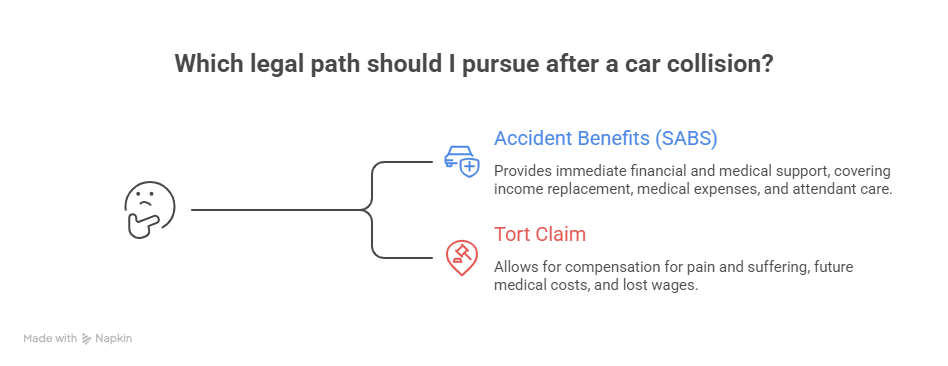
Ontario also runs two separate compensation systems at once. Injured drivers can access statutory accident benefits through their own insurance policy and pursue a tort claim against the at-fault driver. Managing both tracks while recovering from injuries requires professional legal knowledge most people do not have.
Strict deadlines add further risk. Ontario’s accident benefits system requires filing the OCF-1 Application for Accident Benefits within 30 days of the accident. Missing that window can permanently affect your entitlement to benefits.
Maana Law, a personal injury firm based in Mississauga, represents not-at-fault accident victims across Ontario on a no-win, no-fee basis. You pay nothing unless your case is won.
Here is what this guide covers:
- Why not being at fault does not guarantee a fair settlement
- How Ontario’s two-track accident compensation system works
- When legal help matters most
- What a personal injury lawyer does to protect your claim
- What compensation you are legally entitled to receive
- How insurance companies reduce your payout
- How long you have to take legal action in Ontario
Not at fault doesn’t mean the insurer is on your side. Their adjuster is already working to limit your payout.
Represented claimants recover 3–4x more than those without a lawyer, even after legal fees. Call Maana Law for free.
Do I Need a Lawyer If the Car Accident Wasn’t My Fault?
Yes, you need a lawyer even when the accident was not your fault. Not being at fault protects you from liability to the other driver, but it does not protect you from the claims process run by their insurer.
Ontario’s car accident not my fault do I need a lawyer question comes up constantly, and the answer is consistent. Fault determination in Ontario follows rules set by the Financial Services Regulatory Authority of Ontario (FSRA). These rules govern how insurance companies assign fault percentages. They do not always match what a police report says. A police report is evidence of what happened, but insurance companies make their own fault determination independently, and they frequently assign partial fault to reduce their financial exposure.
Contributory negligence principles apply to Ontario car accident tort claims. If an insurer can argue you bear even a small percentage of responsibility for the collision, your compensation is reduced by that same percentage. A common example: an insurer argues you were partially changing lanes and contributed 20% to the collision. Your tort damages drop by 20%, even if the other driver was the primary cause.
Most not-at-fault victims also face a second problem. They do not know the true value of their claim. People tend to calculate their immediate medical bills and a few weeks of missed work. What they miss are future treatment costs, long-term loss of earning capacity, pain and suffering damages, and the impact on their family members under Ontario’s Family Law Act.
According to Insurance Bureau of Canada 2023 data, bodily injury claims in Ontario are among the highest in the country, with complex cases far exceeding initial insurer offers. Without a clear understanding of how much a car accident settlement is worth in Ontario, most claimants have no reference point to judge whether an offer is fair or significantly low. A personal injury lawyer in Mississauga changes that equation completely.
Does Ontario Use a Two-Track System for Car Accident Compensation?
Yes, Ontario’s car accident compensation system has two separate tracks, and both apply to not-at-fault accident victims. Understanding both is the starting point for getting full recovery.
Track 1: Statutory Accident Benefits (SABS)
The Statutory Accident Benefits Schedule (SABS) requires every Ontario auto insurance policy to provide accident benefits regardless of who caused the accident. Your own insurer pays these benefits even when another driver was fully responsible. Key benefits include:
- Income replacement: Up to 70% of gross pre-accident weekly income (standard cap: $400 per week; optional enhanced coverage raises this to $1,000 per week)
- Medical and rehabilitation: Covers treatment, therapy, and recovery costs based on injury classification
- Attendant care: If your injuries require personal assistance at home or in a care facility
- Non-earner benefit: $185 per week if you are not employed and cannot carry out normal daily activities
The Minor Injury Guideline (MIG) creates a major restriction within this track. Insurers classify soft tissue injuries including whiplash, sprains, and strains under the MIG, which caps your medical and rehabilitation benefits at $3,500. This is one of the most contested areas of Ontario personal injury law. Many people with serious ongoing pain are placed under the MIG when their condition qualifies for far more under standard or catastrophic benefit levels.
Track 2: Tort Claim Against the At-Fault Driver
Beyond accident benefits, not-at-fault victims can also sue the at-fault driver for additional damages. Ontario applies two restrictions to tort claims for pain and suffering:
- A statutory deductible of $41,503.50 (2024 amount, adjusted annually under the Insurance Act)
- A verbal threshold requiring your injury to constitute a serious and permanent impairment of an important bodily function
A personal injury lawyer assesses both tracks, challenges MIG placement where your injuries are more serious than the insurer claims, and pursues full recovery on both claims at the same time.
The insurer called asking for a recorded statement? Stop. Don’t give one without talking to a lawyer first.
Recorded statements are used to minimize payouts — not to help you. Maana Law takes over all insurer contact immediately.
Is Hiring a Lawyer After a Not-At-Fault Accident Always the Right Move?
Yes, a lawyer protects your claim in every not-at-fault accident. But specific situations make legal representation especially important.
Your injuries are serious or long-lasting
Surgery, extended rehabilitation, chronic pain, or significant time away from work means your claim carries high financial stakes. Future treatment costs, reduced earning capacity, and ongoing care needs must all be calculated and documented with precision. Insurers will not do this for you, and they will not tell you these categories exist.
Fault is being disputed
Disputed fault is common in intersection collisions, multi-vehicle crashes, and highway accidents. If the at-fault driver’s insurer challenges who caused the accident, a lawyer gathers police reports, witness statements, traffic camera footage, and dashcam recordings. When needed, an accident reconstruction expert provides independent analysis to establish the facts conclusively.
The at-fault driver is uninsured, underinsured, or fled the scene
Hit-and-run accidents and collisions with uninsured drivers require a specific legal process. Ontario’s Motor Vehicle Accident Claims Fund exists for victims who cannot recover from an at-fault driver, but accessing it requires meeting procedural requirements most people are unaware of. If the at-fault driver carries insurance but not enough to cover your losses, an uninsured motorist (UM) coverage claim through your own policy may also be available.
An insurer asked for a recorded statement
If an adjuster from the at-fault driver’s insurer contacts you requesting a recorded statement, do not provide one without legal counsel. That statement is used to look for inconsistencies, admissions of partial fault, or minimizing statements. You have no legal obligation to give one to the other driver’s insurer.
You received an early settlement offer
Quick settlement offers are a tactic. They arrive before the full scope of your injuries is established and before you understand your long-term treatment needs. Accepting one waives your right to any future compensation permanently.
Speaking with a motor vehicle accident lawyer in Mississauga before responding to any insurer is the most important step you can take immediately after the collision.
Can a Personal Injury Lawyer Actually Change the Outcome of Your Claim?
Yes, and the difference is often significant. A personal injury lawyer builds, protects, and presents your claim at every stage of the process. Most Ontario car accident claims settle through negotiation. The strength of your lawyer’s preparation determines the final outcome.
Here is what your lawyer does for a not at fault accident insurance claim:
Gathers and preserves evidence immediately
Evidence disappears quickly after an accident. Your lawyer acts fast to secure police reports, accident scene photographs, surveillance footage, dashcam recordings, and witness contact details. In complex cases, an accident reconstruction expert may be retained to place fault beyond dispute.
Takes over all insurer communications
Once retained, your lawyer handles every interaction with insurance companies. Adjusters cannot ask you leading questions, pressure you into giving recorded statements, or contact you directly to shape your decision-making.
Files OCF forms before deadlines pass
Ontario’s accident benefits system requires submitting specific Ontario Claim Form (OCF) documents on strict schedules. The OCF-1 Application for Accident Benefits must be submitted within 30 days of the accident. Subsequent forms have their own separate deadlines. Missing any of them results in lost benefits. Your lawyer tracks and files all of them. Review our guide on the most common car accident claim mistakes in Ontario including missed OCF deadlines to understand what is at risk.
Documents your full damages
A lawyer calculates all your losses: past and future medical expenses, lost wages, reduced earning capacity, pain and suffering, and emotional distress. Many claimants settle for their immediate out-of-pocket costs and lose years of future compensation they were entitled to receive.
Challenges Minor Injury Guideline classification
If your insurer placed your injuries under the MIG, a lawyer reviews the medical evidence to determine whether that classification is accurate. If it is not, they challenge it with supporting documentation and legal argument at the Licence Appeal Tribunal (LAT).
Takes unresolved disputes to the appropriate forum
If negotiations do not produce a fair result, your lawyer escalates to the LAT for accident benefit disputes, or commences a tort action in court for additional damages.
If you are currently dealing with insurance adjusters after a not-at-fault accident in Ontario, Maana Law offers a free consultation to review your situation and explain exactly what your claim may be worth.
Are Not-At-Fault Victims Entitled to More Than Just Accident Benefits?
Yes. Not at fault car accident compensation in Ontario comes from two sources: your own insurer through accident benefits, and the at-fault driver’s insurer through a tort claim. Both apply to not-at-fault victims, and a lawyer pursues both simultaneously.
Accident Benefits Under SABS
| Benefit | Standard Coverage | Optional Enhanced |
| Income Replacement (weekly max) | $400/week | $1,000/week |
| Medical/Rehab (non-catastrophic) | $65,000 | $1,000,000 |
| Medical/Rehab (catastrophic injury) | $1,000,000 | $2,000,000 |
| Attendant Care (non-catastrophic) | $36,000 | $72,000 |
| Non-Earner Benefit | $185/week | Variable |
Tort Damages From the At-Fault Driver’s Insurer
If your injuries meet Ontario’s verbal threshold for serious and permanent impairment, you can also pursue:
- Pain and suffering damages above the $41,503.50 statutory deductible (2024)
- Past and future medical expenses not covered by your accident benefits
- Lost income and reduced earning capacity, both past and projected future losses
- Out-of-pocket recovery costs not reimbursed elsewhere
- Family Law Act claims: Immediate family members can also claim compensation for loss of care, guidance, and companionship caused by your injuries
For catastrophic injuries, accident benefit limits increase dramatically and certain statutory deductibles do not apply. In serious cases, total compensation across both tracks can reach well into seven figures.
Ontario government data for 2022 showed the average bodily injury liability claim paid through the tort system exceeded $60,000, with seriously injured victims represented by counsel recovering substantially more.
You have two compensation tracks available — SABS benefits and a tort claim. Let us pursue both for you.
Free consultation. No win, no fee. Home and hospital visits available across Mississauga and the GTA.
Do Insurance Companies Try to Reduce Not-At-Fault Settlements?
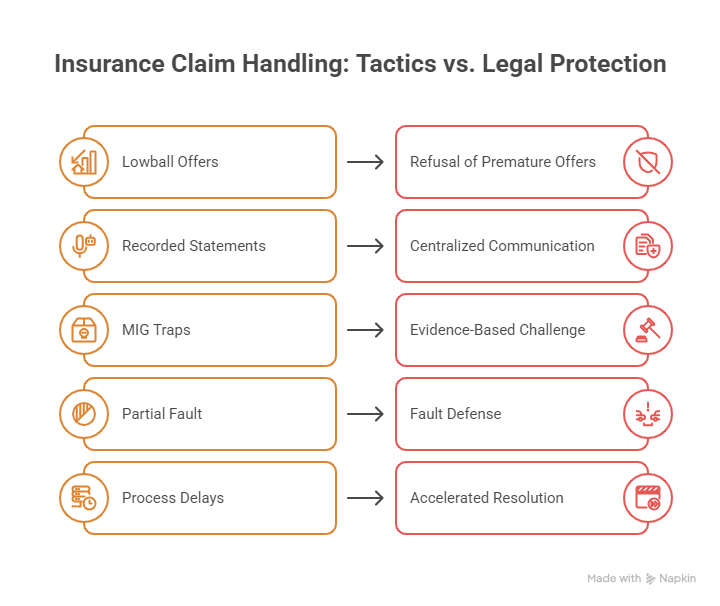
Yes, routinely. Insurance companies use proven tactics to reduce what they pay car accident not my fault settlement claimants. Knowing these tactics ahead of time helps you avoid the most costly mistakes.
Lowball early settlement offers
Insurers contact accident victims quickly after a crash with settlement proposals. These are made before the full extent of your injuries, treatment plan, and lost income is established. Accepting early means permanently waiving your right to any future compensation, no matter how serious your condition becomes.
Pressuring you for a recorded statement
Adjusters from the at-fault driver’s insurer present recorded statement requests as routine procedure. They are not. Adjusters listen for inconsistencies, minimizing language (“I’m okay, just a bit stiff”), or any detail that supports disputing your injury severity or shifting partial fault. You have no legal obligation to provide a recorded statement to the other driver’s insurer.
Classifying your injury under the Minor Injury Guideline
For soft tissue claims, insurers push hard to assign MIG status and cap your medical and rehabilitation benefits at $3,500. This is among the most aggressive tactics used in Ontario. Challenging a MIG classification requires medical documentation and legal argument, not just a verbal objection. Our guide on soft tissue injury settlements in Ontario outlines what these claims can genuinely recover.
Assigning partial fault to reduce your tort damages
Under Ontario’s contributory negligence rules, any fault attributed to you reduces your tort damages by that percentage. Insurers investigate accident scenes specifically looking for details that support placing partial blame on you.
Dragging out the process
Extended timelines, repeated documentation requests, and slow responses are pressure tactics. Insurers know that financially stressed injured victims become more willing to settle low when the process is exhausting and drawn out over months. Understanding when to hire a car accident lawyer in Ontario and doing so early is the most effective way to counter each of these tactics from day one.
Does Ontario Have Strict Deadlines for Not-At-Fault Accident Claims?
Yes, and missing one can permanently end your right to compensation. The deadlines in Ontario’s car accident system are firm, and they begin running the day of the collision.
Accident benefit deadlines:
- Notify your insurer of the accident: within 7 days of the collision
- Submit your OCF-1 Application for Accident Benefits: within 30 days of the accident or as soon as reasonably possible
- Apply to the Licence Appeal Tribunal (LAT) after a benefit denial: within 2 years of the insurer’s written denial
Tort claim deadline:
Ontario’s Limitations Act provides 2 years from the date you knew, or ought to have known, you had a tort claim against the at-fault driver. For most accidents, this runs from the date of the collision itself.
Government entity involvement:
If a municipality bears responsibility for your accident, such as a poorly maintained road or missing signage, specific notice requirements apply. In some circumstances, notice of claim on a municipality must be served within 10 days. Missing this requirement can bar your entire claim against that entity.
Important exception:
If the injured person was a minor at the time of the accident, the 2-year limitation period for the tort claim does not begin until they turn 18. The 30-day accident benefits filing window is the most commonly missed deadline in Ontario.
Many accident victims are in hospital, in recovery, or simply unaware that a legal clock started running on the day of the collision. Our detailed guide covers how long after an accident you can sue in Ontario and what each deadline means for your claim. A personal injury lawyer tracks every deadline from the moment you retain them and makes sure nothing is missed.
Why Maana Law Is the Right Choice for Not-At-Fault Car Accident Claims in Ontario
Choosing a personal injury lawyer after a not-at-fault accident is one of the most consequential decisions you will make during your recovery. Maana Law has built its practice specifically around injured accident victims in Mississauga and across Ontario, with a team that handles every stage of your claim from the first consultation to the final settlement.
- No-win, no-fee representation- You pay nothing unless Maana Law wins your case. There are no upfront legal costs, no retainer fees, and no financial barrier to accessing experienced representation from day one.
- Full command of Ontario’s two-track compensation system- Led by personal injury lawyer Aman Kalra, the Maana Law team handles both accident benefit claims and tort litigation, including MIG challenges, Licence Appeal Tribunal applications, and tort actions in court. One team manages your entire legal recovery.
- Home and hospital visits available- If your injuries prevent travel to a legal office, Maana Law comes to you. Virtual consultations are also available. Your recovery takes priority over logistics.
- Bilingual legal service in English and Hindi- Aman Kalra serves Mississauga’s diverse communities without language barriers or reliance on third-party interpreters, giving every client direct, clear communication with their lawyer.
- Direct access to your lawyer, not a call center- Maana Law maintains a focused caseload so every client deals directly with a lawyer, not rotating paralegal staff or automated case management systems.
- A proven record of results for Ontario accident victims- With over a decade of personal injury experience and a track record of recovering millions in compensation, Maana Law has the resources and results that matter when the stakes are high.
Maana Law’s 5-star Google reviews reflect what happens when a firm puts client outcomes first, every time.
Frequently Asked Questions
Can I handle my own car accident claim if the accident wasn’t my fault?
You can, but it carries serious financial risk. Insurance adjusters are experienced professionals working in their employer’s interest, not yours. Without legal counsel, you may not know the full value of your claim, miss critical filing deadlines, or make statements that reduce your compensation. The risk increases significantly when injuries are serious, fault is disputed, or long-term medical needs are involved.
How much does a personal injury lawyer cost in Ontario after a not-at-fault accident?
Most personal injury lawyers in Ontario, including Maana Law, work on a contingency fee basis. You pay no upfront fees of any kind. Your lawyer takes a percentage of the final settlement or court award only if you win your case. This gives everyone access to qualified legal representation regardless of their current financial situation.
What if the at-fault driver’s insurer disputes who caused the accident?
A fault dispute is one of the strongest reasons to retain a lawyer immediately. Your lawyer collects police reports, witness statements, video footage, and expert analysis to establish the facts independently. In complex collisions, an accident reconstruction expert provides a technical breakdown of how the crash occurred. Your lawyer manages the entire dispute without you dealing directly with the opposing insurer.
How long does a not-at-fault car accident claim typically take to settle in Ontario?
Timelines depend on injury severity, the complexity of fault, and how cooperative the insurer is during negotiations. Cases with clear fault and well-defined injuries may settle within 6 to 18 months. Serious injury cases, disputed fault, or multi-party collisions can take 2 to 4 years. Your lawyer works to resolve your claim as efficiently as possible without accepting a settlement that falls short of your actual losses.
What if the at-fault driver is uninsured or fled the scene of the accident?
Ontario still provides a path to compensation in both situations. If the at-fault driver has no valid insurance, you can claim through your own policy’s uninsured motorist coverage. If the driver fled and cannot be identified, Ontario’s Motor Vehicle Accident Claims Fund is a government-administered program designed specifically for this situation. A lawyer is essential for handling these alternative claim processes correctly.
Conclusion
Being injured in an accident you did not cause is already a difficult experience. Dealing with insurance companies on your own while physically recovering from those injuries makes the financial outcome significantly worse for most claimants.
Three things are worth holding onto from this guide. Ontario’s compensation system offers two separate tracks, and not-at-fault victims are entitled to pursue both at the same time. Filing deadlines are firm and begin running immediately after the accident, including the 30-day window for accident benefits that catches many people off guard. And insurance companies use structured tactics to reduce what they pay, and those tactics are most effective against claimants who do not have legal representation.
The most effective step you can take after a not-at-fault accident in Ontario is contacting a qualified personal injury lawyer as soon as possible. Early legal involvement preserves evidence, locks in your deadlines, and puts you in a stronger position from the moment negotiations begin.
Maana Law represents accident victims throughout Mississauga, Erin Mills, Cooksville, Churchill Meadows, Meadowvale, and the broader Greater Toronto Area. Led by personal injury lawyer Aman Kalra, the firm operates exclusively on a no-win, no-fee basis. You pay nothing unless your case is won. Call Maana Law today or visit the office at 90 Matheson Blvd W, Suite 101, Mississauga, ON to book your free consultation. Home visits and virtual appointments are available for clients whose injuries prevent them from traveling.
References
- Ontario Road Safety Annual Report 2022. Ontario Ministry of Transportation. https://www.ontario.ca/page/ontario-road-safety-annual-report
- Insurance Bureau of Canada. Auto Insurance Facts Book 2023. https://www.ibc.ca/auto
- Financial Services Regulatory Authority of Ontario (FSRA). Auto Insurance Consumer Guide. https://www.fsrao.ca/consumers/auto-insurance
- Ontario Statutory Accident Benefits Schedule (SABS). O. Reg. 34/10. https://www.ontario.ca/laws/regulation/100034
- Law Society of Ontario. Finding a Lawyer or Paralegal. https://lso.ca/public-resources/finding-a-lawyer-or-paralegal
- Licence Appeal Tribunal — Accident Benefits. Tribunals Ontario. https://tribunalsontario.ca/lat/
- Ontario Limitations Act, 2002. S.O. 2002, c. 24, Sched. B. https://www.ontario.ca/laws/statute/02l24
- Insurance Research Council. Auto Injury Research: Represented vs. Unrepresented Claimants. https://www.insurance-research.org/