Amputation injury settlement amounts in Ontario typically range from roughly $250,000 for a single-limb loss to well over $1 million when catastrophic impairment, lifelong prosthetics, and lost income are involved. An amputation injury lawyer can price each part of that claim before you accept any offer.
Losing an arm or a leg changes your life in one moment. The bills start fast. The recovery lasts for years. Many families sit in a hospital room asking the same thing: what is this injury worth, and who will pay for it?
Ontario has no price list for a lost limb. Every claim is built from several parts, and the final number depends on rules most insurers never explain. Some of those rules can cut an award by tens of thousands of dollars, which is why the catastrophic injury rules most victims never hear about matter from day one.
This guide gives you the real numbers. It comes from the team at Maana Law, a Mississauga personal injury firm that helps accident victims across the GTA. Every figure is tied to a named source and is current for 2026. Your own claim may be worth more or less, because age, job, fault, and medical needs all change the result.
Most injury lawyers in Ontario work on a contingency fee, so you pay legal fees only if your claim succeeds. That means cost should not stop you from learning what your claim may be worth.
Here is what this guide covers:
- What counts as an amputation injury, and the most common causes in Ontario
- Settlement ranges for a leg, an arm, a hand, or a finger
- How the pain and suffering cap, the 2026 statutory deductible, and the verbal threshold work
- How SABS catastrophic impairment and tort damages fit together after an amputation
- What evidence you need and how long you have to file
How Much Are Amputation Injury Settlement Amounts in Ontario?
Most amputation claims in Ontario settle between about $250,000 and $1 million or more. The exact figure depends on the limb, your age and job, and the care you will need for life. No official schedule sets a fixed price for a lost limb.
The average settlement for loss of a limb in Ontario is hard to pin down. Most claims end in an out-of-court settlement, and the terms stay private. What the public record does show are the building blocks that make up a claim:
| Building block | Figure | Source |
|---|---|---|
| Cap on pain and suffering (non-pecuniary general damages) | About $470,000 (early 2026) | Law Times |
| General damages for leg loss in compiled Canadian cases | $229,809 to $326,349 (2025 dollars) | MacGillivray Law |
| Total award in Dowhan v. Coates (below-knee amputation, inflation-adjusted) | $585,636 | Bogoroch |
| SABS limit for medical, rehabilitation, and attendant care after a catastrophic impairment | $1,000,000 | Canadian Lawyer |
Here is a simple example. A 35-year-old driver loses a leg below the knee in a crash caused by another driver. Pain and suffering may fall in the low to mid six figures. Add 30 years of lost income, new prosthetics every few years, and home changes, and the total can pass $1 million. This is an illustration, not a prediction for your case.
What Counts as an Amputation Injury, and What Causes It?
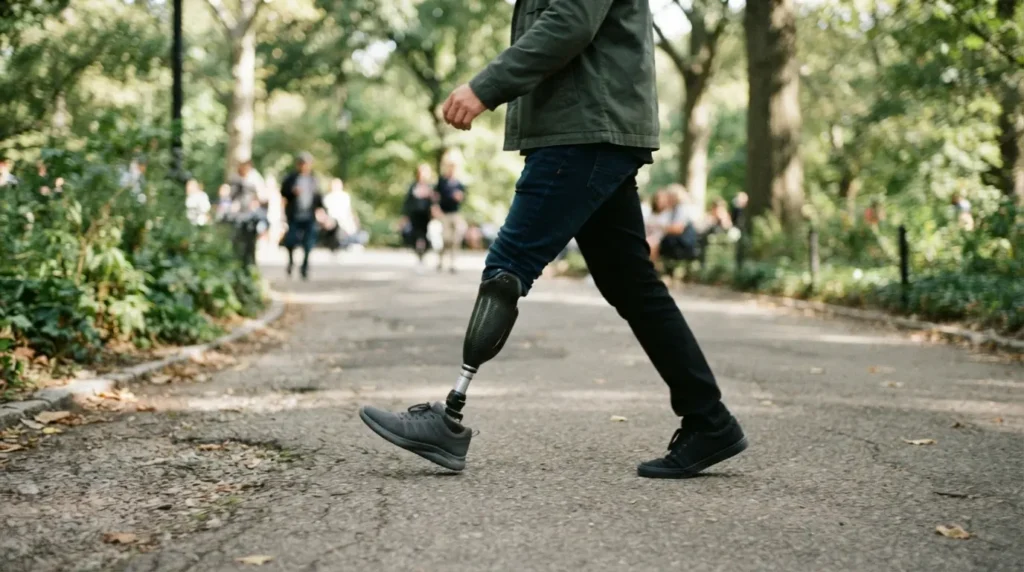
An amputation injury is the loss of a limb or body part, either at the scene (a traumatic amputation) or later in surgery when doctors cannot save it. Both types can support a claim when someone else’s negligence caused the harm.
Doctors group amputations by level, and the level changes the claim. A finger or hand loss affects grip and fine movement. An arm amputation removes part or all of the upper limb. A below-knee (trans-tibial) amputation keeps the knee joint, while an above-knee amputation removes it and makes walking harder. A bilateral amputation means two limbs are lost.
Common causes in Ontario include:
- A car accident claim after a high-speed or rollover crash
- A motorcycle accident claim, because riders have little protection
- A pedestrian accident claim on busy roads in Toronto, Brampton, or Mississauga
- A truck accident claim that involves a crush injury
- A public transit accident claim, such as a fall under a train or bus
- A medical malpractice claim after a missed infection or blocked artery
- Machinery and workplace accidents
The risk on our roads is real. Ontario recorded 623 road deaths and 1,703 serious injuries in 2022, including 88 motorcycle rider deaths and 106 pedestrian deaths, according to the 2022 Ontario Road Safety Annual Report. Some of those injuries involve limb loss. Those victims often pursue a car accident amputation claim, a motorcycle accident amputation claim, or a pedestrian accident amputation claim.
How Much Is an Amputated Leg Worth in a Lawsuit in Ontario?
An amputated leg is typically worth $250,000 or more in an Ontario lawsuit, and the total can pass $1 million once lost income and lifetime care are added. The leg amputation settlement amount in Ontario comes in two layers.
The first layer is general damages for pain and suffering. A review of leg-loss awards by MacGillivray Law puts them between $229,809 and $326,349 in 2025 dollars. Most of those cases come from British Columbia and Saskatchewan, so use them as a comparison point, not a promise for Ontario.
The second layer is money for real losses: lost wages, future care, housekeeping, and equipment. In serious cases, this layer is often larger than the first.
The level of amputation also matters. A below-knee amputation is serious. An above-knee amputation is usually worse because the knee joint is gone. A bilateral amputation sits at the top of the scale.
Dowhan v. Coates shows how the pieces add up. A doctor’s missed diagnosis led to a below-knee amputation. Bogoroch reports an inflation-adjusted total of $585,636, which included:
- $254,235 for pain and suffering
- $142,707 for past wage loss
- $79,448 for future lost opportunity
- $103,283 for future housekeeping
- $5,695 for transportation
That award comes from an older case and has no line for modern prosthetics. A claim filed today would add those costs. This is how a single-leg claim can reach seven figures.
How Much Do You Get Paid for Losing a Limb in Ontario?
No one gets a fixed payout for losing a limb in Ontario. Amputation injury compensation in Ontario can come from up to three sources, and the total depends on your injury, your work, and who caused the accident.
- Accident benefits (SABS). An auto insurer pays medical, rehabilitation, and attendant care costs no matter who caused the crash.
- A lawsuit against the at-fault party. This pays for pain and suffering, lost income, and future care that SABS does not cover.
- Disability coverage. A long-term disability claim through work or a private plan can add monthly income.
An arm, hand, or finger amputation settlement in Ontario depends heavily on your job. A cabinet maker who loses two fingers on a dominant hand may lose far more earning power than an office worker with the same injury. That gap changes the value of the claim.
The label “catastrophic” also changes the value. Lexpert reports that an arm amputation and a trans-tibial or higher leg amputation meet the SABS test. A hand or finger amputation may not qualify on its own. Oatley Vigmond notes that other amputations can still qualify if combined impairments reach a 55% whole person impairment (WPI) rating.
A finger or hand loss is permanent, so it will often meet the verbal threshold for a car accident lawsuit. The court makes the final call. Without a catastrophic label, your SABS limit stays lower, but your lawsuit can still be worth a lot.
If you or a loved one lost a limb in an accident, Maana Law offers a free case review to help you understand what your claim may be worth.
What Is the Average Settlement for Pain and Suffering in Ontario?
Ontario has no true average, because the law sets a ceiling instead. The non-pecuniary general damages cap in Ontario is around $470,000 as of early 2026, and amputations sit near the top of the range.
The Supreme Court of Canada set this cap in 1978 for the most severe injuries, such as paralysis and brain injury. Courts adjust it for inflation each year. Bergeron Clifford reports that the figure was roughly $469,000 in September 2025. Law Times notes that limb amputations tend to draw awards at or near the upper range.
The cap covers pain, suffering, and loss of enjoyment of life. It does not cover money losses such as wages, prosthetics, or home care. Those are separate, and they have no cap.
A judge weighs your age, phantom limb pain (nerve pain felt in the limb that is gone), mental health, lost hobbies, and your ability to return to work. For example, the Dowhan v. Coates award included $254,235 for pain and suffering, well under the cap. A younger person with an above-knee or bilateral amputation and long-term nerve pain would likely argue for much more.
Factors That Drive the Value of an Amputation Claim
Age, job, dominant hand, level of amputation, and fault drive value the most. Together they set how long you will need care and how much work income you lose.
- Age and life expectancy: A younger person lives with the loss longer, so future care and lost income grow.
- Occupation and dominant hand: Tradespeople, drivers, and manual workers often lose more earning power. This is the loss of income and earning capacity after amputation, and a vocational expert often gives evidence on it.
- Level of amputation: A finger, a below-knee leg, an above-knee leg, and a bilateral loss are valued very differently. A whole person impairment (WPI) rating puts a number on the loss.
- Prosthetic needs: An artificial limb is replaced about once every three years on average, so costs add up.
- Fault: Under comparative negligence, a judge reduces your award by your share of blame. If you are 20% at fault, you receive 80%.
- Insurance limits: If the at-fault driver has low limits, your own underinsured motorist coverage may help.
Take two people who both lose a leg below the knee. A 25-year-old welder faces about 40 working years of lost earnings and decades of new prosthetics. A 62-year-old retiree faces fewer lost earnings but may still need home changes and daily help. The welder’s claim is usually worth more, even though the injury is the same.
How Does SABS Catastrophic Impairment Apply After an Amputation?
A trans-tibial or higher leg amputation, or an arm amputation, can qualify as a catastrophic impairment under SABS. That status lifts your combined limit for medical, rehabilitation, and attendant care benefits from $65,000 to $1,000,000.
The Statutory Accident Benefits Schedule (SABS) is a no-fault system under the Insurance Act (Ontario). Your auto insurer pays these benefits whether or not you caused the crash. A minor injury is capped at $3,500 under the Minor Injury Guideline, and other non-catastrophic injuries are capped at $65,000, according to Canadian Lawyer. Thomson Rogers reports that the 2016 reforms cut the combined catastrophic limit from $2 million to $1 million, so lifetime costs need careful planning.
There are three ways to meet the catastrophic impairment under SABS in Ontario test after an amputation:
- A qualifying leg or arm amputation
- Total and permanent loss of use of an arm or a leg
- A 55% whole person impairment (WPI) rating from combined injuries
The label is not automatic. You apply with form OCF-19, and the insurer may ask for assessments. If it refuses, you can appeal to the Licence Appeal Tribunal (LAT).
For example, a 40-year-old pedestrian loses an arm after a driver runs a red light. Once designated, she can draw up to $1,000,000 for therapy, a prosthetic arm, and attendant care, and still sue the driver. Some SABS payments may be deducted from the lawsuit award so she is not paid twice.
Which Tort Damages Can You Claim After an Amputation?
You can claim pain and suffering, lost income, prosthetic limbs, future care, housekeeping help, and home and vehicle changes from the at-fault party. These are called tort damages, and they sit on top of your SABS benefits.
A large part of the claim is the prosthetic costs and future care after amputation in Ontario. The Amputees of War 2026 release reports that above-knee, above-elbow, and below-elbow prostheses can cost $100,000 or more, and below-knee prostheses up to $80,000. It adds that an artificial limb is replaced about once every three years on average. The Assistive Devices Program pays only part of the price. In one case reported by CBC News, it covered about $6,792 of a $91,577 leg quote.
A full claim can include:
- Prosthetic limb costs, including repairs, sockets, and replacements
- Future care costs, such as physiotherapy, counselling, and attendant care
- Loss of future income, if you cannot return to your old job
- Future housekeeping and home maintenance help
- Home and vehicle modifications, such as ramps, a roll-in shower, or hand controls
- Non-pecuniary general damages for pain and suffering
Here is a simple example. A 35-year-old needs a new $80,000 leg every three years for 45 years. That is 15 replacements and $1.2 million before repairs, therapy, or lost wages. Courts convert future costs into today’s dollars, so real awards differ.
What the 2026 Statutory Deductible and SABS Changes Mean for Your Claim
In 2026, a $47,913.01 statutory deductible comes off pain and suffering awards that fall below $159,708.71. Amputation awards for pain and suffering often land above that line, so the deductible may not apply. The July 2026 SABS changes matter more for many victims.
The Financial Services Regulatory Authority of Ontario (FSRA) raised these amounts by 2.4% on January 1, 2026:
| Item (2026) | Deductible | Threshold |
|---|---|---|
| Pain and suffering (general damages) | $47,913.01 | $159,708.71 |
| Family Law Act claims by spouses and children | $23,956.52 | $79,853.70 |
To sue for pain and suffering after a car crash, you must also meet the verbal threshold, which means a permanent and serious impairment. A lost limb is permanent, but the court still decides.
On July 1, 2026, eight SABS benefits became optional. They include income replacement, caregiver, housekeeping and home maintenance, and non-earner benefits. Medical, rehabilitation, and attendant care benefits stay automatic, and the $1,000,000 catastrophic limit did not change.
Optional benefits now apply only to the named insured, a spouse, dependants, and listed drivers. A pedestrian or cyclist hit by a car may not have them, so a lost-income claim may depend on a lawsuit.
How Do You Start an Amputation Injury Claim in Ontario?
Get medical care, tell your insurer within 7 days, file your accident benefits form within 30 days, and speak with a lawyer well before the two-year limitation period ends. Each step protects a different part of your claim.
- Get treatment and keep every record. Hospital notes, surgery reports, and therapy bills all become proof.
- Notify your insurer. Mondaq reports that you must give notice within 7 days and return the OCF-1 application within 30 days.
- Collect accident evidence. Save the police report, photos, witness names, dashcam footage, and pay stubs.
- Build expert proof. A life care plan prices future medical needs. An occupational therapist assessment shows your daily needs and home changes. A WPI rating measures impairment, and vocational expert testimony shows work limits.
- File before the deadline. The Limitations Act, 2002 gives you two years from the day you learn you have a claim, with a 15-year outer limit. Some claims, such as a fall on a city sidewalk, need notice in 10 days.
An amputation injury lawyer in Mississauga or elsewhere in Ontario can coordinate these steps. Maana Law is based in Mississauga, serves the GTA, including Toronto, North York, and Brampton, and meets clients in Hamilton, Ottawa, Kingston, and Eastern Ontario by video. Under a contingency fee arrangement, legal fees come out of the recovery.
For example, if you lose a leg on June 1, 2026, the basic deadline to sue is generally two years from the day you learn you have a claim. The 7-day and 30-day SABS steps come much sooner, and missing them can delay your benefits.
Why Maana Law Is the Right Choice for Amputation Injury Claims
An amputation claim needs a lawyer who understands catastrophic benefits, lifelong costs, and strict deadlines. Maana Law brings over 10 years of personal injury experience to families in Mississauga and across the GTA.
- Catastrophic injury focus. Maana Law handles catastrophic accidents, so SABS designation, future care, and lost income are daily work.
- No Win, No Fee. You pay no legal fees unless your claim succeeds, and the first consultation is free.
- Care that comes to you. Virtual meetings, home visits, and hospital visits let you get advice while you recover.
- Evidence-driven case building. The team studies police reports, expert opinions, and witness statements to show your lifetime costs.
- Bilingual support. Lawyer Aman Kalra speaks Hindi and English.
- Client trust. Maana Law holds 15 Google reviews with a 5-star average.
When a limb is lost, every dollar and every deadline counts, and Maana Law treats them that way.
Frequently Asked Questions
Can you sue for an amputation injury in Ontario?
Yes, if another party’s negligence caused your amputation. You must show they failed in a duty of care and that this caused your injury. SABS benefits do not require proof of fault.
Can my family claim too?
Yes. Under the Family Law Act, a spouse, child, or parent can claim for loss of care, guidance, and companionship. These claims have their own deductible and threshold, shown in the table above.
What if my amputation happened at work?
In most workplaces covered by WSIB, you cannot sue your employer. You may still sue a third party, such as an equipment maker or a negligent driver.
Will my amputation claim go to trial?
Many claims end in an out-of-court settlement. Insurers offer more when your case is ready for trial, and trial becomes likely only when an offer does not cover your lifetime needs.
Should I accept the first settlement offer?
Be careful. Early offers often arrive before doctors know your full prosthetic and care needs. Once you sign a release, you cannot reopen the claim.
Final Thoughts on Amputation Injury Settlement Amounts in Ontario
Amputation injury settlement amounts in Ontario depend on far more than the injury itself. A single-limb loss often starts near $250,000 and can pass $1 million once lifetime prosthetics and lost income are added. A catastrophic impairment designation raises your SABS limit to $1,000,000, while your lawsuit adds pain and suffering up to about $470,000 and money losses that have no cap. The deadlines are short: 7 days to notify your insurer, 30 days to file the OCF-1, and two years to sue.
A lost limb is not a number on a chart. It is a new way of living that needs a plan, a care team, and fair payment. With strong evidence, a life care plan, and a lawyer who knows Ontario’s rules, you can plan your family’s future with confidence.
Maana Law, 90 Matheson Blvd W, Suite 101, Mississauga, ON. Call [add phone number] or visit maanalaw.com. Book your free consultation today. You pay nothing unless we win, and we can meet you in our office, by video, or at your home or hospital.
References
Linked sources:
- Financial Services Regulatory Authority of Ontario (2026). 2026 Automobile Insurance Indexation Amounts Guidance
- Ontario Ministry of Transportation (2022). Ontario Road Safety Annual Report 2022
- Canadian Lawyer. Statutory Accident Benefits Schedule: what’s new after July 1, 2026
- Law Times. The current state of pain and suffering compensation
- Amputees of War (2026). News release, April 30, 2026