Boating accident settlement amounts in Ontario typically range from a few thousand dollars for minor injuries to well over $1 million for catastrophic injuries or wrongful death, though federal law caps total recovery per vessel at $1.5 million in most cases. That gap between a small settlement and a seven-figure one comes down to a handful of factors: how serious the injury is, who caused the crash, and which laws apply to your specific accident.
Summer weekends on Muskoka, Lake Simcoe, and the Kawarthas bring thousands of boats onto Ontario waters, and with that traffic comes collisions, capsizes, and falls that leave real people with real medical bills. At Maana Law, we see how confusing this area of law can be for families who assumed a boat crash worked like a car accident claim. It does not. Boating claims follow federal maritime law, not the Ontario Insurance Act, and that difference changes almost everything about your boat accident settlement Ontario case.
Every case is different, but the same questions come up again and again. How much is a boat accident compensation Ontario claim really worth? Who pays when the at-fault operator has little or no insurance? And how does a boating accident injury settlement Ontario case handle a fatality involving young children? This guide answers each of those questions with the actual law behind the numbers, not guesswork.
This guide breaks down exactly how settlements are calculated, what caps apply, and what steps protect your claim from day one.
Here is what this guide covers:
What factors push a settlement higher or lower How much compensation victims typically receive The federal Marine Liability Act and its compensation caps Who can be held responsible after a crash What damages you can actually claim How long you have to file before your claim expires
What Factors Affect Boating Accident Settlement Amounts in Ontario?
Factors affecting boating accident settlements include the severity of the injury, clear proof of fault, the number of people involved, and the type of vessel in the crash. These four elements shape almost every settlement number a lawyer will discuss with a client.
Severity drives the largest swings. A sprained wrist from a fall on a dock settles for a few thousand dollars. A spinal cord injury from a high-speed collision can justify a claim near the federal cap. Insurers and defence lawyers look closely at medical records, so the strength of your documentation matters as much as the injury itself.
Clear liability also moves the number. When a police marine unit report, witness statements, or a Transport Canada investigation point directly at one operator, that operator’s insurer has less room to argue and often settles faster and closer to full value.
The type of vessel and number of victims matter too. A single fatality on a pontoon boat with one insured owner divides compensation differently than a multi-boat collision with several injured passengers, since the federal liability cap applies per boat, not per victim.
| Factor | Effect on Settlement |
|---|---|
| Severity of injury | Higher severity, higher potential value |
| Clarity of fault | Clear fault speeds up and increases settlement |
| Number of claimants | More claimants can mean smaller individual shares under the cap |
| Vessel type and size | Affects which liability limit applies |
| Available insurance | Uninsured operators limit real-world recovery |
According to Transport Canada’s recreational boating safety data, dozens of Canadians die in boating incidents each year, and many more suffer injuries serious enough to require hospital care, which keeps this area of personal injury law active every summer season.
Weather and visibility play a role too. Nighttime collisions, where running lights were dim or missing, tend to settle higher once fault is established, since courts treat a dark-water crash as a clear failure to follow basic navigation rules. A daytime fender-bender between two slow-moving boats rarely reaches the same value, even with a similar injury, because the facts around fault are murkier.
How Much Compensation Can You Get for a Boating Accident in Ontario?
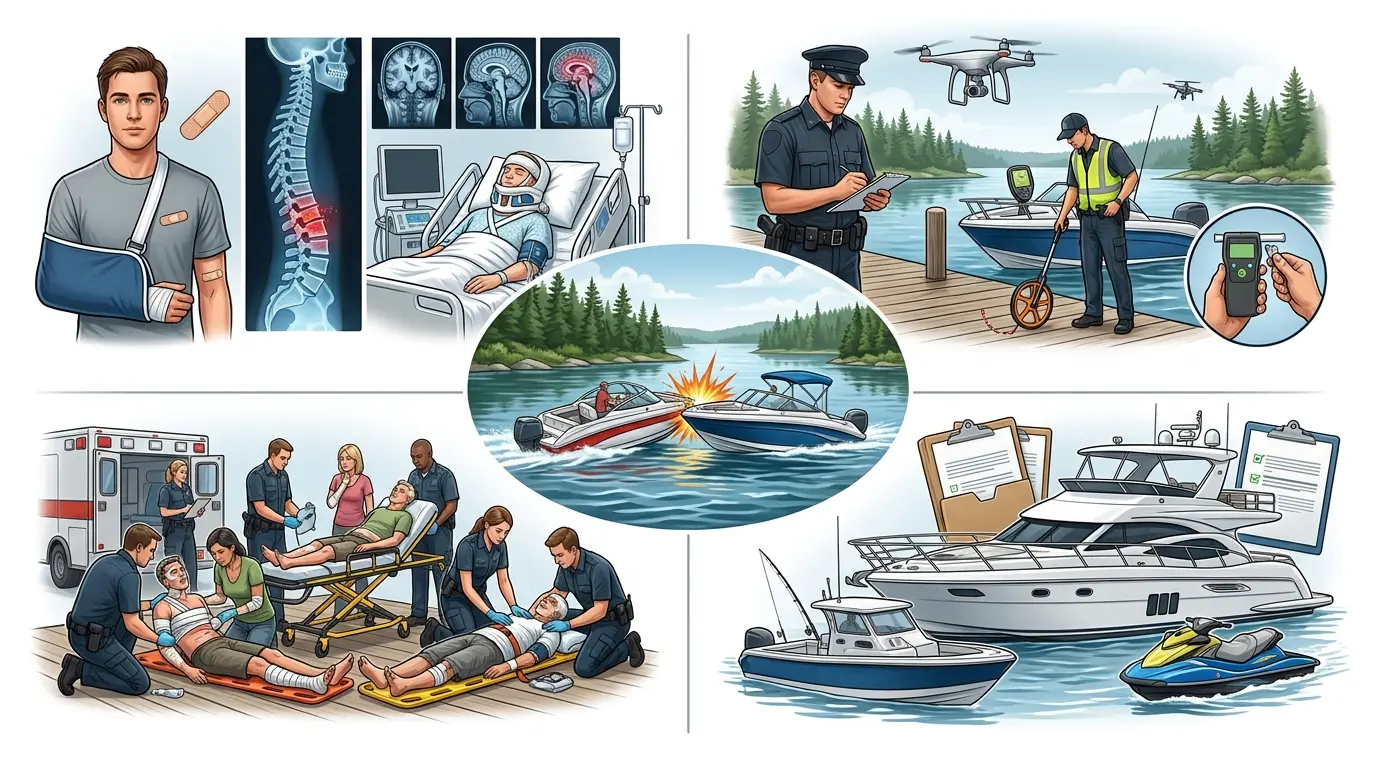
Boat accident compensation in Ontario generally falls into three tiers: minor injury settlements under $50,000, moderate injury settlements between $50,000 and $250,000, and serious or fatal claims that can reach into the hundreds of thousands or low millions, subject to the federal cap.
Minor injuries such as bruising, minor lacerations, or short-term soft tissue pain usually resolve with a modest settlement that covers medical costs and a short recovery period. Moderate injuries, including fractures or injuries requiring surgery, often settle higher because they involve lost income, physiotherapy, and a longer recovery timeline.
Propeller injuries deserve their own mention, since they are one of the more severe boat crash injury compensation categories seen in Ontario cases. A spinning propeller can cause deep lacerations or amputation in seconds, and these cases often involve a failure to shut off the engine near swimmers, which strengthens the liability side of the claim considerably.
Serious injuries change the math entirely. A traumatic brain injury, a spinal injury, or a wrongful death claim brings in future care costs, loss of income over a lifetime, and dependency claims from family members. These cases push toward the $1.5 million liability cap that applies to most pleasure craft under 300 gross tonnes, though real settlements often land below that ceiling once liability is shared or insurance limits are lower than the cap itself.
A well-known Ontario example makes this concrete. The 2019 Lake Joseph collision, which killed two people and injured three others, ended in a confidential settlement after six years of litigation. Reporting on the case showed the combined payout was limited to $2 million because two boat operators were each capped at $1 million in liability, and the minor children of one victim received far less after legal costs than the headline numbers suggested. That case shows why the cap, not the claim amount, often decides the final number.
What Is the Marine Liability Act and How Does It Cap Compensation?
The Marine Liability Act is the federal law that governs almost every boating accident claim in Canada, and it sets a maximum recovery of $1.5 million for death or serious injury claims against a single vessel under 300 gross tonnes.
This law applies instead of Ontario’s Insurance Act because boats are considered “ships” under federal maritime jurisdiction, even small recreational craft like ski boats, pontoons, and jet skis. That single fact surprises most clients, since it means a boating claim behaves more like a shipping case than a car accident case.
The Act also sets a separate $750,000 cap for property damage and goods lost in the incident, and it works alongside the Canada Shipping Act, which sets safety and operating standards that often become evidence of negligence when they are ignored.
There is one important exception. The liability limit does not protect an operator whose conduct was reckless or intended to cause harm. Courts have consistently held that operators cannot hide behind the cap when they acted with disregard for known danger, such as boating at night without lights or operating while impaired.
This federal framework is also why general boating accident compensation questions rarely have a simple answer online. A car accident guide will not tell you anything useful about a boat crash, since the two systems share almost no rules in common beyond the basic idea that a negligent party owes compensation to the person they hurt.
Who Can Be Held Liable After an Ontario Boating Accident?
Liability after a boating accident usually falls on the boat operator, but owners, rental companies, and even other passengers can share responsibility depending on what caused the crash.
The operator is the first party investigators look at, since Canadian law expects any vessel operator to keep a proper lookout, follow navigation rules, and avoid excessive speed near other boats, swimmers, or docks. An operator who was drinking, distracted, or unfamiliar with the water is an obvious target for a boating accident personal injury claim.
Boat owners can also be named if they lent a vessel to someone they knew was inexperienced or impaired, or if they failed to maintain safety equipment such as lights, life jackets, or a working horn. Rental operations face similar exposure when equipment fails or staff skip a proper safety briefing. A slip and fall on a dock or marina walkway may also fall under Ontario’s Occupier’s Liability Act rather than the Marine Liability Act, since that law covers land-based property connected to the water rather than the vessel itself.
Ontario also applies contributory negligence principles to these claims. If a passenger was not wearing a life jacket in rough water, or ignored posted warnings, a court may reduce the settlement by the percentage that passenger’s own conduct contributed to the harm. This is why documenting exactly what happened, and who did what, matters from the very first phone call with a lawyer.
Criminal charges sometimes run alongside the civil claim. Impaired operation of a vessel carries a mandatory minimum fine of $1,000 for a first offence under section 320.14 of the Criminal Code, rising with higher blood alcohol levels, and a criminal conviction can make it far easier to prove fault in the related civil case.
Filing a claim after a boating accident with an experienced team beside you often reveals responsible parties that a victim never considered on their own, and this is exactly where most personal injury clients lose value, usually because of one overlooked defendant that a rushed investigation misses.
Maana Law reviews every angle of liability before recommending a settlement figure, so clients are not left guessing whether they left money on the table.
What Types of Damages Are Included in a Boating Accident Settlement?
A boating accident settlement can include pain and suffering compensation Ontario courts recognize, plus medical costs, lost income, and, in fatal cases, dependency and loss of companionship claims for surviving family members.
Pain and suffering, sometimes called general damages, compensates for the physical and emotional toll of the injury itself. Medical expenses after a boating accident cover hospital visits, surgery, physiotherapy, and any future care a serious injury requires for the rest of a victim’s life.
Lost income after a boating accident is calculated from the date of the crash forward, and includes both wages missed during recovery and any reduction in future earning capacity if the injury is permanent. Family members of a person killed in a boating accident can bring a dependency claim for financial support they would have received, along with a separate claim for loss of guidance, care, and companionship. Anyone building a boat injury claim Ontario insurers will take seriously should start gathering these categories of proof from the first week after the accident, not months later once memories and receipts start to disappear.
| Damage Type | What It Covers |
|---|---|
| Pain and suffering | Physical and emotional harm from the injury |
| Medical expenses | Treatment, surgery, physiotherapy, future care |
| Lost income | Missed wages and reduced future earning capacity |
| Dependency claims | Financial support lost after a fatal accident |
| Loss of companionship | Non-financial loss to surviving family members |
One point trips up almost every client at the start. Accident benefits Ontario drivers receive automatically after a car crash, through no-fault statutory coverage, simply do not exist for boating accidents. A boating victim cannot access that immediate treatment funding and must instead pursue a full civil claim to recover medical costs, which makes early legal advice more important than it would be after a typical car accident.
Maana Law’s team gathers medical records, expert reports, and income documentation early, since a well-documented claim consistently settles for more than one built on estimates alone.
How Long Do You Have to File a Boating Accident Claim in Ontario?
Most boating accident claims in Ontario must be filed within two years of the accident or the date of death, and missing that window can end a valid claim permanently.
This two-year limitation period comes from federal maritime law and general Ontario limitations rules working together, and courts apply it strictly except in narrow circumstances such as a delayed discovery of the injury. Waiting even a few months to speak with a lawyer can cost a claimant access to witnesses, marine police reports, and physical evidence from the vessel itself, all of which fade quickly after a summer accident.
Evidence disappears fast on the water. Witnesses forget details, boats get repaired or sold, and weather conditions that mattered on the day of the crash are never recorded again. Starting an investigation early gives a boating accident lawyer Ontario families trust the best chance to preserve everything a settlement will eventually depend on.
A Real Ontario Case: The Lake Joseph Boating Settlement
The Lake Joseph collision on Muskoka’s cottage country waters is one of the clearest public examples of how these rules play out in practice, and it shows why headline lawsuit amounts rarely match the final settlement.
In the summer of 2019, a nighttime collision between a speedboat and a pontoon boat killed two passengers and injured three others. Family members of one victim sued for loss of guidance, care, and companionship, while the boat operators filed a counterclaim worth more than $3 million for their own injuries and losses. After six years of litigation, the parties reached a confidential settlement.
Public reporting confirmed the combined recovery was capped at $2 million because the Marine Liability Act limited each of the two boat operators to $1 million in liability. Two minor children of one victim each received $100,000 from the settlement, an amount reduced to roughly $72,500 after legal fees and other deductions. Because minors were involved, an Ontario court also had to approve the settlement before the funds could be paid out, which is a standard requirement whenever a child is set to receive compensation. The case is a direct illustration of how the federal cap, not the size of the original lawsuit, sets the real ceiling on what a family can recover, and it was heard through the Federal Court of Canada given the maritime nature of the claim.
What Should You Do After a Boating Accident to Protect Your Settlement?
Protecting a future settlement starts at the scene: get medical attention, report the accident to the marine police or Transport Canada, and gather names, contact information, and photos before evidence disappears.
Seek treatment immediately, even for injuries that seem minor at first, since some soft tissue and head injuries do not show symptoms for days. A documented emergency room or clinic visit creates the first piece of evidence tying the injury directly to the accident.
Report the incident. Any boating accident causing death, disappearance, or injury requiring more than first aid must be reported to the nearest Receiver of Wreck or police, and that report becomes an important record for any future marine accident injury claim.
Collect evidence while it is still available. Photograph the boats, the water conditions, and any visible injuries. Get the names and phone numbers of every passenger and witness, since people who were on the water that day are often impossible to locate months later.
Speak with a personal injury lawyer before giving a recorded statement to any insurance company. Insurers sometimes contact victims quickly after a boating accident, and an early, informal statement can be used later to reduce what a family eventually recovers.
Keep a simple written record of the recovery too. A short daily note about pain levels, missed work, and appointments builds a timeline that supports both the medical expense claim and the pain and suffering claim later, without relying on memory months after the fact.
Why Maana Law Is the Right Choice for Your Boating Accident Claim
Boating accident claims involve federal maritime law, strict liability caps, and evidence that disappears fast, and Maana Law has spent over a decade guiding Mississauga area clients through exactly this kind of complex personal injury case.
Deep experience with complex liability claims Our team has handled catastrophic accidents and wrongful death files where multiple parties and overlapping laws made liability difficult to sort out. No Win, No Fee representation Clients pay nothing upfront and nothing at all unless we recover compensation, which keeps the door open for families facing sudden medical bills. Free consultations with real legal guidance Aman Kalra and our team review the facts of your accident at no cost, so you know where you stand before making any decisions. Home, hospital, and virtual meeting options Recovering from a serious boating injury should not mean travelling across Mississauga for legal advice, so we come to you or meet virtually. Thorough evidence gathering We pull police reports, expert opinions, and witness statements together early, before evidence from the day of the accident disappears. Personalized, direct communication Every client works closely with our team rather than being passed between departments, so questions get answered quickly.
Families across Erin Mills, Cooksville, Churchill Meadows, Meadowvale, and City Centre trust Maana Law because we treat every boating accident claim with the same care we would want for our own families.
Frequently Asked Questions
What is the average boating accident settlement in Ontario?
There is no single average, since settlements range from a few thousand dollars for minor injuries to over $1 million for catastrophic injury or death claims. The specific amount depends on injury severity, clear proof of fault, and the liability limits that apply to the vessel involved.
Can I sue if I was a passenger on the boat, not the operator?
Yes. Passengers injured due to an operator’s negligence, faulty equipment, or an owner’s failure to maintain safety gear can file a claim against the responsible party. Contributory negligence may reduce the amount if the passenger’s own actions, such as not wearing a life jacket, contributed to the injury.
Does boating insurance cover my settlement in Ontario?
Pleasure craft insurance is not legally required in Canada, so recovery often depends on whether the boat owner carried voluntary liability coverage. Commercial passenger vessels must carry at least $250,000 in coverage per passenger, which gives injured passengers a clearer path to recovery.
What happens if the boat operator was impaired?
Impaired operation carries a mandatory minimum fine of $1,000 for a first offence under the Criminal Code, and a conviction often strengthens the related civil claim by establishing clear fault. Punitive damages are generally unavailable in Federal Court, so compensation still focuses on actual losses.
How long does a boating accident lawsuit take to settle in Ontario?
Simple injury claims can resolve within a year or two, while serious or fatal accidents involving multiple parties can take several years, as seen in the Lake Joseph case that settled after six years of litigation. Early evidence gathering typically shortens this timeline.
Conclusion
Boating accidents on Ontario’s lakes create legal questions that most families never expect to face, and the path to a fair settlement runs through federal maritime law rather than familiar car accident rules. Getting this right means understanding three things clearly: the Marine Liability Act sets real caps on recovery, the damages available cover far more than medical bills alone, and the two-year window to file closes faster than most people realize.
Every boating accident is different, and the settlement figures discussed here are starting points, not guarantees, for any specific case. A short conversation with a lawyer soon after the accident is often what separates a fair settlement from a rushed one.
Maana Law, based in Mississauga, ON, offers free consultations for anyone injured in a boating accident anywhere in Ontario. Call our office or book a virtual consultation today, and our team will review your case and explain your options with no obligation.
References
- Marine Liability Act (SC 2001, c. 6), Justice Laws Website
- Canada Shipping Act, 2001
- Criminal Code of Canada, s. 320.14
- Thomson Rogers LLP, “Boating Accidents: Compensation Limits And Other Considerations”
- McLeish Orlando, “Boating Accidents: Accessing Compensation and Compensation Limits”
- Foster Injury Law, “Marine Liability Act Impact on Boat Cases in Canada”
- Yahoo News Canada, “Lawsuits in fatal cottage country boat crash involving Kevin O’Leary finally settled”