

A car accident can change your neck and back in seconds, and it can take months to learn what your claim is actually worth. If you are searching for back and neck accident settlement amounts Ontario victims typically receive, the short answer is this: minor injuries like whiplash often settle between $10,000 and $50,000, moderate injuries like herniated discs can reach $50,000 to $200,000, and severe injuries such as spinal cord damage can exceed $200,000 and climb into the millions. A car accident settlement for back and neck injuries Ontario courts and insurers recognize always depends on medical proof, not just a diagnosis on paper. At Maana Law in Mississauga, we help accident victims understand these numbers and fight for the full value of their claim.
Every case is different. Your settlement depends on your injury, your recovery, your income, and how Ontario’s insurance rules apply to your specific situation. Insurance companies know these numbers too, and they often open with a low offer before you have finished treatment or seen a specialist. Waiting too long to get medical documentation or legal advice can quietly shrink what you are owed, since evidence gathered early carries more weight than evidence gathered months later. Accident victims across Mississauga, including Erin Mills, Cooksville, and Churchill Meadows, face this same pressure after a crash on the Queen Elizabeth Way, Highway 401, or a quiet residential street.
This guide breaks down real settlement ranges, the Ontario-specific rules that can raise or lower your payout, and the deadlines that protect your right to claim at all.
Here is what this guide covers:
Typical settlement ranges for whiplash, disc injuries, and spinal trauma How Ontario’s no-fault insurance system changes your claim The Minor Injury Guideline and how it caps compensation The threshold test and deductible that apply to pain and suffering How long you have to file a claim Tactics insurance adjusters use to reduce payouts
What Are the Average Back and Neck Accident Settlement Amounts in Ontario?
Settlement amounts in Ontario generally fall into three tiers based on injury severity. These figures cover pain and suffering plus related damages like medical costs and lost income, though each case is valued on its own facts.
Minor injuries (whiplash, sprains, soft tissue strain) typically settle between $10,000 and $50,000. Moderate injuries (herniated discs, nerve damage, injuries needing ongoing treatment) usually fall between $50,000 and $200,000. Severe injuries (spinal cord trauma, fractured vertebrae, permanent disability) can range from $100,000 to $5 million or more, depending on how much the injury changes your life.
| Injury Severity | Typical Settlement Range | Common Injuries |
|---|---|---|
| Minor | $10,000 – $50,000 | Whiplash, WAD I-II, soft tissue strain |
| Moderate | $50,000 – $200,000 | Herniated disc, nerve compression, WAD III |
| Severe | $100,000 – $5,000,000+ | Spinal cord injury, fractured vertebrae, permanent disability |
These ranges match patterns seen across Ontario and North American courts, though Ontario adds its own rules, including a statutory deductible that can shrink a pain and suffering award before you see a cent. We cover that deductible later in this guide. A spinal injury settlement Ontario courts award almost always sits at the higher end of these ranges, since spinal damage tends to affect mobility, work capacity, and daily life for years, not months.
Ontario car accident settlement amounts also shift depending on which type of claim you are pursuing. A tort claim against the at-fault driver covers pain and suffering and losses beyond what your own insurer pays, while your Statutory Accident Benefits Schedule claim covers treatment and income support in the meantime. Most successful cases combine both.
In 2021 alone, Ontario recorded 23,960 personal injury collisions and 32,507 people injured on provincial roads, based on data from the Ministry of Transportation’s Ontario Road Safety Annual Report. Back and neck injuries make up a large share of those cases because the spine absorbs so much force in a rear-end or side-impact collision.
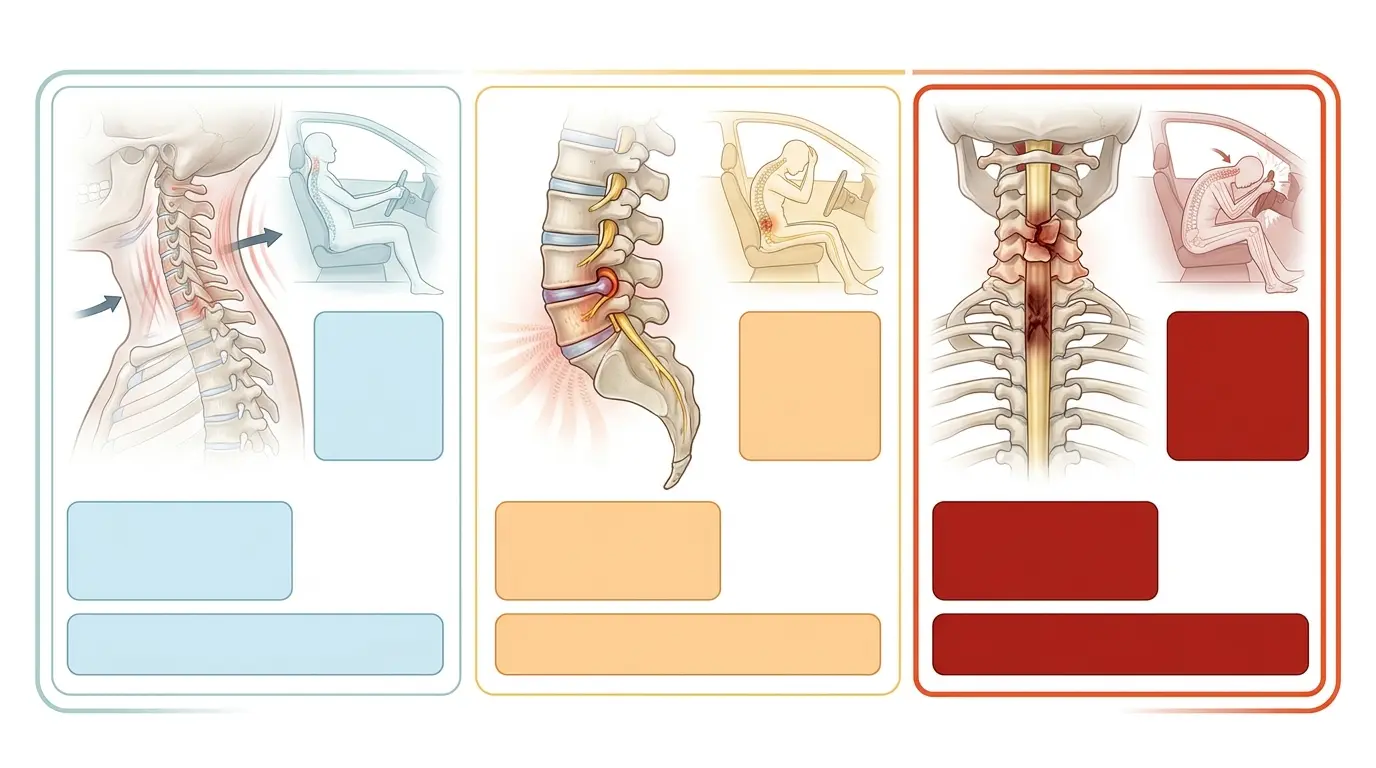
Types of Neck and Back Injuries in Ontario Car Accidents
Car accidents cause a wide range of spinal injuries, from mild strains to life-altering trauma. Knowing your diagnosis helps you understand where your case fits on the settlement scale.
Whiplash happens when your neck snaps forward and back faster than your muscles can control. Doctors classify it using the Whiplash-Associated Disorder (WAD) scale, from WAD I (stiffness, no physical signs) to WAD IV (fracture or dislocation). Most whiplash claims fall under WAD I or II.
A herniated disc occurs when the soft cushion between your vertebrae ruptures and presses on a nerve. This often causes numbness, weakness, or pain that radiates down an arm or leg. Fractured vertebrae are broken bones in the spine, usually from high-impact crashes, and they often require surgery or long-term bracing.
Soft tissue injuries damage muscles, ligaments, or tendons without breaking a bone, but they can still cause months of pain. Spinal cord injuries are the most serious, since they can cause partial or full loss of movement and sensation below the injury site these fall under our broader catastrophic injury practice, since they typically qualify for the highest compensation tier. Some victims also develop myofascial pain syndrome, a chronic condition with painful trigger points in the neck and back muscles, or a cord concussion, a temporary disruption of spinal cord function that mimics a more serious injury before it resolves.
Neck pain after car accident trauma and back pain after car accident trauma can also come with headaches, migraines, or numbness that spreads into the hands or feet. These secondary symptoms are common with WAD III and IV injuries and should always be documented by a doctor, since they can significantly raise your claim’s value. Cervical spine degeneration, an accelerated wear of the neck vertebrae, can also develop in the years after a crash, even when early scans look normal.
How Does Ontario’s No-Fault Insurance System Affect Your Claim?
Ontario runs on a no-fault system, which means your own auto insurer pays your medical and income benefits after a crash, no matter who caused it. This coverage comes through the Statutory Accident Benefits Schedule, or SABS, and it applies before you ever file a lawsuit against the at-fault driver.
Ontario accident benefits under SABS include medical and rehabilitation coverage, income replacement, attendant care, and caregiver benefits, among others. These benefits exist separately from your right to sue for pain and suffering, and they often work together to cover your full recovery. If you want a full breakdown of what SABS pays and how the application process works, our team put together a resource that walks through the exact benefit categories and the one document that starts your 30-day filing clock.
No-fault benefits are not a replacement for a lawsuit. If your injury is serious enough to clear Ontario’s legal threshold, you can also pursue a tort claim against the at-fault driver for pain and suffering compensation Ontario law allows, plus lost income and future care costs that SABS does not fully cover.
What Is the Minor Injury Guideline and How Does It Cap Your Compensation?
The Minor Injury Guideline, known as the MIG, is a rule under Ontario’s auto insurance system that caps medical and rehabilitation benefits at $3,500 for injuries insurers classify as minor. This cap applies to sprains, strains, and WAD I or II whiplash without complications, and it must cover all treatment, including physiotherapy, chiropractic care, and assessments.
The $3,500 limit runs out fast. A few months of physiotherapy and one imaging referral can use up the entire amount, leaving you to pay out of pocket or stop treatment before you have fully healed.
You can challenge a MIG classification if you have a pre-existing condition that complicates recovery, a psychological injury like anxiety following the crash, chronic pain that lasts longer than expected, or functional limitations that stop you from working or doing daily tasks. Getting out of the MIG usually requires medical records, imaging, and a specialist’s opinion showing your injury goes beyond a simple sprain.
If your insurer has placed you in the MIG and your pain has not improved, do not assume that decision is final. Maana Law reviews MIG denials regularly and can help you gather the medical evidence needed to access full benefits.
What Factors Affect Back and Neck Injury Compensation in Ontario?
Several factors affecting injury settlement amounts work together to determine what your case is worth. Whether you are pursuing back injury compensation Ontario law allows or neck injury compensation Ontario insurers must pay, adjusters and courts weigh the same core factors before putting a number on your claim.
Injury severity and diagnosis. A confirmed herniated disc or fracture settles higher than an undocumented strain. Medical evidence. Imaging, specialist reports, and consistent treatment records support a stronger claim. Lost wages and reduced earning capacity. Time off work and any lasting effect on your ability to earn both add to your settlement. Impact on daily life. Missed family events, lost hobbies, and reduced independence all count toward pain and suffering. Insurance policy limits. The at-fault driver’s coverage caps how much you can recover from that policy. Pre-existing conditions. These do not bar a claim, but insurers will argue over what portion of your pain is new.
Courts also look at your age, occupation, and how long your recovery is expected to take. A construction worker with a fractured vertebra faces a very different future than an office worker with the same injury, and settlements reflect that difference.
Building a strong personal injury claim Ontario insurers take seriously starts with seeing a doctor right away and following through on every recommended treatment. Gaps in care are one of the first things adjusters look for when deciding how much to offer.
How Do the Threshold Test and Deductible Affect Your Pain and Suffering Award?
Ontario law sets a legal bar called the threshold test before you can recover pain and suffering damages at all. Under section 267.5 of the Insurance Act, you must show your injury caused a permanent serious impairment of an important physical, mental, or psychological function. Minor, temporary injuries generally do not qualify.
Even if you clear the threshold, a statutory deductible applies to smaller awards. As of 2026, if your general damages award falls below $159,708.71, the court subtracts a deductible of $47,913.01 before you receive payment. This means a $40,000 pain and suffering award could be reduced to zero, while a $60,000 award would drop to roughly $12,000 after the deduction is applied.
This deductible is one reason many injury victims feel shortchanged even after winning their case. It only disappears once your award climbs above the threshold amount, which is why documenting the full extent of your injury matters so much from the very first doctor’s visit.
A skilled lawyer works to build your medical file early, since the deductible only shrinks once your evidence shows the full, lasting impact of your injury.
What Types of Compensation Can You Claim Beyond Pain and Suffering?
Pain and suffering is only one part of an accident injury compensation Ontario claim. Most settlements also include several other categories of loss that add up over the course of a recovery.
Medical expense recovery covers costs not fully paid by SABS or your provincial health plan, including emergency medical care costs like ambulance rides and emergency room visits right after the crash. Rehabilitation costs, such as physiotherapy, occupational therapy, and chiropractic care, often continue for months and can be claimed as they accumulate. For more serious injuries, surgery costs for procedures like a discectomy or spinal fusion can add a significant amount to your total claim.
Lost wages recovery repays income missed while you were unable to work, and reduced earning capacity compensates you if your injury limits what you can earn going forward, even after you return to your job. If your injury causes permanent restrictions, long-term disability compensation accounts for the lasting change to your work life and daily routine this is where a long-term disability claim can run alongside your accident case rather than replace it.
Courts also consider the impact on daily activities your injury causes, from missed housework to lost time with family. General damage ranges are reviewed periodically to reflect inflation-adjusted damage awards, which is part of why the threshold and deductible figures change most years.
How Long Do You Have to File a Back or Neck Injury Claim in Ontario?
Ontario’s Limitations Act gives you two years from the date of your accident to file a lawsuit against the at-fault driver. If your injury was not obvious right away, the clock can start from the date you discovered it instead, though this exception is narrow and best confirmed with a lawyer early.
Accident benefits claims move on a much faster schedule. You generally have 7 days to notify your insurer that you plan to claim benefits, and 30 days to submit your completed application once you receive the forms. Missing either deadline can mean reduced or denied benefits, even if your tort claim is still on track.
If a municipality’s road maintenance contributed to your crash, special notice rules apply, and waiting too long can permanently bar that part of your claim. Because these deadlines overlap and move at different speeds, getting legal advice soon after your accident protects every part of your case.
What Insurance Adjuster Tactics Should You Watch For?
Insurance adjusters are trained to protect their company’s bottom line, not your recovery. Recognizing their tactics early can help you avoid mistakes that lower your settlement.
Adjusters often dispute the origin of your injury, suggesting it existed before the crash or came from something else entirely. They may point to gaps in your treatment as proof your injury was not that serious, even if the gap happened because you could not afford a copay. Some adjusters offer a quick, low settlement soon after the accident, hoping you will accept before you know the full cost of your recovery.
One of the biggest risks comes from signing a release. Once you accept a settlement and sign, your file closes permanently, even if your pain gets worse or you need surgery later. Never sign anything from an insurer without a lawyer reviewing it first, and this is exactly where most accident victims in Mississauga lose real money, usually because of one clause they did not know to question.
Why Maana Law Is the Right Choice for Your Back or Neck Injury Claim
Maana Law has spent more than a decade helping accident victims across Mississauga, including Erin Mills, Cooksville, Churchill Meadows, and Meadowvale, recover fair compensation. Led by Aman Kalra, our team combines careful case preparation with the kind of communication clients say they actually understand.
No Win, No Fee representation. You pay nothing upfront, and we only get paid if we win your case. Free consultations, in person or virtual. We review your accident and injuries at no cost, so you know where you stand before deciding anything. Home and hospital visits. If you cannot travel because of your injury, we come to you. Bilingual, client-first communication. Aman Kalra communicates fluently in Hindi and English, and our team keeps you updated at every stage. Proven track record. We have secured millions in compensation through settlements and verdicts for injured clients. Full case-building support. We gather police reports, medical records, and expert opinions to build the strongest possible claim.
Our clients consistently point to clear communication and steady support through a difficult recovery. That combination is what turns a confusing claim into a fair settlement.
Frequently Asked Questions
How much is a whiplash settlement worth in Ontario?
Most whiplash settlement Ontario cases fall between $10,000 and $50,000, depending on the WAD grade, recovery time, and whether symptoms become chronic. A well-documented WAD II or III injury with ongoing treatment tends to settle higher than a mild WAD I case that resolves in weeks.
Can I still get compensation if I had a pre-existing back or neck condition?
Yes. Ontario law allows compensation for any new injury or worsening of a prior condition caused by the accident. Your lawyer will need medical evidence separating your pre-accident baseline from your post-accident limitations to support this part of the claim.
Do I need a lawyer for a back or neck injury claim in Ontario?
You are not required to hire a lawyer, but insurers have adjusters and lawyers working to limit what they pay. A personal injury lawyer levels that playing field, handles negotiations, and knows how the threshold test and deductible affect your final number.
What if the insurance company denies my Minor Injury Guideline dispute?
You can escalate the dispute through the Licence Appeal Tribunal, or pursue further legal action, depending on your situation. Strong medical evidence showing your injury exceeds MIG limits is usually the deciding factor in these disputes.
How long does a back and neck injury claim take to settle in Ontario?
Simple, well-documented claims can resolve in several months, while complex cases involving surgery or long-term disability can take one to three years. Cases that go to trial instead of settling often take even longer.
Final Thoughts on Back and Neck Injury Settlements in Ontario
Every back and neck injury claim moves through the same basic path: diagnosis, treatment, negotiation, and resolution, but the amount you recover depends on how well each stage is documented and handled.
Three things matter most. First, your medical records need to clearly show the injury and its impact on your life. Second, Ontario’s threshold test and deductible mean small claims need strong evidence to produce a real payout. Third, deadlines move fast, and missing one can cost you benefits or your right to sue entirely.
If you are dealing with neck and back injury settlement Ontario questions after a crash, you do not have to work through this alone. Maana Law serves accident victims throughout Mississauga and the surrounding GTA. Call our office or book a free consultation online, in person, by video, or at your home or hospital bedside, and let our team review your case at no cost.
References
- Ontario Ministry of Transportation, Ontario Road Safety Annual Report (ORSAR)
- Government of Ontario, Insurance Act, R.S.O. 1990, c. I.8, s. 267.5
- Government of Ontario, Limitations Act, 2002, S.O. 2002, c. 24, Sched. B
- Government of Ontario, Statutory Accident Benefits Schedule, O. Reg. 34/10
- Financial Services Regulatory Authority of Ontario (FSRA), fsrao.ca
- Insurance Bureau of Canada, ibc.ca