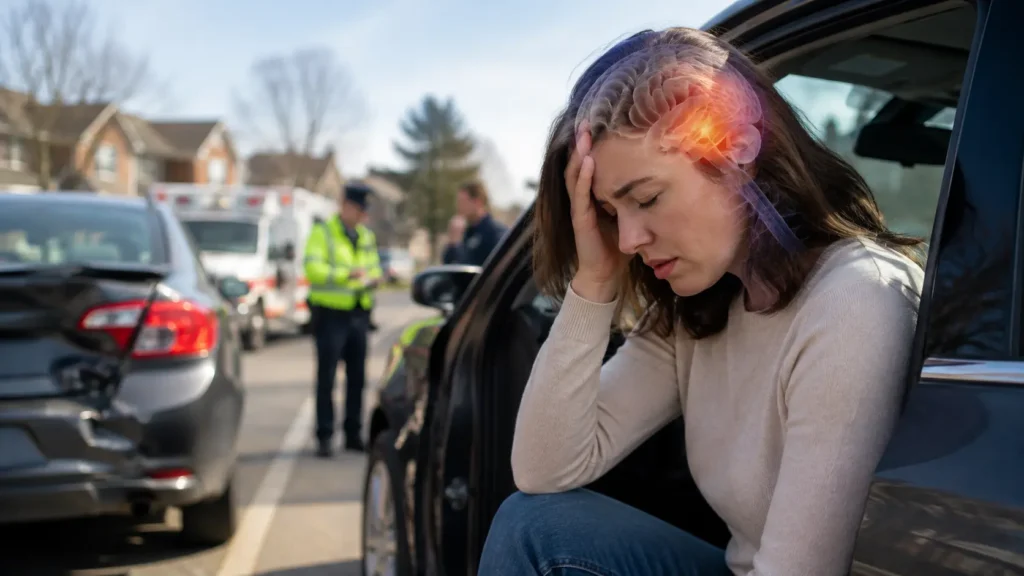
Concussion after a car accident Ontario cases are among the hardest injuries to prove, mainly because they rarely show up on a CT scan or MRI. A driver can walk away from a low-speed collision feeling shaken but fine, then spend the next month fighting headaches, brain fog, and an insurer who questions whether anything is actually wrong. Maana Law, a Mississauga concussion injury lawyer team, has represented accident victims across Mississauga through exactly this pattern, where the injury is real but the proof takes work to build.
Peel Region recorded 42,733 vehicle collisions in 2024, with personal injury collisions rising to 1,751, an 8.4% increase over the year before. Head and brain injuries are among the least visible of those cases, and often the least believed. Nationally, Brain Injury Canada reports that about 165,000 Canadians sustain a traumatic brain injury every year, alongside roughly 200,000 concussions, and both figures are widely considered underestimates because so many go unreported or undiagnosed.
Here is what this guide covers:
- What a concussion actually is, medically and legally
- How to recognize symptoms that show up immediately or days later
- Ontario’s protocol for diagnosing and managing concussions
- Why concussions usually fall outside the Minor Injury Guideline
- What proves a concussion claim, and when it can become catastrophic
Talk to Maana Law about building the record that proves what the scan can’t show.
What Is a Concussion, and Why Do Doctors Sometimes Miss It at the Scene?
A concussion is a mild traumatic brain injury (mTBI) caused by a sudden jolt or impact that makes the brain move rapidly inside the skull, and it does not require a direct hit to the head or loss of consciousness to occur. The forceful back-and-forth motion in a car crash, similar to what causes whiplash in the neck, can injure the brain the same way.
Paramedics and ER doctors often use the Glasgow Coma Scale, which scores eye, verbal, and motor responses from 3 to 15, to screen for brain injury at the scene or on arrival. A score of 13 to 15 is generally classified as mild, which is where most concussions fall. That classification is exactly why so many get missed early: a “mild” score can still clear a patient for discharge even when real brain injury has occurred, since concussions typically do not appear on standard CT or MRI imaging.
Because the injury is invisible on a scan, the first assessment often happens under adrenaline, minutes after a crash, which is the worst possible moment to judge how a brain injury will actually unfold over the following days.
How Do You Know If You Have a Concussion After a Car Crash?
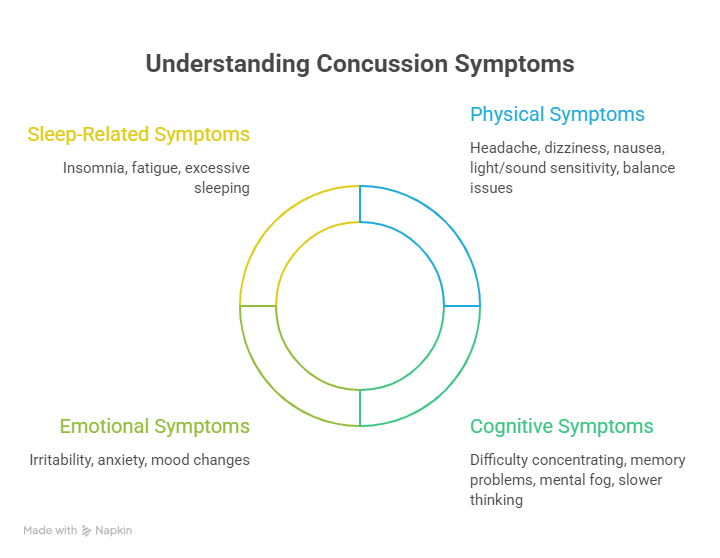
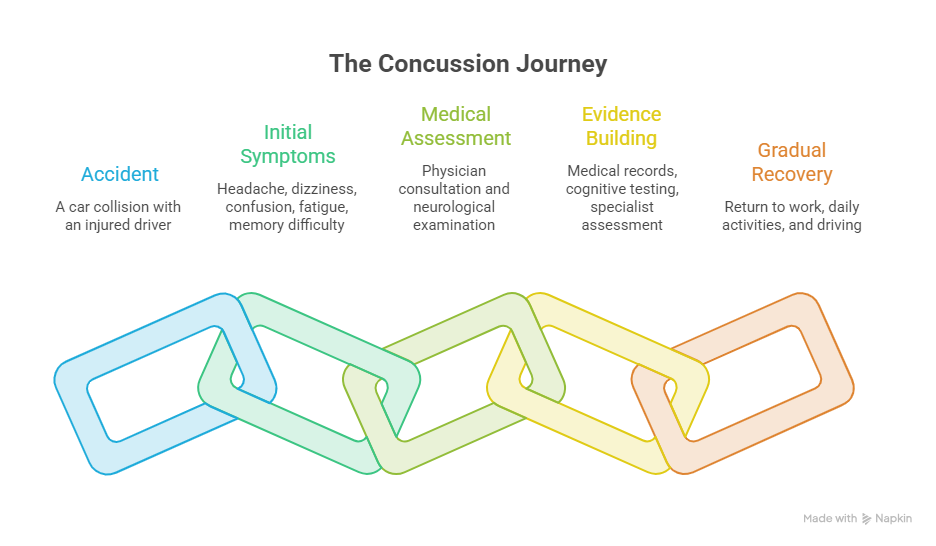
You likely have a concussion if you experience headaches, dizziness, confusion, memory problems, or unusual fatigue in the hours or days following a car accident, even if you felt fine at the scene. Symptoms generally fall into four categories:
- Physical: headaches, dizziness, nausea, sensitivity to light or sound, vestibular dysfunction (balance and inner-ear symptoms)
- Cognitive: difficulty concentrating, memory problems, mental fog, slower thinking
- Emotional: irritability, anxiety, sudden mood changes
- Sleep-related: insomnia, excessive fatigue, sleeping far more or less than usual
Delayed concussion symptoms after accident cases are common. Many people leave the scene feeling shaken but clear-headed, only to develop headaches, confusion, or emotional changes over the following 24 to 72 hours as swelling and chemical changes in the brain progress.
Emergency providers sometimes use what is known as the 4-hour rule, a clinical observation period where staff check level of consciousness, pupil response, and motor function every 30 to 60 minutes after a head injury. This window helps rule out a dangerous bleed, but it is not designed to catch every concussion, since many symptoms take much longer than four hours to surface. A clear 4-hour observation period does not mean you are free of concussion risk once you go home.
What Is the Protocol for Diagnosing and Managing a Concussion in Ontario?
Ontario follows the Living Concussion Guidelines, first developed by the Ontario Neurotrauma Foundation and now maintained under the Ontario Ministry of Health, which set out how clinicians should diagnose mild traumatic brain injury and manage prolonged symptoms. The guidelines are updated on a rolling basis, at least every six months, rather than as a single fixed document, which reflects how quickly concussion research changes.
The protocol covers initial diagnosis, symptom-specific management for issues like post-traumatic headache, sleep disturbance, and cognitive difficulty, and structured return-to-activity, return-to-work, and return-to-school guidance for adults and children. A doctor following this protocol will typically reassess symptoms in stages rather than clearing a patient in one visit, which is part of why concussion recovery is measured in weeks, not days.
Staged recovery generally moves from rest and reduced screen time in the first few days, to light daily activity as symptoms allow, to a gradual return to work, school, or driving once concentration and reaction time have been tested rather than assumed. Skipping stages, often because a patient feels pressure to return to normal life quickly, is one of the most common reasons mild symptoms turn into prolonged ones.
Returning to driving too early is a bigger risk than most people assume. A November 2025 study by ICES and the Sunnybrook Research Institute, published in BMJ Open, followed 425,158 Ontario adults diagnosed with a concussion and found their risk of a subsequent traffic crash rose by about 50%, with the danger highest in the first four weeks after the injury. One in 13 people in that study went on to be injured in a later crash. That is exactly why the staged protocol treats driving as a milestone to earn back, not a default right to resume the day symptoms feel manageable.
If your doctor has not referred you to a concussion-specific assessment within the first few weeks, that gap alone can weaken both your recovery and your claim.
Why Are Concussions Often Excluded From the Minor Injury Guideline?
Concussions are usually excluded from Ontario’s Minor Injury Guideline (MIG) because the guideline’s definition of a “minor injury” covers sprains, strains, whiplash-associated disorders, contusions, abrasions, lacerations, and subluxations, and a diagnosed traumatic brain injury does not fit any of those categories. That means a confirmed concussion claim is not automatically capped at the MIG’s $3,500 treatment limit the way a soft tissue injury often is.
This distinction matters because insurers sometimes try to fold concussion symptoms into a MIG-capped soft tissue file anyway, especially when imaging comes back normal and the only evidence is self-reported symptoms. Getting a clear mTBI diagnosis on record, rather than a vague note about “dizziness” or “headache,” is what keeps a concussion claim outside that cap.
If your insurer has tried to treat your head injury as a minor claim, Maana Law can review your medical file and push back on that classification before it limits your treatment funding.
Being outside the MIG does not mean unlimited funding, though. A non-catastrophic concussion claim still falls under the standard $65,000 combined medical, rehabilitation, and attendant care cap, shared with any other injuries from the same accident. That pool can run out fast once neuropsychological testing, specialist visits, and ongoing therapy are added up, which is exactly why documentation quality, covered next, has such a direct effect on how far your benefits actually stretch.
What Is Post-Concussion Syndrome, and When Does It Signal a Bigger Claim?
Post-Concussion Syndrome (PCS) is the diagnosis given when concussion symptoms persist beyond the typical recovery window, generally weeks to a few months, rather than resolving on their own. When headaches, cognitive fog, or mood changes are still disrupting daily life after three months, that persistence itself becomes medically and legally significant.
A real case shows how far this can go. The Ontario Superior Court of Justice ruled on a case involving Paul Taylor in January 2024, after a 17-day trial, awarding him $250,000 in pain and suffering plus over $700,000 in future income and care costs after being rear-ended by an inattentive driver. The court found his brain fog, memory loss, and chronic pain from post-concussion syndrome forced him out of his career, even though he had managed to keep working for nearly two years first.
Second-impact syndrome, a rare but serious risk where a second head injury before the first has healed can cause severe brain swelling, is one reason doctors are cautious about clearing patients for full activity too early. It is also a reason insurers cannot fairly treat every concussion as a short-term, low-value claim.
What Documentation Proves a Concussion Claim?
A concussion claim gets proven through consistent specialist documentation over time, not a single ER visit or a normal scan result. Because standard CT scan and MRI findings are usually normal in concussion cases, the medical record needs to build a different kind of evidence.
Strong documentation typically includes:
- A detailed OCF-3 (Disability Certificate) describing specific cognitive and physical limitations, not just a general diagnosis
- A neuropsychological assessment, which tests memory, attention, and processing speed against expected baselines
- Specialist referrals, such as neurology, vestibular rehabilitation, or neuro-optometry, depending on which symptoms dominate
- Consistent clinical notes over several months showing the same or worsening symptoms, not a one-time complaint
A neuropsychological report carries particular weight because it turns subjective symptoms like “brain fog” into measurable, comparable data. Insurers find it far harder to dismiss a documented cognitive testing deficit than a patient’s own description of feeling foggy.
Timing the assessment matters too. A neuropsychological evaluation done too early, while swelling and acute symptoms are still settling, can understate the injury. Most specialists prefer testing several weeks after the accident, once the acute phase has passed, so the results reflect the injury’s real trajectory rather than a temporary low point.
Documentation. Timing. The right specialists. Let Maana Law build that same kind of case for you.
When Does a Concussion Qualify as a Catastrophic Impairment in Ontario?
A concussion can qualify as a catastrophic injury impairment when imaging confirms a traumatic brain injury and the person meets specific functional outcome thresholds set out in the Schedule, raising the available benefit caps far above the standard $65,000 non-catastrophic limit. For adults, this generally requires imaging-confirmed brain injury combined with a defined level of functional impairment. For children under 18, admission to a designated trauma or rehabilitation program, or documented developmental delays at follow-up, can support the designation instead.
Most single, uncomplicated concussions do not reach this threshold. It becomes relevant when a concussion overlaps with other findings, such as a whole person impairment rating of 55% or more, or a marked mental or behavioural disorder affecting multiple areas of daily function. Getting this designation usually requires a formal OCF-19 application supported by specialist reports, and it opens access to benefits like enhanced attendant care and lifetime medical funding that a standard non-catastrophic claim does not provide.
What Is the Average Settlement for a Concussion in a Car Accident?
The average settlement for a concussion in a car accident in Ontario generally falls between $50,000 and $150,000 in general damages for a mild traumatic brain injury, with moderate cases reaching $150,000 to $500,000 and severe or catastrophic brain injuries settling from $500,000 to over $2,000,000. These figures cover pain and suffering only. Economic losses, including lost income and future care costs, are calculated separately and can significantly increase the total.
Ontario’s non-pecuniary damages are subject to a judicially recognized upper limit, adjusted annually for inflation and currently sitting at approximately $460,969. Catastrophic brain injury cases regularly approach that ceiling. Paul Taylor’s case above shows how a single mild TBI diagnosis, when paired with genuine, well-documented post-concussion symptoms, resulted in an award of well over $1,000,000 once lost income and future care were added to the pain and suffering amount.
A tort claim large enough to pursue these amounts is filed with the Ontario Superior Court of Justice, which for Mississauga and the rest of Peel Region sits at the Brampton courthouse, 7755 Hurontario Street. SABS accident benefits disputes over a concussion diagnosis, by contrast, go through the Licence Appeal Tribunal rather than through that courthouse directly.
When Should You Involve a Lawyer for a Concussion Claim?
You should involve a lawyer when symptoms persist past the first few weeks, when your insurer questions or denies treatment for a normal-imaging injury, or when a catastrophic designation is being disputed. Concussion claims are uniquely vulnerable to delay, since the injury looks fine on paper and the person often appears fine to people who do not know them well.
Timing matters more than most people realize. In Lloyd v. Baker, the Ontario Court of Appeal upheld a decision barring a woman’s post-concussion syndrome lawsuit because she waited six years to sue, even though a doctor had told her in December 2016, five years earlier, that she would likely never return to her previous baseline. The court found that early warning, not a formal neuropsychological diagnosis, was enough to start her two-year limitation clock. Waiting for certainty before getting legal advice cost her the entire claim.
A lawyer working on a contingency fee agreement coordinates the neuropsychological and specialist evidence a concussion claim actually needs, pushes back on a MIG classification or denied treatment plan, and tracks your limitation period from the point your doctor first suggests the recovery may not go smoothly, not from the day a formal diagnosis arrives.
If your recovery isn’t going the way it should, get your symptoms and your file reviewed now — for free.
Why Maana Law Is the Right Choice for Your Concussion Claim
Maana Law has spent over ten years helping Mississauga accident victims prove injuries that insurers try to dismiss because they cannot see them on a scan. We know how to build the kind of record a concussion claim needs, and we act before a delayed diagnosis becomes a missed deadline.
- No Win, No Fee representation You pay nothing upfront, and nothing at all unless we recover compensation for you.
- Experience with “invisible” injury claims We know how to document cognitive and functional symptoms an insurer cannot see on imaging.
- MIG classification pushback We challenge attempts to cap a real brain injury claim at the minor injury treatment limit.
- Catastrophic impairment support We coordinate the specialist reports a CAT designation application actually requires.
- Local knowledge across Mississauga From Erin Mills and Cooksville to Churchill Meadows, Meadowvale, and City Centre, we understand the claim patterns our neighbours face.
Clients come to us worried that no one believes how they feel. We build the record that proves it.
Frequently Asked Questions
How long do concussion symptoms last after a car accident?
Most concussion symptoms resolve within two to four weeks, though a meaningful share of people experience symptoms for three months or longer, which is when the diagnosis shifts toward post-concussion syndrome. Recovery time depends on injury severity, prior concussion history, and how quickly proper treatment begins.
Does a normal CT or MRI scan mean I don’t have a brain injury?
No, a normal CT or MRI is expected in most concussion cases, since standard imaging is designed to rule out bleeding or fracture, not to detect the microscopic changes involved in a concussion. Insurers sometimes point to normal scans as evidence there is no injury, but this does not reflect how concussions actually work medically.
Can I still make a claim if I went back to work after my concussion?
Yes, returning to work does not disqualify a concussion claim, especially if you pushed through symptoms or later had to reduce your hours or change roles because of ongoing cognitive or physical effects. Documentation showing what returning to work actually cost you, in effort, hours, or role changes, supports the claim rather than undermining it.
What is second-impact syndrome, and why does it matter after a car accident?
Second-impact syndrome is a rare but serious condition where a second head injury, before the brain has fully healed from the first, can cause dangerous swelling. It matters after a car accident because it is one reason doctors recommend a careful, staged return to activity rather than resuming normal life the moment symptoms feel manageable.
Can a mild concussion turn into a catastrophic impairment claim?
A single mild concussion rarely qualifies as catastrophic on its own, but it can when imaging confirms significant brain injury or when the impairment combines with other findings to meet the Schedule’s functional thresholds. This usually requires a formal application supported by neuropsychological and specialist evidence, not just a persistent symptom report.
Conclusion
A concussion is one of the few car accident injuries that can be completely real and completely invisible on a scan at the same time. That gap between how the injury feels and how it looks on paper is exactly where claims get underestimated, both by the people living through them and by the insurers reviewing the file.
Three things matter most from everything above. Delayed symptoms are common, not suspicious, and a clean scan does not mean a clean bill of health. Concussions generally fall outside the Minor Injury Guideline once properly diagnosed, which protects access to real treatment funding. And the two-year clock to sue can start the moment a doctor suggests your recovery may not go smoothly, long before a formal diagnosis confirms it.
Acting early protects both your recovery and your claim. Maana Law, located at 90 Matheson Blvd W Suite 101, Mississauga, ON, offers a free consultation with No Win, No Fee representation for concussion and traumatic brain injury claims. Call today to have your symptoms and your file reviewed before a deadline or a denial limits what you can recover.
References
- Oatley Vigmond, “Concussion Symptoms After a Car Accident: What to Watch For,” https://oatleyvigmond.com/concussion-symptoms-after-a-car-accident-what-to-watch-for/
- Living Concussion Guidelines, “About,” https://concussionsontario.org/concussion/about
- Brain Injury Canada, “Statistics,” https://braininjurycanada.ca/en/statistics/
- ICES, “Concussions Linked to Increased Risk of a Serious Traffic Crash,” https://www.ices.on.ca/news-releases/concussions-linked-to-increased-risk-of-a-serious-traffic-crash/
- Ontario Superior Court of Justice, “Brampton Courthouse,” https://www.ontariocourts.ca/scj/locations/brampton/
- Law Times, “Ontario Court of Appeal Denies Untimely Claim for Damages for Post-Concussion Syndrome,” https://www.lawtimesnews.com/practice-areas/personal-injury/ontario-court-of-appeal-denies-untimely-claim-for-damages-for-post-concussion-syndrome/393413
- Peel Regional Police, “Statistical Report Five-Year Summary (2020-2024),” https://www.peelpolice.ca/media/fqworbtk/statistical-report-five-year-summary-2020-2024.pdf