

Accident benefits denied Ontario letters rarely explain what they actually mean for your recovery, and that gap is where most people lose ground. A denial is not the end of your claim. It is the start of a deadline. Maana Law, an Accident Benefits Dispute Lawyer serving accident victims across Mississauga, has helped people read past the insurance language in these letters and figure out exactly what to do next, often within days of receiving one.
Peel Region recorded 42,733 vehicle collisions in 2024, with personal injury collisions rising to 1,751, an 8.4% increase over the year before. A meaningful share of those injured people are dealing with a delayed or denied claim right now.
Here is what this guide covers:
- The real difference between a delayed claim and a denied one
- What a denial letter must legally include, and why many do not qualify
- The most common reasons insurers deny or cut off benefits
- The deadlines you cannot afford to miss
- What to do in the first seven days, and what never to say to your insurer
Send it to Maana Law and we’ll tell you exactly which clock has started — free of charge.
What Is the Difference Between a Delayed and a Denied Accident Benefits Claim?
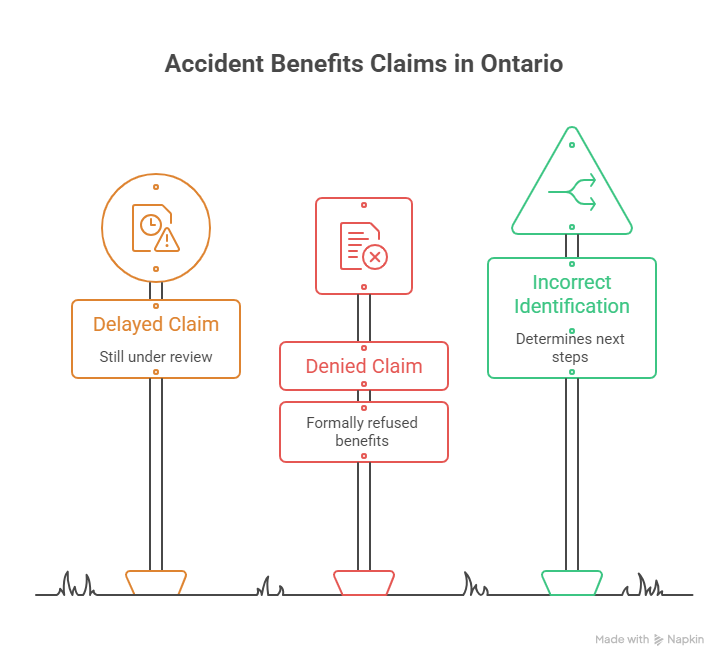
A delayed claim is still under review, while a denied claim is a formal, written refusal of a specific benefit. Delayed accident benefits Ontario situations happen when your insurer requests more documents, waits on an assessment, or simply takes longer than expected to process your file. Nothing has been refused yet, but the clock on your recovery is still running.
A denial is different. It comes through a Notice of Denial, sometimes called an Explanation of Benefits (EOB), and it must clearly state that a specific benefit is being refused, along with the reasons and your right to dispute it. Ontario courts and tribunals have been strict about this distinction. In Smith v. TD General Insurance Company, the tribunal found that vague correspondence, or a routine dispute notice attached to an unrelated letter, does not count as a valid denial. The word “denied” needs to actually appear, in plain language a non-lawyer can understand.
Knowing which situation you are in changes what you do next. A delay usually calls for follow-up and documentation. A denial starts a legal countdown.
What Happens When an Insurer Denies Your Accident Benefits Claim?
A denial means the insurer has refused to pay a specific benefit, but it is not the final word on your entitlement. What happens if insurance rejects my claim is a question with a clear legal answer in Ontario: you have the right to dispute it, first through reconsideration and then through the Licence Appeal Tribunal (LAT), and many denials get overturned or renegotiated once real evidence is put in front of an adjudicator.
The denial letter itself matters more than most people realize. It must set out the specific benefit being refused, the medical or factual reason for the refusal, and the dispute process available to you, including the relevant time limits. A letter that only asks for more information, without the word “denied,” is not a valid denial and does not start your appeal clock.
Read your letter carefully before assuming the worst. Some “denials” are really requests wrapped in confusing language, and knowing the difference saves you from either missing a real deadline or panicking over a routine document request.
Real tribunal decisions back this up. In a 2026 reconsideration involving Peel Mutual Insurance, the Licence Appeal Tribunal ordered a fresh hearing on six previously denied treatment plans worth more than $34,000, after finding the insurer’s own paperwork contradicted the reason it gave for the denial. The claimant’s original treatment plans had been rejected outright, yet the tribunal sent them back for a proper review once the inconsistency came to light.
What Are the Most Common Reasons Accident Benefits Get Denied?
Accident benefits most often get denied for three reasons: insufficient medical evidence, a missed deadline or form, and a dispute over whether the treatment or injury relates to the accident at all. These three account for the large majority of denials insurers issue in Ontario.
- Insufficient medical evidence: Your OCF-3 or treatment plan does not clearly document functional limitations, so the insurer decides the file does not support the benefit. A one-line note saying a patient has “neck pain” carries far less weight than a report describing exactly what the patient can no longer do at work or at home.
- Missed deadlines or incomplete forms: A late OCF-1, an incomplete OCF-18, or a missing signature gives the insurer grounds to deny while the paperwork gets sorted out. These denials are often the easiest to fix, since the underlying medical need may not be in dispute at all.
- Causation or pre-existing condition disputes: The insurer argues your symptoms come from an unrelated condition rather than the crash, which is common in soft tissue injury and chronic pain claims. A pre-existing condition does not automatically disqualify you, but it does mean your file needs clear medical language distinguishing what changed after the collision.
Causation or pre-existing condition disputes: The insurer argues your symptoms come from an unrelated condition rather than the crash, which is common in soft tissue injury and chronic pain claims such as whiplash. If your denial involves a whiplash diagnosis specifically, our guide on whiplash injury after a car accident covers how those claims typically get challenged. A pre-existing condition does not automatically disqualify you, but it does mean your file needs clear medical language distinguishing what changed after the collision.
Beyond these three, a Minor Injury Guideline (MIG) classification dispute is its own frequent trigger, since insurers often place an injury inside the $3,500 MIG cap even when a doctor recommends treatment beyond it. Failure to attend an insurer’s examination (IE) is another serious one. Under section 55(1)2 of the Statutory Accident Benefits Schedule (SABS), missing a properly scheduled IE without a valid reason can bar you from disputing that specific denial at the LAT altogether, a result confirmed in A.U. v. TD Insurance Meloche Monnex.
What Time Limits Must You Watch After a Denial or Delay?
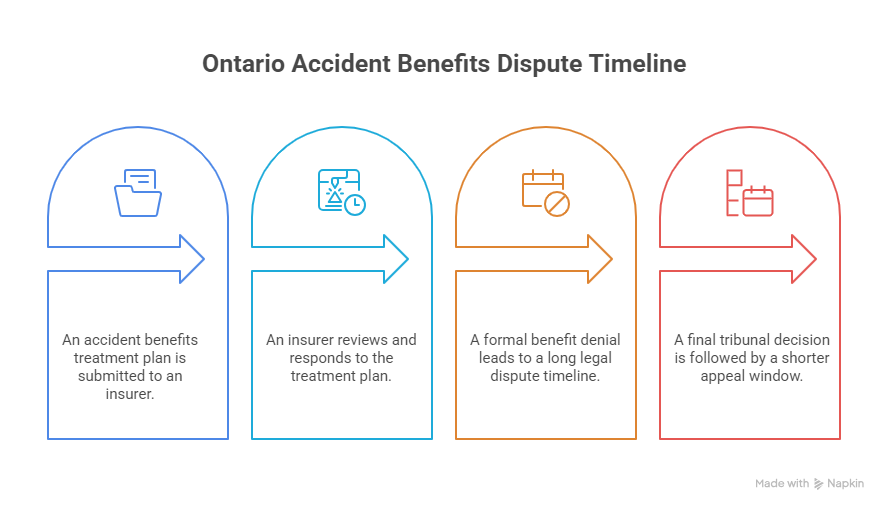
The most important time limit is two years from the date of a clear, written denial to file a dispute with the Licence Appeal Tribunal, and missing it generally ends your right to challenge that specific decision. This is the same appeal deadline that governs most SABS disputes, and Ontario courts have confirmed there is no rolling limitation period. Ongoing talks with your insurer, or a promise to “look into it,” do not pause the clock.
Two other deadlines matter earlier in the process:
| Step | Deadline |
| Insurer response to an OCF-18 treatment plan | 10 business days from receipt (section 38(8) of the SABS) |
| Responding to a Section 33 information request | 10 business days |
| Disputing a benefit denial at the LAT | 2 years from a clear, written denial |
| Appealing a final LAT decision to Divisional Court | 30 days from the date the tribunal issues its decision |
If an insurer misses the 10-business-day OCF-18 response window, they generally must pay for the requested treatment starting on the 11th business day until they issue a proper response. Knowing this cuts both ways: it protects you when an insurer is slow, and it means you need to track your own dates just as closely.
Money left unpaid during a dispute does not simply sit still, either. Under Section 51 of the Schedule, overdue benefits accrue interest, and tribunal decisions on unreasonable conduct have applied a rate of 2% per month, compounded, on amounts an insurer should have paid but did not. That adds up fast on a treatment plan or income replacement benefit that sits unpaid for months while a dispute works its way through the system.
A final LAT decision is not automatically the last word either. If a decision contains an error of law, a party can appeal to the Divisional Court, but only within 30 days of the tribunal issuing its decision, a deadline Tribunals Ontario has confirmed it cannot extend.
If your insurer has already denied treatment, Maana Law can review the denial letter and confirm exactly which clock has started before it runs out.
If your insurer’s conduct looks unreasonable, Maana Law can check if you qualify.
What Should You Do in the First 7 Days After a Denial?
In the first seven days after a denial, your priority is to preserve your position, not to argue your case yet. Take these steps in order:
- Read the letter fully and confirm whether it is a true denial or a document request.
- Save everything, including the envelope or email timestamp, since the date you received it matters for your deadlines.
- Contact your treating doctor or physiotherapist and ask them to document your current functional limitations in writing.
- Avoid signing anything new from the insurer, including broad medical authorizations, until you understand what it releases.
- Book a consultation with a personal injury lawyer if the denial involves a treatment plan, an IE dispute, or an MIG classification you disagree with.
None of these steps require you to have already decided whether to fight the denial. They simply keep your options open while you figure out the right next move.
Should You Request Reconsideration or Go Straight to the LAT?
A reconsideration request is usually the faster, lower-risk first step, but it should not replace tracking your LAT deadline. Reconsideration means asking your insurer directly to review the denial with new medical evidence attached, and many insurers will revisit a file when a stronger OCF-3 or specialist report lands on their desk.
Reconsideration works best when your original submission was thin and you now have better documentation. It works poorly when the insurer’s position is about a legal classification, such as an MIG dispute, rather than missing paperwork. In those cases, filing at the LAT sooner, rather than waiting out a reconsideration that may go nowhere, protects your two-year window.
There is no fixed rule that says you must try reconsideration before the LAT, and many lawyers run both tracks at once: requesting reconsideration with the insurer while preparing a LAT application in case that request goes nowhere. The mistake to avoid is treating reconsideration as a pause button on your deadline. It is not. The two-year clock keeps running the entire time an insurer is “reviewing” your request, regardless of how many emails go back and forth.
What Should You Avoid Saying to Your Insurance Company?
You should avoid speculating, admitting fault, or minimizing your symptoms when talking to your insurer, since anything you say can end up quoted in their file against you. A few specific habits cause real damage to claims:
- Guessing at how long you think you will be off work, rather than deferring to your doctor
- Saying you “feel fine” on a phone call days after the crash, even if pain has not set in yet
- Describing the accident in a recorded statement without knowing what the insurer is trying to establish
- Posting about your recovery, activities, or the accident on social media
- Signing a broad medical or employment records release before a lawyer has reviewed it
None of this means being dishonest with your insurer. It means being precise, and letting medical documentation, not casual conversation, carry the weight of your claim.
What Evidence Strengthens a Denied Accident Benefits Dispute?
A denied claim gets stronger with updated, specific medical evidence that directly answers the insurer’s stated reason for denial, not generic paperwork. If your OCF-3 was vague, an updated version with concrete functional limitations, such as sitting tolerance, lifting restrictions, or concentration problems, does more to change an outcome than a general statement that you are “still in pain.”
Concentration and memory problems in particular are often tied to a concussion rather than a soft tissue injury, and insurers frequently discount them without a specialist assessment. If that applies to your file, our guide on concussion after a car accident in Ontario covers what that documentation should look like.
Strong evidence typically includes:
- A specialist opinion addressing the exact medical dispute the insurer raised
- Consistent clinical records showing symptoms and treatment across time, not just at one visit
- A clear before-and-after picture of your functional ability compared to before the accident
- Direct responses to the insurer’s stated reasons, rather than a broad restatement of your injury
Evidence that targets the specific denial reason, rather than simply repeating your original submission, is what tends to move both reconsideration requests and LAT disputes forward. Adjudicators read dozens of files a week, and a report that speaks directly to the insurer’s stated objection stands out from one that simply restates the original claim in different words.
When Does a Denial Signal You Need a Lawyer?
A denial signals you need a lawyer when it repeats after you have already provided evidence, when the insurer’s conduct looks unreasonable, or when your case may qualify for a special award. Under the Schedule, the LAT can order a special award of up to 50% of the amount owed, plus interest, when an insurer’s conduct is found to be excessive, stubborn, or unreasonable rather than a simple, honest mistake.
The numbers explain why legal help matters at this stage. According to data reported by the Ontario Trial Lawyers Association, claimant win rates at the LAT fell from 33% in the tribunal’s first year to 11% in 2023 and just 8% in 2024, with insurers prevailing in 74% of decisions that year. Tribunals Ontario has pointed out that 96% of closed cases resolve without a formal hearing, which means most disputes are settled or withdrawn well before reaching that stage, often through negotiation a lawyer is positioned to lead.
A lawyer working on a contingency fee agreement reviews whether your denial pattern points toward bad faith conduct, prepares the medical evidence your LAT application actually needs, and negotiates directly with the insurer while your file is still open, rather than after months have already passed.
Ontario’s dispute resolution process for accident benefits has changed shape over the years. Before 2016, disputes went through a separate mediation step at the former Financial Services Commission of Ontario before reaching arbitration. Today, the Dispute Resolution process runs through the LAT directly, with reconsideration as the informal first step and formal LAT adjudication as the backstop. Knowing which stage your dispute is actually in, rather than assuming an old mediation-style process still applies, changes how a lawyer approaches your file from day one.
Have your denial letter reviewed by Maana Law before your deadline runs out. Free, no obligation.
Why Maana Law Is the Right Choice When Your Accident Benefits Are Delayed or Denied
Maana Law has spent over ten years helping Mississauga accident victims push back against denials that should never have happened. We read every denial letter the way an adjudicator would, and we act on the deadline it actually creates, not the one an insurer implies.
- No Win, No Fee representation You pay nothing upfront, and nothing at all unless we recover compensation for you.
- Fast review of denial and delay letters We tell you within days whether a letter is a real denial and what deadline it starts.
- Experience building LAT-ready evidence We know what an adjudicator needs to see to overturn a weak denial.
- Bad faith and special award assessment We flag patterns of unreasonable insurer conduct that can justify a special award.
- Local knowledge across Mississauga From Erin Mills and Cooksville to Churchill Meadows, Meadowvale, and City Centre, we understand the claim patterns our neighbours face.
Clients come to us holding a letter they do not fully understand. We tell them exactly what it means and what happens next.
Frequently Asked Questions
Are accident benefits mandatory in Ontario?
Yes, every auto insurance policy in Ontario must include the mandatory accident benefits set out in the Statutory Accident Benefits Schedule. Insurers cannot sell a policy that pays less than these minimum benefit levels, though optional coverage can add more on top.
Who is eligible for accident benefits in Ontario?
Anyone injured in a motor vehicle accident in Ontario is generally eligible for accident benefits, including drivers, passengers, cyclists, and pedestrians, regardless of who caused the crash. If you do not have your own auto policy, you can usually claim through the vehicle that struck you or through the Motor Vehicle Accident Claims Fund.
Does a denied treatment plan mean my injury isn’t real?
No, a denied treatment plan usually reflects the insurer’s view that the proposed care is not “reasonable and necessary” under their internal standards, not a judgment that your injury does not exist. Many denials get resolved once a specialist report or updated functional evidence directly answers the insurer’s specific objection.
How long does an insurer have to respond to an OCF-18 treatment plan?
An insurer has 10 business days from receiving your OCF-18 to respond with what they will approve, deny, or need more information about. If they miss that window, they generally have to pay for the treatment starting from the 11th business day until they respond properly.
Can I get a lawyer even after my claim has already been denied?
Yes, you can bring in a lawyer at any point, including after a denial, and doing so before your two-year LAT deadline passes gives you the most options. A lawyer can still request reconsideration, gather stronger evidence, or file at the LAT, depending on how much time remains and what the denial actually says.
Conclusion
A denial letter feels final, but under Ontario law, it is usually just the opening move in a process you are entitled to challenge. Reading the letter correctly, tracking the deadline it actually creates, and responding with targeted medical evidence changes outcomes far more often than people expect.
Three things matter most from everything above. A real denial must use clear, unequivocal language, and vague correspondence does not start your appeal clock. The reasons behind most denials, thin evidence, missed paperwork, or a causation dispute, are fixable with the right documentation. And once a valid denial arrives, your two-year window to dispute it at the LAT is already running, whether or not you have decided what to do yet.
Acting early protects your options while they are still open. Maana Law, located at 90 Matheson Blvd W Suite 101, Mississauga, ON, offers a free consultation with No Win, No Fee representation for delayed and denied accident benefits claims. Call today to have your denial letter reviewed before your deadline runs out.
References
- McLeish Orlando LLP, “What to Do When Accident Benefits Are Delayed or Denied in Ontario,” https://www.mcleishorlando.com/accident-benefits/accident-benefits-delayed-denied-ontario/
- Canadian Lawyer Magazine, “Special Award a Much-Needed Remedy Against Egregious Conduct by Insurers,” https://www.canadianlawyermag.com/news/general/special-award-a-much-needed-remedy-against-egregious-conduct-by-insurers/382668
- ZTGH, “What Constitutes a Proper Denial of Specified SABS Benefits,” https://ztgh.com/what-constitutes-a-proper-denial-of-specified-sabs-benefits-for-the-purposes-of-starting-a-limitation-clock-in-disputing-that-denial-by-jonathan-beiles/
- Rogers Partners LLP, “Failure to Attend Insurer’s Exams Fatal to SABS Claim,” https://www.rogerspartners.com/failure-attend-insurers-exams-fatal-sabs/
- FDT Law, “Ten Points You Need to Know About the Treatment and Assessment Plan (OCF-18),” https://fdtlaw.ca/blog/ten-points-treatment-assessment-plan-ocf-18/
- Insurance Business Canada, “Ontario Accident Benefits Tribunal Under Fire as Claimants Win Just 8% of Cases,” https://www.insurancebusinessmag.com/ca/news/claims/ontario-accident-benefits-tribunal-under-fire-as-claimants-win-just-8-of-cases-572648.aspx
- Peel Regional Police, “Statistical Report Five-Year Summary (2020-2024),” https://www.peelpolice.ca/media/fqworbtk/statistical-report-five-year-summary-2020-2024.pdf
- Tribunals Ontario, “Statutory Appeals Information Sheet,” https://tribunalsontario.ca/documents/lat/Statutory%20Appeals%20Information%20Sheet.html
- Insurance Business Canada, “Peel Mutual Heads to Rehearing After Tribunal Undoes Treatment Plan Denials,” https://www.insurancebusinessmag.com/ca/news/legal-insights/peel-mutual-heads-to-rehearing-after-tribunal-undoes-treatment-plan-denials-576300.aspx