

Whiplash injury after a car accident often feels manageable at first, then gets worse over the next few weeks. That delay is the exact reason so many people wait too long to protect their claim. Whiplash injury lawyer teams see this pattern often: a driver walks away from a crash feeling fine, then wakes up three days later with a stiff neck that will not turn. Maana Law has represented accident victims across Mississauga who faced this exact confusion about their symptoms and their rights.
Crashes in this region are not rare. Peel Regional Police recorded 42,733 collisions across Peel Region in 2024, with reportable collisions up 25.1% from the year before and personal injury collisions climbing to 1,751, an 8.4% increase over 2023. A large share of those injuries are neck and soft tissue injuries like whiplash.
Here is what this guide covers:
- What whiplash is and why doctors sometimes miss it at first
- Why symptoms can show up days or weeks after the crash
- When Ontario law treats whiplash as “minor” versus a serious injury
- The difference between accident benefits and a tort claim
- Why insurance companies push fast settlements
- The exact point in your recovery when you should call a lawyer
Find out what that delay could mean for your claim – a quick, free call is all it takes.
What Is Whiplash and Why Do Doctors Sometimes Miss It?
Whiplash is a soft tissue injury to the neck caused by a sudden, forceful back-and-forth motion, most often in a rear-end collision, and doctors sometimes miss it early on because the pain and stiffness have not built up yet at the first exam. The medical term is Whiplash-Associated Disorder (WAD), and it covers everything from mild neck strain to nerve damage.
The injury happens fast. During a collision, the head snaps backward then forward in a fraction of a second, similar to the motion that gives the injury its name. This stretches or tears the muscles, ligaments, and tendons in the neck and upper back before the body has time to brace for impact. The cervical spine, shoulder blades, jaw, and upper back can all absorb part of that force, which is why pain sometimes radiates well beyond the neck itself.
Roughly a quarter of rear-impact collisions result in a whiplash claim, and close to half of people diagnosed with whiplash still report some symptoms two years after the crash. Those numbers are part of why whiplash gets treated as a serious medical and legal issue, even when the vehicle damage looks minor.
Doctors classify whiplash using the Quebec Task Force WAD scale, Grade 0 through Grade IV:
| Grade | Description |
| WAD 0 | No neck pain, no physical signs |
| WAD I | Neck pain, stiffness, no physical signs found on exam |
| WAD II | Neck pain plus reduced range of motion or point tenderness |
| WAD III | Neck pain plus neurological signs, such as numbness or reduced reflexes |
| WAD IV | Neck pain with fracture or dislocation of the cervical spine |
Emergency room doctors often clear patients with WAD 0 or WAD I because early X-rays and scans look normal. Soft tissue damage does not always show up on an X-ray, since imaging in the ER is mainly used to rule out a fracture or dislocation, not to confirm a strain or ligament sprain. That is one reason mild whiplash gets waved off too quickly at the hospital.
See what a real Erin Mills whiplash claim actually settled for once it was properly documented.
How Long After a Car Accident Can Whiplash Symptoms Show Up?
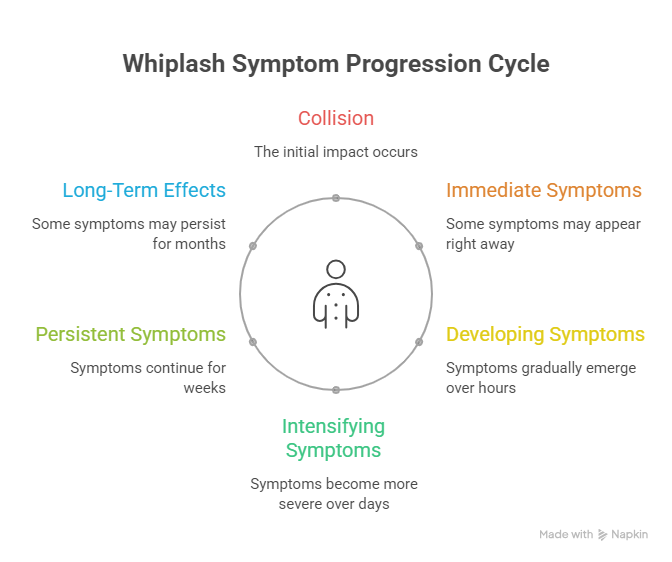
Whiplash symptoms can appear immediately or take up to several days to develop, and in some cases they do not surface for one to two weeks. This delay happens because adrenaline from the crash masks pain, and inflammation in the neck muscles builds up gradually.
Common whiplash symptoms after car accident cases include:
- Neck pain and stiffness
- Headaches, often starting at the base of the skull
- Dizziness or blurred vision
- Tinnitus (ringing in the ears)
- Numbness and tingling in the arms or hands
- Difficulty swallowing or hoarseness
- Fatigue and sleep disturbances
Delayed whiplash symptoms are common enough that many physicians recommend a follow-up exam five to seven days after any collision, even if the person felt fine at the scene. A driver who feels only mild soreness on day one may find their neck almost locked in place by day four. This gap between the accident date and the symptom date is exactly why insurance adjusters sometimes question a claim, and exactly why documenting the timeline matters from the start.
Some symptoms take even longer to connect back to the crash. Sleep disturbances, fatigue, and jaw pain are often dismissed as stress or unrelated health issues, especially when they show up two or three weeks after the accident. Writing down the date each new symptom starts, even in a simple phone note, creates a record that links the symptom back to the collision instead of leaving it open to question later.
When Does Whiplash Cross the Line From Minor to Serious Under Ontario Law?
Whiplash crosses from minor to serious under Ontario law when it moves past WAD Grade II, when pain becomes chronic, or when it comes with a complicating factor like a pre-existing condition or a second injury. Below that line, Ontario’s Statutory Accident Benefits Schedule (SABS) treats the injury as “minor,” and the Minor Injury Guideline (MIG) caps medical and rehabilitation funding at $3,500 total.
That cap covers physiotherapy, chiropractic care, massage therapy, and related treatment combined. For many whiplash cases, $3,500 runs out long before recovery is complete.
A claim can move outside the MIG when medical evidence shows:
- A pre-existing condition that slows recovery
- Chronic or disabling pain that does not resolve within the expected window
- Neurological symptoms, such as nerve or sensory deficits
- A second injury, such as a concussion or fracture, alongside the whiplash
This is the point where when to see a lawyer for whiplash becomes a real question rather than a theoretical one. If your treatment provider suggests your recovery is taking longer than expected, that note in your file can be the difference between a $3,500 ceiling and full access to the treatment you actually need.
Accident Benefits vs. Tort Claims : What Is the Difference for Whiplash Victims?
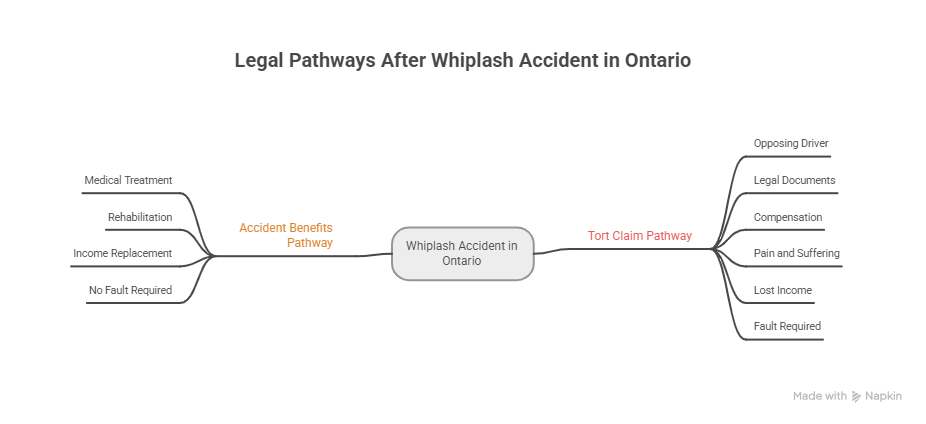
The difference is fault and source of payment: accident benefits come from your own insurer on a no-fault basis, while a tort claim is a lawsuit against the at-fault driver for damages the no-fault system does not cover. Most whiplash victims qualify for both at the same time. Accident benefits under SABS pay out no matter who caused the crash. A tort claim adds full pain and suffering damages above the statutory deductible, but only if you can prove the other driver was at fault.
| Feature | Accident Benefits (SABS) | Tort Claim |
| Fault required? | No | Yes, must prove the other driver was at fault |
| Who pays | Your own insurer | The at-fault driver’s insurer |
| Covers | Medical costs, income replacement | Pain and suffering, lost income beyond benefits |
| Deadline | Strict internal timelines, often 30 to 104 days | Two years under the Limitations Act |
Many accident victims only file for accident benefits and never realize a soft tissue injury claim car accident case might also support a separate tort claim, especially if the whiplash developed into chronic pain. A car accident neck injury lawyer typically reviews both paths at the same time, since missing the deadline on either one closes a door permanently.
If your insurer denies or reduces your accident benefits, for example by placing your whiplash claim in the Minor Injury Guideline against medical advice, you can dispute that decision through the Licence Appeal Tribunal’s Automobile Accident Benefits Service (LAT-AABS), the government tribunal set up to resolve exactly this type of disagreement. If you are already facing that kind of pushback, our guide on what to do when accident benefits are delayed or denied in Ontario walks through the appeal process step by step. A tort claim large enough to go beyond Small Claims Court is filed with the Ontario Superior Court of Justice at the Brampton courthouse, 7755 Hurontario Street, which serves all of Peel Region, including Mississauga.
If you are still deciding whether the gap between what your insurer covers and what your recovery actually costs is worth pursuing further, Maana Law offers a free case review to walk through both options with you.
Why Do Insurance Companies Push Early Settlements for Whiplash Claims?
Insurance companies offer quick settlements for whiplash claims because early offers are almost always lower than what the injury is worth. Adjusters know that whiplash symptoms often worsen over the following weeks, and once you sign a release, you cannot go back and ask for more money later, even if new symptoms appear.
An adjuster may call within days of the crash, sound friendly, and offer a number that feels like a relief. That offer is usually calculated before your full recovery timeline is known. Delayed whiplash symptoms are the biggest risk here: chronic neck pain, nerve issues, or a WAD grade upgrade can surface weeks after a settlement is signed, and by then the file is closed.
A basic rule protects you here: never accept or sign anything from an insurance company before a doctor has confirmed you have reached maximum medical recovery, or before a lawyer has reviewed the offer.
What Are the Warning Signs Your Whiplash Injury Is More Serious Than It Seems?
Whiplash shifts from a minor injury to a serious one when pain becomes chronic, spreads to new areas, or comes with neurological symptoms. Watch for these red flags:
- Neck pain lasting longer than three months
- Numbness, tingling, or weakness spreading into the arms or hands
- Chronic headaches that did not exist before the crash
- Dizziness, blurred vision, or tinnitus that persists
- Difficulty concentrating, memory issues, or mood changes
- Pain that worsens instead of improving with physiotherapy
Several of these red flags, headaches, dizziness, and trouble concentrating, also show up after a head injury. If you struck your head during the crash as well, it is worth reading our guide on concussion after a car accident in Ontario, since a concussion is assessed and claimed differently from whiplash even when both happen in the same collision.
Chronic pain and nerve-related symptoms often point toward cervical spondylosis or spinal canal narrowing, both of which are far more serious than a standard soft tissue strain. If your physiotherapist or chiropractor flags a plateau in your progress, or your GP orders an MRI after weeks of no improvement, treat that as a signal to get a legal opinion, not just a medical one.
How Do Doctors Treat Whiplash and How Long Does Recovery Take?
Doctors treat whiplash with a combination of rest, physiotherapy, and gradual movement, and most mild cases improve within six to twelve weeks. Treatment usually starts conservative and builds up only if symptoms stick around.
A typical care plan includes:
- Physiotherapy, focused on restoring range of motion in the neck and shoulders
- Chiropractic care, including spinal adjustment to reduce stiffness and improve mobility
- Soft tissue therapy, such as massage, to ease muscle tension around the cervical spine
- Rehabilitation exercises, often continued at home between clinic visits
- Pain management, ranging from over-the-counter medication to prescribed muscle relaxants for more severe strain
Range-of-motion testing at each visit helps a doctor or physiotherapist track whether the neck is improving on schedule. A WAD I injury that has not improved after six weeks of consistent physiotherapy is a signal worth flagging to both your doctor and your lawyer, since it may point toward a longer recovery than the Minor Injury Guideline was designed to cover. Some patients with WAD III or IV injuries, or with cervical spondylosis, deal with symptoms for a year or more, and a small number never fully return to their pre-accident baseline.
What Evidence Do You Need to Prove a Whiplash Injury Claim?
A strong whiplash claim needs consistent medical documentation from the day of the accident through your full recovery. Because whiplash rarely shows up on an X-ray or CT scan, your paper trail becomes the main proof of the injury and its impact on your life.
Key documentation includes:
- Emergency room or walk-in clinic records from the day of the crash
- Family doctor notes tracking your symptoms over time
- Physiotherapy or chiropractic care records, including range-of-motion testing results
- Diagnostic imaging, such as X-ray, MRI, or CT scan reports, even if they come back clear
- A journal of symptoms, missed work, and daily activities you can no longer do normally
Gaps in treatment hurt a claim more than people expect. If you stop physiotherapy for six weeks because of work or cost, an insurance adjuster may argue the injury healed and the pain returned for an unrelated reason. Keeping appointments consistent, even brief check-ins, keeps that argument off the table.
Local examples show why this matters. Maana Law has documented a case involving a rear-end collision on Erin Mills Parkway in Mississauga, where a shoulder and soft tissue injury claim reached roughly $55,000 once medical costs, lost wages, and ongoing therapy were fully accounted for. Claims like this rarely start at that number. They grow as documentation builds.
How Long Do You Have to File a Whiplash Claim in Ontario?
Under Ontario’s Limitations Act, you generally have two years from the date of the car accident to start a lawsuit for your whiplash injury. This clock usually starts on the accident date, but it can start later if you did not know, and could not reasonably have known, that you had a compensable injury.
Accident benefits claims run on a much shorter internal clock. Notice requirements and application deadlines with your own insurer can fall within 30 to 104 days of the crash, well before the two-year mark most people associate with car accident claims. Missing these earlier deadlines can limit what your own insurer is required to cover, even while your tort claim deadline is still open.
Evidence fades fast. Witnesses forget details, surveillance footage gets deleted, and vehicle damage gets repaired. Waiting even a few months to sort out documentation can weaken a claim that would have been strong if handled earlier.
When Should You Contact a Lawyer for Whiplash After a Car Accident?
You should contact a lawyer as soon as your whiplash symptoms have not resolved within the first two to three weeks, or immediately if you notice any red flag symptoms like numbness or chronic pain. Here is a simple timeline:
- First week: Get checked by a doctor, even if you feel fine. Start a symptom journal.
- First month: If pain, stiffness, or headaches persist past three to four weeks, book a consultation with a whiplash injury lawyer. This is also when insurance adjusters typically start calling with early offers.
- After a diagnosis change: If your doctor upgrades your WAD grade, orders an MRI, or flags chronic pain, contact a lawyer immediately. This shifts your claim outside the Minor Injury Guideline and changes what you are owed.
There is no cost barrier to getting this advice early. Most personal injury lawyers, including Maana Law, work on a No Win, No Fee basis, so you pay nothing upfront and nothing at all unless your claim succeeds. A free consultation at this stage costs you nothing and can prevent a rushed settlement that leaves real money on the table.
A free, no-pressure conversation with Maana Law will tell you exactly where you stand.
Why Maana Law Is the Right Choice for Your Whiplash Injury Claim
Maana Law has spent over ten years helping accident victims across Mississauga secure fair compensation for injuries insurers try to downplay, including whiplash and other soft tissue injuries. The team knows how these claims get minimized, and how to push back with real medical documentation and legal pressure.
- No Win, No Fee representation You pay nothing upfront, and nothing at all unless we win your case.
- Free consultations, including home and hospital visits If travel is hard because of your injury, we come to you, virtually or in person.
- Direct guidance from Aman Kalra Our lead lawyer speaks with clients personally, in English or Hindi, so nothing gets lost in translation.
- Experience with soft tissue and chronic pain claims specifically We understand how MIG caps, WAD grades, and delayed symptoms affect what a whiplash claim is actually worth.
- Local knowledge of Mississauga and the surrounding area From Erin Mills to Meadowvale, we know the insurers and the process clients in our community face.
Clients come to us confused about paperwork, deadlines, and lowball offers. We leave them with a clear plan and someone fighting for the full value of their claim.
Frequently Asked Questions
What is a reasonable settlement for whiplash?
A reasonable whiplash settlement typically falls between $5,000 and $10,000 for mild cases, and well into six figures for cases involving chronic pain or nerve symptoms. The exact number depends on the WAD grade, how long symptoms last, and how much treatment and income you lost. A lawyer can estimate a fair range once your medical records and recovery timeline are clear.
How hard is it to prove whiplash?
Whiplash is harder to prove than a broken bone because it often does not appear on X-rays, MRIs, or CT scans. Consistent medical records, physiotherapy notes, and a documented symptom timeline are what make a claim credible to an insurer or a court.
What is the average settlement payout for whiplash injury in Canada?
Ontario whiplash and soft tissue injury settlements commonly range from $15,000 to over $100,000 for more serious or chronic cases, though payouts vary by province and injury severity. A statutory deductible applies to smaller pain and suffering awards, which a lawyer factors into the real value of your claim.
Is it worth claiming for whiplash?
Yes, if your whiplash affected your daily life, work, or required ongoing treatment. Even claims that start as “minor” under the MIG can be worth pursuing if symptoms persist, since medical costs and lost income add up quickly once the $3,500 treatment cap is reached.
How long does it take to get compensation for whiplash?
Accident benefits payments can start within weeks of a properly filed claim, while a full tort settlement or court award for whiplash usually takes several months to a few years, depending on how long your recovery takes and whether the case settles or goes to trial.
Conclusion
Whiplash rarely announces itself the day of the crash, and that quiet start is exactly why so many people underestimate it. Understanding the gap between minor and serious injury, knowing your two-year filing deadline, and recognizing when insurance offers move too fast all protect the same thing: your right to full compensation.
Three things matter most from everything above. Whiplash symptoms can take days or weeks to appear, so a clean bill from day one does not mean you are in the clear. Ontario’s Minor Injury Guideline caps treatment funding at $3,500, which often runs out before real recovery does. And once you sign a settlement, new or worsening symptoms will not reopen your case.
Acting early protects evidence, protects your treatment funding, and protects your legal options while they are still open. Maana Law, located at 90 Matheson Blvd W Suite 101, Mississauga, ON, offers a free consultation with No Win, No Fee representation for whiplash and other car accident injury claims. Call today to book your free case review, in person, virtually, or at home if travel is difficult.
References
- MacGillivray Injury & Insurance Law, “Whiplash,” https://macgillivraylaw.com/suing-after-a-car-accident/whiplash
- Auger Hollingsworth, “What You Should Know About Whiplash,” https://ahinjurylaw.com/what-you-should-know-about-whiplash-ottawa-lawyer/
- Richmond Steveston Physiotherapy & Sports Injury Clinic, “Managing Whiplash Injuries After a Car Accident,” https://physiosteveston.ca/managing-whiplash-injuries-after-a-car-accident-how-chiropractic-care-can-help/
- HIMPRO, “What Is the Average Payout for Soft Tissue Injury?” https://himpro.ca/what-is-the-average-payout-for-soft-tissue-injury/
- Peel Regional Police, “Statistical Report Five-Year Summary (2020-2024),” https://www.peelpolice.ca/media/fqworbtk/statistical-report-five-year-summary-2020-2024.pdf
- Ontario Superior Court of Justice, “Brampton Courthouse,” https://www.ontariocourts.ca/scj/locations/brampton/
- Tribunals Ontario, “Licence Appeal Tribunal – Automobile Accident Benefits Service (LAT-AABS),” https://tribunalsontario.ca/lat-aabs/