
The Statutory Accident Benefits Schedule Ontario system pays for medical care and lost income after a car accident, no matter who caused the crash. That single fact confuses more accident victims than almost anything else in Ontario’s insurance system, because “no-fault” does not mean “automatic” or “full coverage.” Maana Law has guided accident victims across Mississauga through SABS applications that felt simple at first and turned complicated the moment a benefit got capped or denied.
Peel Region saw 42,733 vehicle collisions in 2024, with personal injury collisions climbing to 1,751, an 8.4% increase over the year before. Every one of those injured drivers and passengers had to deal with SABS in some form.
Here is what this guide covers:
- What SABS is and where the rules come from
- How the no-fault system works and what it actually pays for
- Every benefit category available, with current dollar amounts
- The Minor Injury Guideline and why it caps so many claims
- Why claims get denied, and what forms actually matter
- The difference between SABS and a tort claim, and the deadlines for both
Let Maana Law check your file against every category you might be entitled to.
What Is the Statutory Accident Benefits Schedule Ontario?
The Statutory Accident Benefits Schedule (SABS) is a regulation under Ontario’s Insurance Act that sets out the minimum accident benefits every auto insurance policy in the province must provide after a car accident. The current version is Ontario Regulation 34/10, and it applies to every driver, passenger, cyclist, and pedestrian injured by a motor vehicle in Ontario.
SABS covers medical treatment, income loss, and daily living support, funded through your own auto insurer rather than the driver who caused the crash. The Financial Services Regulatory Authority of Ontario (FSRA) regulates how insurers apply the schedule and reviews the treatment rates providers can charge under it.
Because SABS is a regulation, not a suggestion, insurers cannot pay less than what it sets out, though many policies include optional add-ons above the mandatory minimums.
How Does the No-Fault Benefits System Work After a Car Accident?
Ontario’s no-fault system means you claim accident benefits Ontario car accident support from your own insurer regardless of who caused the collision. You do not need to prove the other driver was careless to receive medical and income benefits. Your insurer pays first, then may seek reimbursement from the at-fault driver’s insurer separately, a process that happens behind the scenes and does not affect your benefits.
This structure exists so injured people get medical and income support fast, without waiting for a fault investigation or lawsuit to finish. If you were a passenger, cyclist, or pedestrian and do not have your own auto policy, you can generally claim through the vehicle that struck you, or through the Motor Vehicle Accident Claims Fund if no insurance applies at all.
No-fault benefits Ontario car accident claims run alongside any tort lawsuit you might file later. The two systems serve different purposes, which the sections below explain in full.
Every standard Ontario auto insurance policy must include SABS coverage at the mandatory minimum levels set out in the regulation. Insurers can sell optional enhanced benefits on top of that floor, such as a higher weekly income replacement cap or extended attendant care, but they cannot sell a policy that pays less than the mandatory schedule requires. Reading your own policy’s declaration page, not just the regulation, is the only way to know whether you carry optional coverage above the minimum.
Types of Benefits Available Under Ontario’s SABS
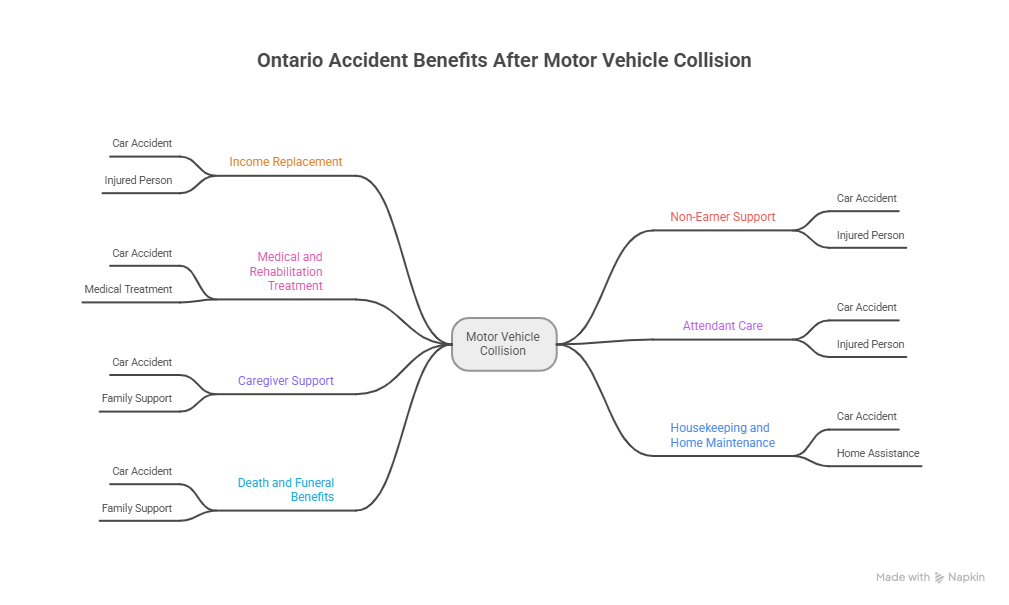
SABS provides seven main benefit categories, each with its own dollar limits and eligibility rules, so what accident benefits Ontario actually cover depends heavily on which category applies to your injury. The table below shows the standard mandatory amounts under current policies.
| Benefit | Standard Amount | Key Condition |
| Income Replacement Benefit (IRB) | 70% of gross income, up to $400 per week | Must be substantially unable to work |
| Non-Earner Benefit (NEB) | $185 per week | For those not employed; 4-week waiting period |
| Medical and Rehabilitation Benefit | $65,000 (non-catastrophic) / $1,000,000 (catastrophic) | Combined with attendant care under most current policies |
| Attendant Care Benefit | Up to $3,000/month (non-catastrophic) / $6,000/month (catastrophic) | Personal support worker or family caregiver costs |
| Caregiver Benefit | $250/week for one dependent, plus $50/week per extra dependent | Generally requires catastrophic impairment |
| Housekeeping and Home Maintenance Benefit | $100 per week | Catastrophic claims, or by optional coverage |
| Death and Funeral Benefit | $25,000 (spouse), $10,000 (per dependent), up to $6,000 (funeral) | Paid to surviving family |
The Income Replacement Benefit (IRB) and Non-Earner Benefit cannot both be claimed. This is called an Election of Benefits, and you generally choose whichever pays more based on your work status at the time of the crash.
What Is the Minor Injury Guideline and Why Does It Cap So Many Claims?
The Minor Injury Guideline (MIG) is the rule that caps medical and rehabilitation funding at $3,500 total for injuries insurers classify as minor, and it affects more SABS claims than any other single provision in the schedule. Of that $3,500, up to $2,200 can be used on pre-approved treatment without needing insurer sign-off, and the remaining $1,300 requires a separate approval request.
Minor injury under the regulation means a sprain, strain, whiplash-associated disorder, contusion, abrasion, laceration, or subluxation, plus any clinically associated symptoms. No attendant care benefits are available inside the MIG, which is a major gap for anyone who needs help at home during recovery.
Notice that a concussion is not on that list. If your crash left you with a head injury alongside a whiplash-associated disorder or other soft tissue injury, your claim likely does not belong inside the MIG at all, our guide on concussion after a car accident in Ontario explains how that diagnosis is assessed and claimed.
A claim moves outside the MIG when medical evidence shows a pre-existing condition that slows recovery, chronic pain, a psychological impairment, or functional limitations that go beyond what the guideline was designed to cover. This is also the point where SABS benefits alone often stop being enough, which the later sections of this guide explain in more detail.
If your treatment provider believes your recovery does not fit inside the $3,500 MIG cap, Maana Law can review your file and help build the medical case to move it out.
Maana Law tracks every SABS and LAT deadline for you, so nothing slips through unnoticed.
Why Do SABS Claims Get Denied or Cut Off Early?
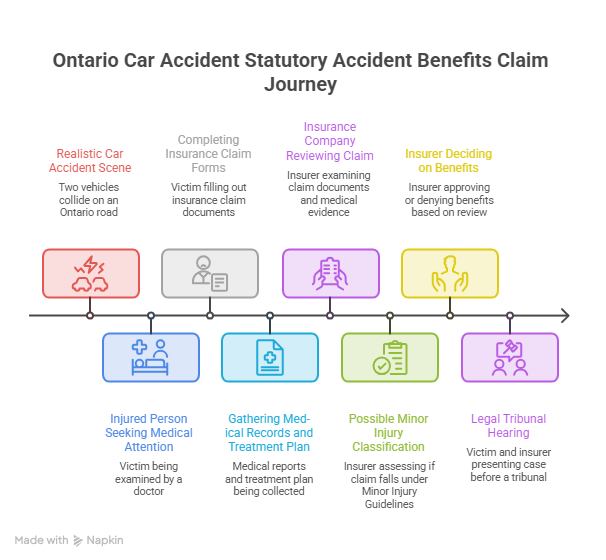
SABS claims get denied or cut off most often because of missing paperwork, a Minor Injury Guideline classification the medical evidence does not support, or a disagreement between your doctor and the insurer’s own examiner. Three documents drive nearly every dispute:
- OCF-1 (Application for Accident Benefits): Starts your claim. The 30-day filing clock only begins once your insurer actually gives you this form, a point confirmed in the Nichols v. Gore Mutual decision.
- OCF-3 (Disability Certificate): Your doctor’s assessment of how the injury limits your daily function. Vague or incomplete answers here are a common reason for a MIG classification that undersells the injury.
- OCF-18 (Treatment Plan): Requests approval for specific treatment. Insurers deny or delay these constantly, and every denial should come with written reasons you can challenge.
If you are already facing a denial or an unexplained delay on any of these forms, our guide on what to do when accident benefits are delayed or denied in Ontario walks through the next steps.
Two earlier steps set up everything that follows. Your Notice of Loss tells the insurer a claim is coming and should go in as soon as possible after the crash. If you were employed, your employer completes an OCF-2 (Employer’s Confirmation Form) to confirm your income and job duties, which directly feeds into your income replacement calculation. A missing or delayed OCF-2 is a common, avoidable reason an insurer stalls an income replacement claim for weeks.
Under Section 33 of the Schedule, your insurer can request information reasonably needed to assess your claim, and you generally have 10 business days to respond. Failing to respond can pause your benefits, but it does not block you from later disputing the decision. If your insurer’s examination (IE) produces a report that contradicts your own doctor’s findings, that conflict does not automatically end your claim. It usually means the dispute is headed toward the Licence Appeal Tribunal, covered next.
Recent Licence Appeal Tribunal decisions show how strictly this deadline gets enforced. In TD General Insurance Co. v. Welder, decided in 2026, a claimant who filed his dispute about 28 months after TD’s denial letter lost his case entirely, even though his request involved standard psychological and chiropractic treatment costs. A similar result followed in a 2026 Co-operators decision, where a claimant missed the two-year window by just 45 days and still received no extension. Both cases turned on the same point: a clear, properly worded denial letter starts the clock immediately, regardless of ongoing talks with the insurer.
SABS vs. Tort Claim: How the Two Work Together
SABS and a tort claim work together as two separate sources of compensation: SABS pays no-fault medical and income benefits through your own insurer, while a third-party liability claim (tort claim) lets you sue the at-fault driver for damages SABS does not cover, including pain and suffering. Most people are entitled to pursue both after a car accident.
There is a catch. Under collateral benefits deduction rules, any SABS payments you already received get subtracted from a tort settlement or award, so the two systems do not pay you twice for the same loss. For 2026, Ontario’s statutory threshold and deductible for pain and suffering damages, set by FSRA and indexed to inflation, are:
| Figure | 2026 Amount |
| Statutory threshold | $159,708.71 |
| General damages deductible | $47,913.01 |
| Family Law Act damages deductible | $23,956.52 |
If your pain and suffering award falls below the threshold, the deductible applies in full and can significantly reduce, or even eliminate, your net payout. A tort claim generally must be filed within two years of the accident under Ontario’s Limitations Act, and it is filed with the Ontario Superior Court of Justice, which for Mississauga and the rest of Peel Region sits at the Brampton courthouse.
What Are Ontario’s 2026 Changes to Accident Benefits?
Starting July 1, 2026, Ontario is restructuring SABS so that most benefits become optional, while only the Medical and Rehabilitation Benefit and the Attendant Care Benefit stay mandatory, according to a Law Times report on the new rules. The change applies to auto insurance policies entered into or renewed on or after that date.
Under the restructured rules, the two mandatory benefits carry their own separate caps rather than sharing one combined pool:
- Medical and Rehabilitation: $3,500 for minor injuries, $65,000 over 260 weeks for non-catastrophic injuries, $1,000,000 for catastrophic injuries
- Attendant Care: $65,000 over 260 weeks for non-catastrophic injuries, $1,000,000 for catastrophic injuries
Optional benefits, including the Non-Earner Benefit, Caregiver Benefit, and Housekeeping and Home Maintenance Benefit, will only be available to the named insured, their spouse, dependents, and drivers listed on the policy, and only if purchased. Anyone renewing a policy close to this date should check exactly what coverage they are keeping or losing.
When Are SABS Benefits Alone Not Enough?
SABS benefits alone are usually not enough when your medical costs, lost income, or ongoing care needs exceed what the mandatory caps provide, which happens often once an injury moves outside the Minor Injury Guideline. A $65,000 combined medical and attendant care cap sounds substantial until you factor in months of physiotherapy, home support, and specialist visits after a serious soft tissue or catastrophic impairment injury.
Watch for these signs your SABS benefits will not cover the full cost of recovery:
- Your treatment plan (OCF-18) requests exceed what is left in your MIG or standard benefit pool
- You cannot return to your pre-accident job, even after your income replacement benefit runs out at 104 weeks
- You need attendant care beyond what the monthly cap provides
- Your injury may qualify for a Catastrophic Impairment Designation, which raises your caps but requires a formal medical assessment
A Catastrophic Impairment Designation is what raises your benefits to the higher $1,000,000 caps described earlier. Ontario recognizes eight qualifying categories, including paraplegia or tetraplegia, severe mobility impairment or amputation, bilateral vision loss, a traumatic brain injury confirmed by imaging, and a whole person impairment rating of 55% or more under the AMA Guides. Getting this designation usually requires an OCF-19 application supported by specialist reports, and insurers frequently push back on it even when the medical evidence is strong.
Any of these situations point toward pursuing a tort claim alongside your SABS benefits, not instead of them.
Why a Lawyer Helps Even in a No-Fault SABS Claim
A lawyer helps in a no-fault claim because insurers make classification, denial, and cutoff decisions that directly affect how much you receive, and those decisions can be appealed with the right evidence. Disputing a denied or reduced benefit means filing an application with the Licence Appeal Tribunal (LAT), generally within two years of a clear written denial. Missing that window, or accepting a vague denial letter without challenging it, can close the door permanently.
A lawyer working under a contingency fee agreement reviews your OCF-3 and OCF-18 forms before they go to the insurer, pushes back on unsupported MIG classifications, and coordinates your SABS claim with any tort claim running in parallel so nothing gets missed on either deadline.
The numbers show why this matters. The Licence Appeal Tribunal received more than 16,000 applications in 2023-24, and over 96% involved accident benefits disputes like these. Tribunal data reviewed by Tribunal Watch Ontario shows claimant success rates falling from 33% in 2017 to just 10% in 2023, while insurer success rose from 56% to 71% over the same period. A weak or late-filed dispute is far less likely to succeed today than it was a few years ago, which is exactly why the paperwork and deadlines above deserve attention from the start, not just after a denial arrives.
Free consultation with Maana Law before a small paperwork issue becomes a denied benefit.
Why Maana Law Is the Right Choice for Your SABS Claim
Maana Law has spent over ten years helping Mississauga accident victims get the full accident benefits they are entitled to, not just what an insurer initially offers. We know where SABS claims typically break down, and we act before small paperwork issues turn into denied benefits.
- No Win, No Fee representation You pay nothing upfront, and nothing at all unless we recover compensation for you.
- Direct review of your OCF forms We check your OCF-1, OCF-3, and OCF-18 submissions before problems become denials.
- Experience disputing MIG classifications We know what medical evidence moves a claim outside the $3,500 cap.
- Coordinated SABS and tort strategy We track both deadlines so you never lose a benefit or a claim by missing a date.
- Free consultations, including home and hospital visits Aman Kalra and our team meet clients wherever recovery makes travel difficult.
- Local knowledge across Mississauga From Erin Mills and Cooksville to Churchill Meadows, Meadowvale, and City Centre, we understand the insurers and claim patterns our neighbours face.
Clients come to us after an insurer has already said no. We give them a clear path to say it again, correctly.
Frequently Asked Questions
What is Section 33 of the Statutory Accident Benefits Schedule?
Section 33 gives your insurer the right to request information and documents reasonably needed to decide your benefit entitlement, and you generally have 10 business days to respond. Ignoring the request can pause your benefits, but a reasonable explanation for a delay can restore them, and non-compliance does not stop you from applying to the LAT.
What do accident benefits cover in Ontario?
Accident benefits in Ontario cover medical and rehabilitation treatment, income replacement, attendant care, caregiver costs, housekeeping and home maintenance, and death and funeral expenses after a car accident. Coverage amounts depend on whether your injury is classified as minor, non-catastrophic, or catastrophic.
How much compensation do you get for a car accident in Ontario?
Compensation ranges from $3,500 for a minor injury under the MIG to $1,000,000 or more in combined SABS and tort compensation for a catastrophic injury, depending on which benefits and claims apply. SABS pays according to fixed caps, while a tort claim adds pain and suffering damages above the 2026 statutory threshold of $159,708.71, minus any SABS benefits already received.
How long do I have to apply for SABS benefits after an accident?
You should submit your OCF-1 application as soon as your insurer provides the form, since the 30-day filing clock starts on the date you receive it, not the date of the accident. Waiting too long to request the form or gather supporting medical documents can delay your benefits.
Do I need a lawyer to apply for SABS benefits?
You do not need a lawyer to submit an initial SABS application, but a lawyer becomes valuable the moment a benefit is denied, capped under the MIG against medical advice, or disputed by an insurer’s examination. Reviewing your file early can prevent a small paperwork problem from becoming a denied claim.
Conclusion
SABS exists to get injured drivers, passengers, cyclists, and pedestrians medical and income support quickly, without waiting on a fault investigation. That speed comes with tradeoffs: fixed caps, a Minor Injury Guideline that limits many claims to $3,500, and strict deadlines that do not bend for confusion or delay.
Three things matter most from everything above. The benefit amounts are fixed by regulation, not negotiable case by case, so knowing your category matters as much as knowing your injury. The Minor Injury Guideline cap runs out fast for anyone with a real recovery timeline. And once an insurer issues a clear written denial, your two-year window to dispute it at the LAT starts immediately.
Acting early protects your benefits while your options are still open. Maana Law, located at 90 Matheson Blvd W Suite 101, Mississauga, ON, offers a free consultation with No Win, No Fee representation for SABS applications, denied claims, and combined SABS and tort cases. Call today to review your file before a deadline or a denial limits what you can recover.
References
- Financial Services Regulatory Authority of Ontario, “SABS Guidelines Review Consultation Paper,” https://www.fsrao.ca/media/26151/download
- Law Times, “Statutory Accident Benefits Schedule: New Rules for 2026,” https://www.lawtimesnews.com/practice-areas/personal-injury/statutory-accident-benefits-schedule-new-rules-for-2026/393262
- Ontario Trial Lawyers Association Blog, “Section 33 of the Schedule,” https://otlablog.com/section-33-of-the-schedule-when-is-the-production-request-reasonably-required/
- Peel Regional Police, “Statistical Report Five-Year Summary (2020-2024),” https://www.peelpolice.ca/media/fqworbtk/statistical-report-five-year-summary-2020-2024.pdf
- Ontario Superior Court of Justice, “Brampton Courthouse,” https://www.ontariocourts.ca/scj/locations/brampton/
- Tribunals Ontario, “Licence Appeal Tribunal – Automobile Accident Benefits Service (LAT-AABS),” https://tribunalsontario.ca/lat-aabs/
- Insurance Business Canada, “TD Defeats Late Accident-Benefits Claim on Limitation Period, Minor Injury Guideline,” https://www.insurancebusinessmag.com/ca/news/legal-insights/td-defeats-late-accidentbenefits-claim-on-limitation-period-minor-injury-guideline-584370.aspx
- Tribunal Watch Ontario, “Auto Accident Benefits Adjudication: Backlog Reduction but Troubling Trends,” https://tribunalwatch.ca/2025/auto-accident-benefits-adjudication-backlog-reduction-but-troubling-trends/