If you were seriously hurt in a truck accident, your first question is probably: what is my case worth?
There is no single average truck accident settlement in Ontario. Serious cases range from moderate five-figure amounts for injuries with full recovery to over one million dollars for catastrophic impairment or fatal accidents. Where your claim lands depends on injury severity, fault, insurance coverage, and how many people are claiming from the same accident. Consulting an experienced truck accident lawyer in Mississauga early is the single most important step toward protecting the full value of your claim.
Ontario’s compensation system has two parallel streams accident benefits and a tort claim against the at-fault party and both can run at the same time. The full value of a truck accident claim is almost always larger than it first appears, especially when you account for future care costs, lost income, and the rights of surviving family members. For a broader foundation, our guide on What to Do After a Truck Accident in Ontario explains the legal framework that governs truck accident claims in this province.
By the end of this article, you will understand:
- Why truck accident settlements are structurally higher than standard car accident claims
- How injury severity, age, and occupation affect your claim’s value
- What Ontario’s Statutory Accident Benefits Schedule covers and where it falls short
- What the catastrophic impairment designation means for your benefits and tort claim
- The time limits that apply to every part of your case
What Settlement Ranges Can Truck Accident Victims Expect in Ontario?
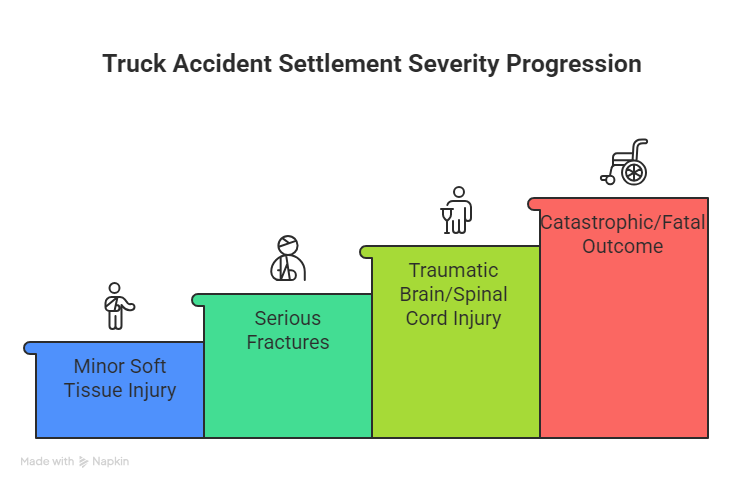
A single average figure is misleading. A handful of catastrophic cases settling in the millions skews any reported average far above what most claimants recover. A tiered breakdown by injury severity gives a more honest picture.
| Injury Category | Typical Settlement Range | Key Value Driver |
|---|---|---|
| Soft tissue, full recovery | $30,000 – $100,000 | Speed of recovery; limited future care needs |
| Serious fractures, multiple injuries | $100,000 – $400,000 | Permanence of impairment; ongoing rehab; lost wages |
| Traumatic brain injury or spinal cord injury | $400,000 – $1,500,000+ | Long-term care needs; earning capacity loss |
| Catastrophic impairment under SABS | $1,000,000 – $3,000,000+ | Maximum SABS entitlement; full future care costing |
| Fatal accident with Family Law Act claimants | Varies widely | Estate claim plus individual FLA claims for each dependent |
These ranges reflect the tort component only. They do not include accident benefits received separately under the Statutory Accident Benefits Schedule (SABS).
Why Are Truck Accident Claims Higher Than Standard Car Accident Claims?
Truck accident settlements are structurally higher for two reasons: the injuries tend to be more severe, and more insurance money is available. To understand how these figures compare with ordinary vehicle claims, our article on how much a car accident settlement is worth in Ontario provides a useful baseline.
A loaded commercial truck can weigh 40 times a passenger vehicle. The forces involved routinely produce traumatic brain injuries, spinal fractures, amputations, and crush injuries that a standard car collision rarely generates.
On the insurance side, commercial carriers in Ontario must carry third-party liability coverage at substantially higher minimums than the $200,000 minimum required for private vehicles under the Ontario Highway Traffic Act. Most large trucking companies carry combined single-limit policies ranging from $5,000,000 to $20,000,000. The money to pay a large settlement is typically available. The challenge is proving liability and fully building the claim.
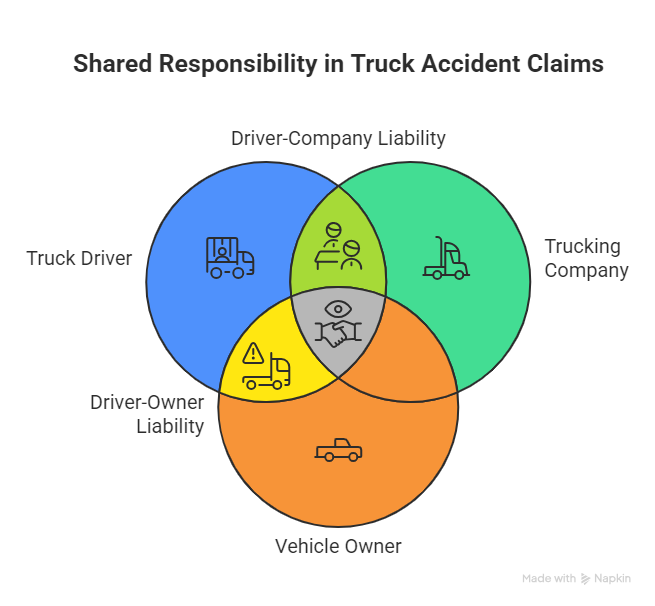
Multiple defendants are also in play: the driver, the trucking company, the vehicle owner, the broker, and the shipper may each carry separate liability and separate insurance. That structure rarely exists in a standard two-car collision. You can review the national framework for commercial carrier safety at the Canadian Council of Motor Transport Administrators.
What Factors Determine the Value of a Truck Accident Claim?
Settlement value is not a formula. Courts and insurers apply specific factors to each case, which is why two people with similar injuries can have very different outcomes.
Injury Severity and Permanent Consequences
The strongest driver of settlement value is how permanently the injury affects your life. A fracture that heals completely is worth far less than one producing chronic pain that prevents you from returning to work. Traumatic brain injuries, spinal cord injuries, amputations, and serious burns consistently reach higher settlement tiers because they involve extended rehabilitation, permanent loss of function, and significant future care costs.
Psychological injuries, including post-traumatic stress disorder, are fully compensable in Ontario when properly documented. They should not be treated as secondary to physical injuries. Our overview of hard-to-prove injuries in Ontario explains why PTSD and psychological harm require careful clinical documentation to succeed. Ontario courts have consistently awarded meaningful damages for psychological harm when it is supported by clinical evidence.
Age, Occupation, and Pre-Accident Life
Earning capacity loss is calculated over your remaining working life. A 32-year-old tradesperson who can no longer perform physical work has an economic loss claim worth far more than the same injury sustained by a retired person, even if the pain and suffering damages are comparable.
Pre-accident lifestyle is the baseline for general damages. Someone who was physically active and can no longer participate in those activities has a stronger claim than someone whose pre-accident life was primarily sedentary. Document this with photographs, activity records, and statements from people who knew you before the accident.
Pre-existing conditions do not eliminate your right to compensation. Under the thin skull and crumbling skull doctrines applied in Ontario courts following the Supreme Court of Canada’s decision in Athey v. Leonati [1996] 3 SCR 458, the defendant takes you as they find you. If the accident aggravated a pre-existing condition, you are entitled to compensation for that aggravation.
Special Damages vs. General Damages
Special damages cover quantifiable financial losses: medical expenses, rehabilitation costs, lost wages, future income loss, and future care costs. These are supported by receipts, expert reports, employment records, and actuarial calculations. The more thoroughly documented, the more precisely argued.
General damages cover pain and suffering, emotional distress, and loss of enjoyment of life. The Supreme Court of Canada established a cap on non-pecuniary general damages, currently indexed to approximately $410,000. This cap applies only to general damages, not to the claim as a whole. In catastrophic cases, special damages typically far exceed the general damages component.
Ontario’s Insurance Act also imposes a statutory deductible on non-pecuniary general damages in claims that fall below the serious and permanent impairment threshold. That deductible is currently approximately $41,700. For most serious truck accident claims this deductible does not apply, but your lawyer will assess this carefully in lower-severity cases. You can review the Ontario Insurance Act at the Ontario e-Laws website.
How Does Ontario’s Two-Track Claim System Affect Your Settlement?
Every person injured in an Ontario truck accident has access to two parallel compensation streams. Running both at the same time is almost always the right approach for a seriously injured victim. The motor vehicle accident lawyers at Maana Law are experienced in managing both streams simultaneously to maximise total recovery.
| Feature | Accident Benefits (SABS) | Tort Claim |
|---|---|---|
| Who pays | Your own auto insurer | At-fault party’s insurer |
| What is covered | Income replacement, medical/rehab, attendant care to prescribed limits | All losses not covered by SABS, plus amounts above SABS limits |
| Time to apply | Within 30 days of the accident | Within 2 years under the Limitations Act, 2002 |
If you have questions about how your specific situation fits into this two-track system, Maana Law’s truck accident team in Mississauga offers a free initial consultation with no obligation to retain.

Why Accident Benefits Are Not the Full Picture
SABS benefits are a floor, not a ceiling. The standard income replacement benefit pays 70 percent of your gross weekly income up to $400 per week. For most working Ontarians, that is a fraction of actual income. The standard medical and rehabilitation benefit is $65,000 for non-catastrophic injuries, which can be exhausted quickly by a serious injury requiring ongoing physiotherapy, occupational therapy, or specialist care.
Accident benefits function as a financial bridge while the tort claim, which can take years to fully build is being developed. Settling your accident benefits file prematurely, without legal advice, can permanently waive entitlements you did not know existed.
The Catastrophic Impairment Designation
This is the most important legal threshold in Ontario truck accident law. A finding of catastrophic impairment unlocks dramatically higher SABS benefit entitlements. The medical and rehabilitation benefit ceiling increases from approximately $65,000 to $1,000,000 under the current Statutory Accident Benefits Schedule, Ontario Regulation 34/10 as amended. Higher documented care costs directly increase the future care component of the tort claim as well.
For a detailed look at what qualifies and what compensation is available, read our guides on catastrophic injuries in Mississauga: rights and compensation and catastrophic injury compensation in Ontario.
Injuries that typically meet the catastrophic impairment threshold include severe traumatic brain injury, complete or incomplete spinal cord injuries with significant loss of function, bilateral amputations, and other conditions defined in the Schedule. The designation is not automatic. It requires qualified medical assessment and is routinely disputed by insurers. Timing this designation and selecting the right assessors is a strategic legal decision that can make a significant difference to total recovery.
Who Else Can Be Held Liable Beyond the Truck Driver?
One of the defining features of a commercial truck accident claim is the extended liability chain. This is something that almost never exists in an ordinary two-car collision.
The truck driver carries personal liability if their negligence caused the accident. The trucking company is vicariously liable for its drivers and may also carry independent liability for negligent hiring, inadequate training, or failure to maintain vehicles. The registered vehicle owner, which may be a leasing company rather than the carrier, can carry separate coverage. The freight broker who arranged the shipment and the shipper who loaded the cargo may each face claims if loading errors or cargo securement failures contributed to the accident.
Each of these parties may carry their own insurance policy. Identifying all of them and the coverage available under each policy is one of the most valuable things a truck accident lawyer with commercial trucking litigation experience can do in the early stages of a claim.
What Rights Do Surviving Family Members Have After a Fatal Truck Accident?
A fatal truck accident opens two separate streams of compensation under Ontario law. If you have lost a loved one, our wrongful death lawyers in Mississauga handle both streams in parallel so that no deadline is missed.
The estate of the person who died can claim for losses suffered before death: pain and suffering experienced between the accident and death, loss of income during that period, and care costs incurred. These claims are brought under the Trustee Act, RSO 1990, c T.23.
Surviving family members have their own independent claims under the Family Law Act, RSO 1990, c F.3. Under the Act, a qualifying family member can claim for loss of guidance, care, and companionship. Qualifying family members include spouses, children, grandchildren, parents, grandparents, and siblings of the person who died. Each qualifying family member brings a separate claim. For a full breakdown of how these amounts are calculated, read our article on average wrongful death settlements in Ontario and, if you are ready to act, our step-by-step guide on how to file a wrongful death lawsuit in Ontario.
The combined value of those claims, together with the estate claim, can form a substantial part of the total settlement. Time limits apply separately to each stream, and the deadlines differ depending on the type of claim. Waiting for legal advice is not a safe option when multiple family members have independent rights that could be lost.
Why Maana Law Is the Right Choice After a Truck Accident in Ontario
When a commercial truck accident turns your life upside down, you need a legal team that understands how Ontario’s injury compensation system works and is genuinely committed to getting you the full value of your claim. Maana Law represents seriously injured Ontarians and their families on a plaintiff-side basis, working exclusively for people who have been hurt not for insurers or trucking companies.
| What We Offer | What It Means for You |
|---|---|
| Contingency fee representation: no fee unless we recover compensation | You pay nothing out of pocket to pursue your claim, regardless of how long the case takes |
| Ontario-specific truck accident knowledge across SABS, tort, and Family Law Act claims | Your lawyer understands the two-track claim system and every deadline that applies to your situation |
| Full liability chain investigation covering driver, carrier, owner, broker, and shipper | Every available source of compensation is identified, not just the most obvious one |
| Free initial consultation with no obligation | You can understand your rights and what your claim is worth before you commit to anything |
| Multilingual accessibility | You can discuss your case in the language you think in, which matters when the details are this important |
| Purpose-driven representation that treats you as a person, not a file number | You are kept informed, respected, and supported throughout a process that can take years |
- Maana Law handles plaintiff-side personal injury claims in Ontario with a focus on seriously injured truck accident victims and their families, including cases involving catastrophic impairment, wrongful death, and Family Law Act claims by surviving dependents.
- The firm operates on a contingency fee basis, meaning clients pay nothing unless compensation is recovered.
- Multilingual service and a commitment to accessibility reflect the firm’s purpose-driven approach to client representation.
Frequently Asked Questions
What is the average truck accident settlement amount in Ontario?
There is no fixed average. Serious cases involving permanent disability or brain injury commonly reach six or seven figures. Moderate injuries with full recovery typically settle in the mid five-figure range. Get a case-specific assessment before relying on any published number. For context, you can also review how car accident settlements are valued in Ontario, truck cases typically exceed those figures significantly due to injury severity and available coverage. For a comprehensive overview of how accident benefit entitlements work, the Financial Services Regulatory Authority of Ontario (FSRAO) publishes consumer-facing guidance on accident benefits that is worth reviewing alongside legal advice.
Can I sue the trucking company directly, or only the driver?
You can pursue both. Trucking companies are vicariously liable for their drivers and may also be independently liable for negligent hiring or maintenance failures. They carry far larger insurance policies than individual drivers, so pursuing the company directly increases the compensation available to you. For guidance on when to engage legal representation, our article on when to hire a lawyer after an Ontario accident sets out the key warning signs you should not ignore.
How does my partial fault affect my settlement?
Your damages are reduced by your percentage of fault, but you are not barred from recovering. At 20 percent fault, you recover 80 percent of total damages. Insurers routinely argue inflated fault percentages as a negotiation tactic, which is one more reason legal representation matters from the start.
How long does a truck accident claim take to settle in Ontario?
Most serious claims take two to five years. Settling early almost always produces a lower recovery than a fully developed claim where future care costs and income loss have been properly calculated and documented. Transport Canada’s commercial vehicle safety standards and inspection records searchable through Transport Canada’s commercial vehicles portal can form part of the liability evidence in longer-running claims.
What happens if the victim died in the truck accident?
Two streams open. The estate can claim for pre-death losses under the Trustee Act. Surviving family members: spouses, children, grandchildren, parents, grandparents, and siblings can pursue their own claims under the Family Law Act for loss of care, guidance, and companionship. Together, these can form a significant portion of the total settlement value. See our full article on wrongful death settlement averages in Ontario for typical ranges across both streams.
Conclusion
Ontario truck accident settlements range from five figures for injuries with full recovery to seven figures for catastrophic impairment or fatal cases. Injury severity, future care needs, and income loss are the primary drivers of total value.
Ontario’s two-track system, the extended liability chain beyond the driver, and the independent rights of surviving family members mean the full value of a claim is almost always larger than it first appears. Time limits are strict. The 30-day SABS application window, the two-year tort limitation under the Limitations Act, 2002, and separate deadlines for estate and Family Law Act claims mean waiting for legal advice is never safe. Our guide on the steps to take immediately after a motor vehicle accident in Ontario walks you through the critical actions in the first days after a collision.
If you or someone in your family was seriously injured in a truck accident in Ontario, act before a deadline closes a door that cannot be reopened.
Contact Maana Law’s truck accident team in Mississauga for a free consultation. You pay nothing unless compensation is recovered for you.