

Every day in Ontario, car accident victims sign away rights they did not know they had. Insurance adjusters call within 48 hours. OCF forms have deadlines measured in days. Insurers make decisions about your injuries and your money before you have had a chance to understand what you are entitled to.
What happens when you hire a Mississauga car accident lawyer is this: your lawyer immediately takes over the entire claims process, files time-sensitive documents on your behalf, and builds a case that reflects your actual losses. At Maana Law in Mississauga, that work begins the moment you call.
Here is what this guide covers:
- What your lawyer does from day one, including the urgent actions that protect your benefits
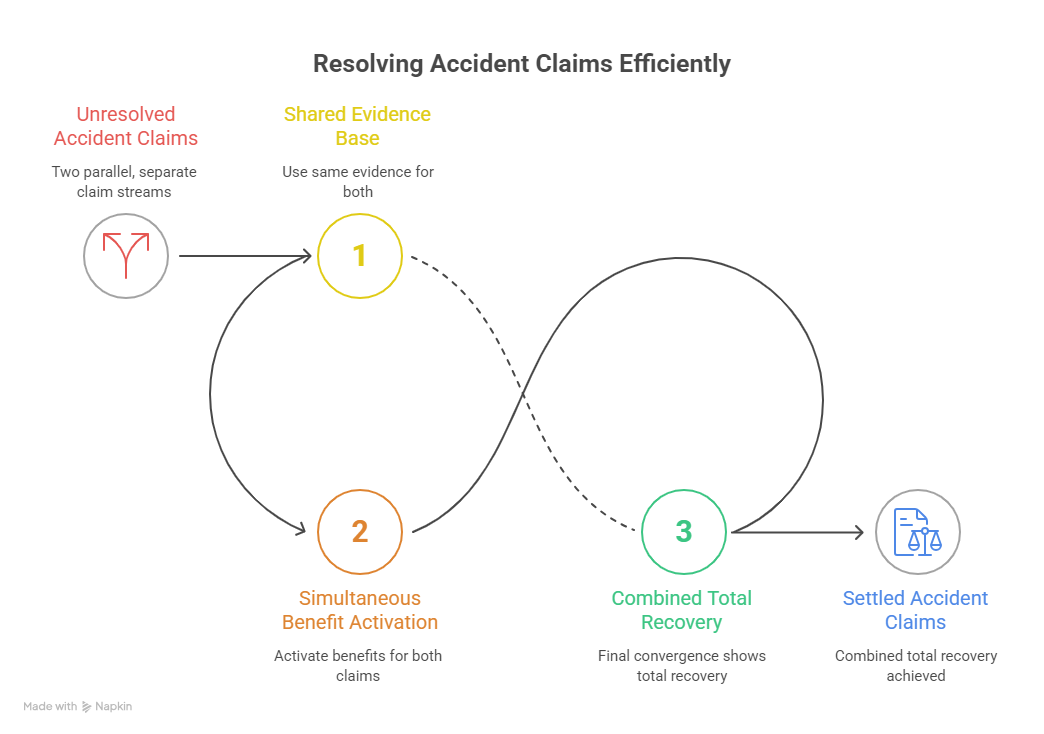
- How your SABS accident benefits claim and tort claim work side by side
- What insurance company tactics look like and how lawyers counter them
- How long the process takes and what it costs you
What Does a Car Accident Lawyer Do on the Day You Hire Them?
What does a car accident lawyer do from day one is assess your entire legal situation, protect you from triggering irreversible deadlines, and lay the groundwork for your claim before the insurer gets ahead of you.
During your first consultation, your lawyer reviews the facts of your accident and the nature of your injuries. They identify whether your case falls under the Minor Injury Guideline (MIG), qualifies for the non-minor injury classification, or may meet the threshold for a catastrophic accident lawyer. They explain your rights under Ontario’s no-fault insurance system and the full scope of the Statutory Accident Benefits Schedule (SABS). They also flag whether you have a separate tort claim against the at-fault driver, in addition to your accident benefits claim.
One of the most time-sensitive actions your lawyer takes on day one is advising you about the 7-day insurer notification requirement under Ontario’s Insurance Act. You must notify your own insurer within seven days of the accident. Missing this window creates grounds for your insurer to dispute or deny your accident benefits claim entirely.
According to the Ontario Road Safety Annual Report, there were approximately 56,000 injury collisions reported across the province in 2022. Each of those claimants entered the same process. The difference between a full recovery and an underpaid claim often comes down to who managed the paperwork and when.
Ontario’s OCF-1 deadline is 30 days from your accident. Has yours been filed? Let us check right now.
Missing the OCF-1 window permanently eliminates your accident benefits. Maana Law files everything from day one.
How Does Your Lawyer Build the Evidence Your Case Needs?
How does a car accident lawyer work when building your case is through systematic, time-sensitive evidence collection that begins in the first days after your accident, not months later when memories fade and footage is deleted.
Your lawyer gathers:
- The police report and records from the Collision Reporting Centre (accidents involving property damage over $5,000, as of January 1, 2025, must be reported)
- Dashcam footage, traffic camera recordings, and any available surveillance video from the scene
- Witness statements while recollections are still fresh
- Your complete medical records from the date of the accident forward
- Employment and income records to support Income Replacement Benefit (IRB) claims
- Expert assessments from occupational therapists (OT), functional capacity evaluators, vocational evidence specialists, and accident reconstruction experts when needed
At the same time, your lawyer handles the OCF forms that govern your access to accident benefits. These are not optional administrative steps. They are the legal foundation of your SABS claim.
The critical OCF forms your lawyer manages include:
- OCF-1 (Application for Accident Benefits): Must be submitted within 30 days of the accident missing this deadline eliminates your right to benefits. Our guide on the most common car accident claim mistakes in Ontario explains what happens when these early filings are missed.
- OCF-2 (Employer’s Confirmation of Income): Required to support your IRB claim
- OCF-3 (Disability Certificate): Completed by your treating physician to confirm your injury and functional limitations
- OCF-6 (Expense Claims): Documents out-of-pocket costs related to your injuries
- Form 1 (Attendant Care Assessment): Applies when you need help with personal care because of your injuries
- OCF-10 (Election of Benefits): Used to choose between certain benefit types where an election is required
These forms directly determine how much funding you receive and whether your claim stays within the MIG’s $3,500 treatment cap or moves into the non-minor classification where benefits can reach $65,000. The injury classification decision made in the first months of your claim shapes almost every financial outcome that follows and most claimants don’t know it is happening until the damage is done.
What Ontario Deadlines Does Your Lawyer Protect You From Missing?
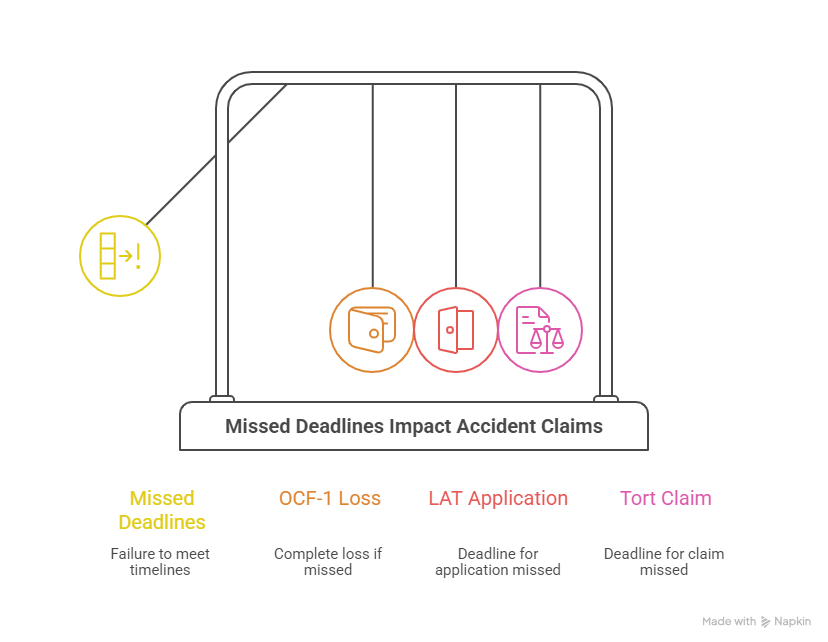
Car accident lawyer first steps in Ontario are almost always about deadlines. Ontario’s accident claims system runs on strict timelines, and missing even one can permanently close off a category of compensation.
Here are the key deadlines your lawyer tracks and protects from the moment they take your case:
| Deadline | Timeframe | What You Risk If You Miss It |
| Collision Reporting Centre notification | Within 24 hours of accident | May compromise the official accident report and coverage |
| Insurer notification | Within 7 days | Grounds for insurer to deny accident benefits claim under the Insurance Act |
| OCF-1 (Application for Accident Benefits) | Within 30 days of accident | Complete loss of SABS accident benefits entitlement |
| Tort claim (lawsuit against at-fault driver) | 2 years from accident date | Permanently barred from pursuing compensation from the at-fault driver |
| LAT dispute filing | 2 years from insurer’s denial | Permanently lose the right to dispute that benefit decision at the Licence Appeal Tribunal |
The 2-year limitation period for tort claims runs under Ontario’s Limitations Act, 2002 and the Highway Traffic Act. Your lawyer logs this date immediately and monitors it throughout the life of your file.
For what to expect after hiring personal injury lawyer in Ontario, expect your lawyer to create a full deadline calendar in the first week and keep you updated every time a milestone approaches.
If you were injured in a car accident in Ontario, contact Maana Law today for a free consultation and make sure every one of these deadlines is protected from day one.
How Does Your Lawyer Manage Your SABS Accident Benefits Claim?
The car accident lawyer process explained in practical terms involves managing two parallel claims simultaneously: your accident benefits claim under SABS and your tort claim against the at-fault driver. Both streams require attention from the start.
Under the Statutory Accident Benefits Schedule, you are entitled to accident benefits regardless of who caused the collision. This is Ontario’s no-fault system. Benefits available to you include:
- Income Replacement Benefit (IRB): Pays up to 70% of your gross pre-accident income, subject to a standard maximum of $400 per week
- Attendant Care Benefit (ACB): Covers the cost of personal care assistance when you cannot manage independently due to your injuries
- Medical and Rehabilitation Benefits: Up to $65,000 for non-minor injuries, and up to $1,000,000 for cases that meet the Catastrophic Impairment (CAT) criteria
- Non-Earner Benefit: Available if you were not employed at the time of the accident but have experienced a complete inability to carry on a normal life
- Housekeeping and Home Maintenance Benefit: Covers household tasks you can no longer perform because of your injuries
Your lawyer reviews your injuries against the MIG from the beginning. Soft tissue injuries are routinely placed in the MIG by insurers, capping your treatment funding at $3,500. If your condition is more serious, your lawyer uses your medical records, physician notes, and specialist reports to challenge that classification and move you into the non-minor category or pursue a CAT designation where the stakes are far higher.
A critical threshold to know: at the 104-week mark (approximately two years post-accident), the standard for IRB eligibility changes. The test shifts from whether you are unable to perform the essential tasks of your own pre-accident occupation to whether you are unable to perform the essential tasks of any occupation for which you are reasonably suited by education, training, or experience. Your lawyer prepares vocational evidence and medical documentation well before this threshold to protect your ongoing income replacement benefits.
If your insurer denies benefits or cuts them off without adequate justification, your lawyer files a dispute with the Licence Appeal Tribunal (LAT), which operates under the Financial Services Regulatory Authority of Ontario (FSRA). You have two years from the date of the insurer’s denial to bring an application. What actually happens at a LAT hearing and how evidence submitted months before the hearing date determines the outcome is something most claimants are unprepared for without legal guidance.
What Happens When the Insurance Company Pushes Back on Your Claim?
How does car accident lawsuit work when your insurer is actively opposing your claim? Your lawyer anticipates every resistance tactic and prepares a specific counter before it is deployed against you.
The most common insurer tactics in Ontario car accident claims are:
MIG misclassification: The insurer categorizes your injury under the Minor Injury Guideline even when your condition clearly exceeds that threshold. This artificially caps your treatment at $3,500 and cuts off access to higher benefits. Your lawyer challenges this using your diagnostic records, physician reports, and treating clinician notes.
Excessive Independent Medical Examination (IME) requests: Insurers have the right under Ontario’s Insurance Act to request an independent examination (IE) using their own chosen medical professional. When used as a delay tactic or to generate reports that contradict your treating physicians, your lawyer can challenge both the frequency of requests and the weight of any adverse report produced.
IRB cutoff at the 104-week threshold: Many insurers automatically reduce or terminate Income Replacement Benefits at the two-year point when the disability definition shifts. Your lawyer builds your vocational file and supporting documentation in advance to address this threshold before the insurer uses it.
Treatment plan denials and underfunding: When your healthcare provider submits an OCF treatment plan for physiotherapy, psychology, chiropractic care, or other services, the insurer may deny or underfund it. Your lawyer responds with supporting medical evidence and, where the insurer refuses to act reasonably, takes the dispute to the LAT.
CAT rebuttal assessment requests: When your lawyer pursues a Catastrophic Impairment designation, the insurer will request their own medical rebuttal. Your lawyer prepares your treating team for this challenge and ensures your medical documentation is detailed enough to withstand scrutiny.
Under Ontario’s contributory negligence rules, the insurer may also argue that you share partial fault for the accident. Under the 50% fault bar, if you are found to be more than 50% responsible, you lose your right to tort damages entirely. Your lawyer builds fault evidence using the Ontario Fault Determination Rules and, where needed, accident reconstruction expert analysis to ensure your motor vehicle accident claim in Mississauga is fully protected. For a full breakdown of your rights when the collision was not your fault, read our guide on car accident claims where you were not at fault in Ontario.
How Does Your Lawyer Pursue a Tort Claim for Pain and Suffering in Ontario?
Hiring a car accident attorney what to expect on the tort side of your case involves a longer, more complex process than accident benefits. While SABS pays benefits regardless of fault, a tort claim is a direct lawsuit against the at-fault driver for damages that go beyond what accident benefits cover.
To succeed in a tort claim, your lawyer must prove three things:
- The other driver was negligent
- That negligence caused the collision and your specific injuries
- Your injuries cross Ontario’s legal threshold for pain and suffering recovery
Ontario applies a statutory deductible to pain and suffering awards that fall below a set threshold. As of 2025, the pain and suffering deductible stands at $155,965.54. If your pain and suffering award is below this amount, the full deductible is applied and your net recovery may be zero. If your award exceeds the threshold, only the deductible amount is subtracted from your total. For context, the 2024 deductible was $153,509.39, reflecting annual indexing under the Insurance Act.
This deductible does not apply to claims for future income loss, future care costs, or housekeeping and attendant care expenses beyond what SABS provides.
What does a personal injury lawyer do for you in the tort process is build a complete, evidence-backed damages picture. That includes medical expert opinions on your diagnosis and long-term prognosis, occupational therapist assessments of your functional limitations, accident reconstruction analysis to establish how the collision happened, and economic projections of your future income loss.
Most Ontario car accident tort claims resolve through negotiated settlement before reaching a courtroom. Understanding when to settle versus go to trial in Ontario is a critical decision your lawyer guides you through based on the strength of your evidence and the insurer’s position.
Insurer placed you under the MIG? That $3,500 cap may be wrong — and challengeable.
MIG misclassification is one of the most common insurer tactics in Ontario. Maana Law challenges it with the right medical evidence.
What Is the Typical Car Accident Claim Timeline in Ontario?
The car accident lawyer timeline in Ontario depends on the complexity of your injuries, how quickly liability can be established, and whether your insurer cooperates or actively contests your claim at every stage.
Here is a general guide to how the process unfolds:
| Stage | Typical Timeframe |
| Initial consultation, file opening, and insurer notification | Week 1 |
| OCF form filing and accident benefits activation | Days 1–30 |
| Medical documentation and evidence gathering | Months 1–6 |
| Accident benefits disputes at LAT, if required | Months 3–18 |
| Tort claim discovery and examinations for discovery | Year 1–2 |
| Mediation and settlement negotiations | Year 1–3 |
| Trial, if no settlement is reached | Year 2–4+ |
Most Ontario car accident claims resolve before trial. Settlement occurs when both sides reach a number that accounts for the strength of the available evidence and the legal risk of proceeding further. Your lawyer negotiates from a position built on months of careful documentation.
For catastrophic injury cases, the timeline is often longer. The full scope of your future care needs home modifications, attendant care, medical aids, lost earning capacity must be thoroughly documented before any settlement is advisable. Accepting a settlement before those figures are established can leave significant long-term care costs unrecovered.
Car accident lawyer responsibilities throughout this entire timeline include keeping you informed at every meaningful development, advising you honestly on the value of each settlement offer, and advancing your case to trial if the insurer refuses to negotiate in good faith.
What Does It Cost to Hire a Car Accident Lawyer in Ontario?
Hiring a personal injury lawyer in Ontario costs you nothing upfront. Nearly all personal injury lawyers, including those at Maana Law, work on a contingency fee model.
This means:
- No retainer fees before your case starts
- No hourly billing during the file
- No out-of-pocket legal costs while your case is active
- A fee only if your case succeeds
The contingency fee is a percentage of your final settlement or court award, agreed to in writing before your lawyer begins. Under Ontario’s Solicitors Act, contingency fee agreements must be clearly written and fully disclosed before you sign. Your lawyer’s fee obligation to you is a legal document, not a verbal arrangement.
Additional litigation costs such as expert reports, accident reconstruction fees, court filing fees, and medical record retrieval — are typically paid from the final settlement amount rather than directly by you during the case.
What does a personal injury lawyer do for you on the fee side is remove the financial barrier to representation. You are not disadvantaged by your inability to pay upfront. Maana Law’s No Win, No Fee model means you access the same quality of legal advocacy as anyone with resources to pay by the hour. The way contingency fees are structured in Ontario including the fees most injury lawyers don’t walk clients through clearly before signing has a direct effect on how much of your settlement you actually take home.
No upfront fees. No win, no fee. Home and hospital visits available. Ready when you are.
Maana Law manages your SABS claim, OCF forms, MIG challenges, and tort claim — all under one roof in Mississauga.
Why Maana Law Is the Right Choice for Your Car Accident Claim
When you are recovering from an accident, you need more than a lawyer who knows the law in general. You need a team that understands Ontario’s accident benefits system from every angle, knows how insurers build their opposition, and has the experience to push back with the right evidence at the right time.
Here is what sets Maana Law apart:
- Hands-on command of Ontario’s SABS and MIG framework- Aman Kalra and the Maana Law team work within the Statutory Accident Benefits Schedule, the Minor Injury Guideline, and the Catastrophic Impairment designation process every single day. They know where insurers apply pressure and how to respond with targeted medical and legal evidence.
- No Win, No Fee representation- You pay nothing unless your case succeeds. There are no upfront costs, no hidden charges, and no financial risk to you for getting the legal protection you need.
- Free consultations, home visits, and hospital visits- If you cannot travel to the Mississauga office, Maana Law comes to you. Virtual meetings are also available for your convenience at any stage of your case.
- Multilingual service in Hindi and English- Aman Kalra is fluent in both languages, making Maana Law accessible to a broad range of communities across Mississauga and the Greater Toronto Area.
- Individual case strategy, not a standard template- Every file receives a specific plan built around your police report, your medical records, your employment history, and the specific facts of your accident not a recycled approach applied to every claim.
- A proven record across Mississauga communities- Over more than a decade, Maana Law has recovered millions in compensation for accident victims across Erin Mills, Cooksville, Churchill Meadows, Meadowvale, City Centre, and surrounding areas.
Your recovery is what matters most. Maana Law handles everything else.
Frequently Asked Questions
How soon after a car accident should I contact a lawyer in Ontario?
You should speak with a lawyer as soon as possible ideally within the first few days after the accident. Ontario’s Insurance Act requires you to notify your insurer within 7 days of the collision, and you must submit your OCF-1 (Application for Accident Benefits) within 30 days. A lawyer ensures both deadlines are met and prevents your insurer from using delay against you from the start.
Can I manage my car accident claim without a lawyer in Ontario?
You have the legal right to manage your own claim, but most claimants are at a significant disadvantage without legal representation. Insurance adjusters are trained to minimize payouts. A lawyer understands the full scope of SABS benefits you are entitled to, can identify when the insurer has misclassified your injuries under the MIG, and knows how to challenge insurer decisions through the LAT if benefits are wrongly denied or reduced.
What is the difference between an accident benefits claim and a tort claim?
An accident benefits claim pays for your medical treatment, income loss, and care needs regardless of who caused the collision this is Ontario’s no-fault system under the Statutory Accident Benefits Schedule. A tort claim is a separate lawsuit against the at-fault driver for pain and suffering and losses beyond what accident benefits cover. Your lawyer pursues both at the same time. The tort claim for pain and suffering is subject to a statutory deductible of $155,965.54 as of 2025.
What happens if my insurer denies or cuts off my accident benefits?
If your insurer denies or reduces your accident benefits, your lawyer can file a dispute with the Licence Appeal Tribunal (LAT) under the Financial Services Regulatory Authority of Ontario (FSRA). The deadline to file a LAT application is 2 years from the date of the insurer’s denial. Your lawyer will prepare the medical evidence, legal submissions, and arguments needed to advance your case at the hearing.
How much compensation can I recover from a car accident claim in Ontario?
Your total compensation depends on the severity of your injuries, your income before the accident, and how your case is classified. Under SABS, non-minor injury cases can access up to $65,000 in medical and rehabilitation benefits. Cases meeting the Catastrophic Impairment criteria can access up to $1,000,000. Tort damages for pain and suffering, future income loss, future care costs, and other heads of damage are assessed separately and added on top of your accident benefits. Your lawyer evaluates your specific facts and gives you a realistic picture of your claim’s value early in the process.
Final Thoughts
Hiring a car accident lawyer in Ontario is not simply about getting legal advice. It is about having someone who understands exactly how the system operates standing between you and an insurance company that is motivated to pay as little as possible.
The process moves fast. Benefit classifications are challenged early. Insurer tactics begin within days of your accident report. Deadlines in Ontario are measured in days and weeks, not months and once they pass, they cannot be reset. Getting legal advice quickly is not a precaution. For most people, it is what determines how much of their life they actually recover.
Ontario’s car accident claims process is built on forms, timelines, and legal thresholds that most people have never encountered before. A lawyer who knows this system does not just protect you from losing what you are owed. They position your claim to recover the full amount from both your accident benefits and your tort claim, at every stage of the process.
Maana Law is ready to help you take the first step. Visit us at 90 Matheson Blvd W Suite 101, Mississauga, Ontario, call us for a free consultation, or request a virtual, home, or hospital visit. No fees unless we win your case.