
Settling a car accident claim in Ontario without a lawyer is possible. It is also one of the most reliable ways accident victims walk away with far less than their injuries are actually worth.
Ontario’s insurance system runs on two separate tracks: accident benefits through your own insurer under the Statutory Accident Benefits Schedule (SABS), and a tort claim against the at-fault driver. Each track has its own deadlines, its own forms, and its own rules. Insurers know every one of those rules. When you do not, the negotiation tilts in their direction before you make your first phone call.
The Insurance Research Council reported in its 2023 consumer panel study that injury claimants represented by lawyers received settlements averaging 3.5 times higher than those who settled independently. That figure does not mean self-representation always fails. It means it carries a cost that most people do not see until after they have already signed the release form. An experienced Mississauga Car accident Lawyer can assess these factors and help you understand your potential recovery.
At Maana Law, our team works with car accident victims across Mississauga every day, and we consistently see the same patterns repeat in self-represented claims. Whether you decide to manage your own claim or retain legal support, understanding those patterns before you file anything gives you a real advantage.
Here is what this guide covers:
- How Ontario’s no-fault insurance system affects both tracks of your claim
- The immediate steps that protect your right to full compensation
- How to file your accident benefits correctly and on time
- How to calculate your claim value before accepting any offer
- How to write a demand letter and counter insurance adjuster pressure tactics
- The specific conditions under which self-representation stops working in your favour
Not sure if you’re already at a disadvantage? A free case review will tell you — before you file anything.
Adjusters handle dozens of files daily. Maana Law reviews your situation at no cost so you know exactly where you stand.
Can You Settle a Car Accident Claim Without a Lawyer in Ontario?
Yes, and car accident settlement without lawyer Ontario is entirely achievable under the right conditions. The outcome depends on your claim’s complexity and how well you understand Ontario’s insurance legislation before you start negotiating.
Self-representation produces the best results when:
- Your injuries are soft tissue only, fully healed, and confirmed by a physician
- Liability is clear and not disputed by either insurer
- Your total documented losses fall below $50,000
- You have reached maximum medical improvement (MMI) and no further treatment is needed
Self-representation becomes a financial liability when injuries are ongoing, when liability is contested, or when multiple insurers are involved. Ontario’s Limitations Act, 2002 gives you two years to file a tort claim, but accident benefits deadlines arrive far sooner. You must notify your insurer within 7 days of the collision and submit your OCF-1 Application for Accident Benefits within 30 days. Missing either deadline gives your insurer a documented basis to reduce or deny your benefits.
According to the Ontario Road Safety Annual Report, Ontario recorded approximately 59,000 injury collisions in 2021 alone. A significant share of those victims attempted to negotiate their own claims. Many settled well below what a complete understanding of their rights would have produced.
Not every Ontario car accident requires legal representation but knowing when it does is critical. Personal injury lawyer costs are one factor; claim complexity is another. Yes, and car accident settlement without lawyer Ontario is entirely achievable under the right conditions…
When Self-Representation Works
Fully healed soft tissue injuries, uncontested liability, documented losses without ongoing expenses, and a cooperative insurer create the conditions most likely to produce a fair self-represented outcome. If your treatment costs fall under the Minor Injury Guideline (MIG) cap of $3,500 and your lost wages are simple to calculate, the process is manageable for someone willing to research Ontario’s insurance rules carefully.
When You Are Already at a Disadvantage
Insurance adjusters handle dozens of active files at the same time. They understand the SABS, the MIG thresholds, and how to read your medical records in ways that benefit the insurer. The moment you provide a recorded statement without understanding your rights, or sign a medical authorization that covers your entire health history, you may have already narrowed your recovery without realizing it. How much that single documentation gap costs claimants who start the process on the wrong footing is something that becomes visible only after the first settlement offer lands.
Lowball offer. Recorded statement. Broad medical release. Delay tactics. Recognize the playbook — then counter it.
Maana Law takes over all insurer communication and negotiates from a position of legal knowledge. No cost unless we win.
How Does Ontario’s No-Fault Insurance System Affect Your Claim?
Ontario’s DIY car accident claim process operates under a no-fault insurance model. This means your own insurer pays your accident benefits regardless of who caused the collision.
No-fault does not mean the at-fault driver faces no consequences. It means your accident benefits come from your own insurer first, while a separate tort claim against the at-fault driver runs on a parallel track. Both tracks carry different timelines, different eligibility criteria, and different outcomes.
Your Accident Benefits Track (SABS)
The Statutory Accident Benefits Schedule governs your income replacement, medical treatment, rehabilitation costs, and related benefits after a collision. If your injuries fall under the Minor Injury Guideline (soft tissue strains, sprains, whiplash without neurological involvement), your treatment funding is capped at $3,500. Injuries that exceed that threshold may qualify for additional medical and rehabilitation benefits, but your insurer will challenge that reclassification and will typically request an Independent Medical Examination (IME) from a physician they select to support their position.
The Financial Services Regulatory Authority of Ontario (FSRA) oversees accident benefit disputes. When an insurer denies or limits a benefit, claimants may apply to the Licence Appeal Tribunal (LAT) for resolution. The LAT received over 6,000 new applications in fiscal year 2022-23, which reflects how routinely Ontario insurers contest their obligations to injured claimants.
The tort track allows you to pursue the at-fault driver for pain and suffering and losses that accident benefits do not cover. Ontario’s tort threshold requires that your injury cause a permanent serious impairment of an important physical, mental, or psychological function before you can claim pain and suffering in a tort action. If your injury meets that threshold, a statutory deductible of approximately $41,503.50 (2024 figures) still applies to any pain and suffering award below $131,854.01.
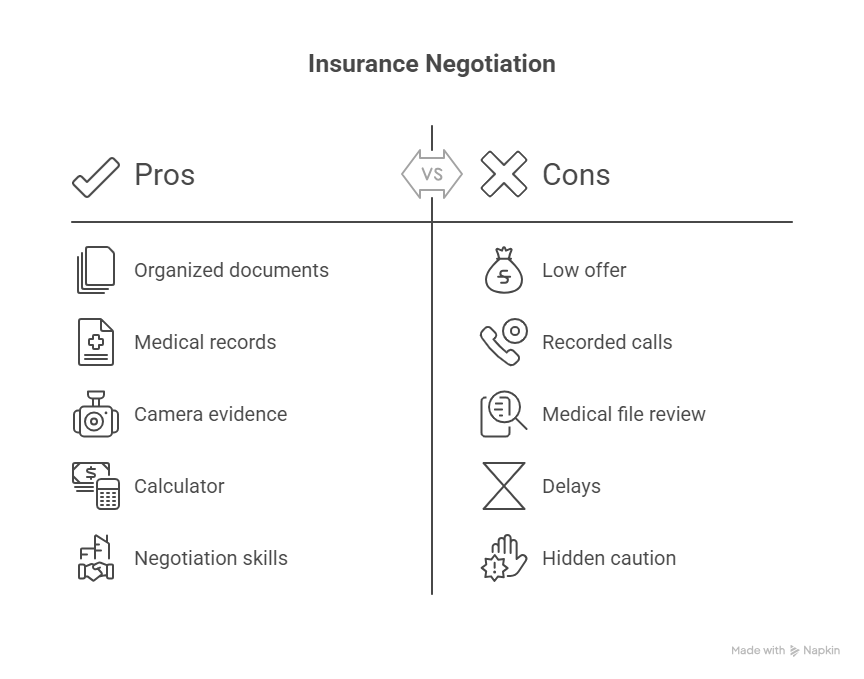
These are the exact numbers insurers use to anchor low settlement offers. If you do not know them before you enter negotiations, you will not know when a number you are being given is misleading.
What Steps Do You Need to Take Right After a Car Accident?
The quality of a self represented car accident claim Ontario is set in the first hours and days after a collision. Evidence disappears quickly. Witness recollections fade within weeks. Delays in seeking treatment create gaps that adjusters reference for months.
Take these steps without delay:
- Call police and wait for an official accident report. In Ontario, a police report is the foundational document for any claim involving injury and disputed liability.
- Photograph the scene thoroughly from multiple angles: vehicle damage, skid marks, road conditions, traffic controls, weather, and all visible injuries.
- Collect names, phone numbers, and addresses from all witnesses before anyone leaves the scene.
- Preserve dashcam footage immediately. Overwrite cycles are short, and footage lost within days of the collision cannot be recovered.
- Seek medical attention the same day, even if you feel uninjured. Delayed treatment is the leading reason insurers dispute injury severity in Ontario claims.
- Notify your insurer within 7 days as required under Ontario insurance law.
- Begin a written pain journal the same week. Daily entries documenting pain levels, functional limitations, and how injuries affect your work and household routines create a record that supports general damages claims months later.
Most claimants who struggle with the process of settling a car accident claim themselves did not lose their claim at the negotiation table. They lost it in the first 30 days, because the documentation was too thin to support the full value of their losses. What those gaps look like from the adjuster’s side of the file, and exactly which ones are hardest to close after the fact, is one of the more consequential things to understand before you submit your first form.
If you are uncertain whether your current documentation is strong enough to support your full claim value, the team at Maana Law offers a free, no-obligation case review before you file anything.
How Do You File an Accident Benefits Claim in Ontario?
Filing your accident benefits claim is the formal entry point into the car accident claim process without attorney. Ontario uses standardized OCF forms to initiate and manage all accident benefit claims. Filing the wrong form, filing late, or omitting required supporting documentation gives your insurer a documented reason to delay your benefits from the start.
The Core OCF Forms
OCF-1 – Application for Accident Benefits. Must be submitted within 30 days of the accident. This initiates your accident benefits file. Your insurer cannot process any benefits until this form is received and acknowledged.
OCF-3 – Disability Certificate. Completed by your treating physician or healthcare provider. This certificate documents how your injuries limit your daily function and employment capacity, and it supports both income replacement and medical benefit claims.
OCF-10 – Election of Income Replacement Benefit. This form allows you to select which income replacement option applies to your situation. The election directly affects how much weekly benefit you receive and for how long. It is difficult to reverse once made.
OCF-18 – Treatment Plan. Submitted by your physiotherapist, chiropractor, or other treatment provider when requesting funding for specific rehabilitation. Treatment within the MIG does not require pre-approval for the first $3,500. Beyond that cap, OCF-18 approval becomes a frequent point of dispute between claimants and insurers.
What Happens After You File
Under SABS, your insurer must acknowledge your OCF-1 within 10 business days and respond to each treatment plan within a regulated timeframe. If they deny a benefit or treatment plan without a valid clinical basis, you can escalate through the FSRA’s dispute resolution process or file a LAT application.
Keep a copy of every form you submit and every response you receive. Request all decisions in writing. Verbal assurances from an adjuster are not binding and will not protect you if the dispute escalates.
How Do You Calculate What Your Car Accident Claim Is Worth?
How much can I get for car accident without lawyer is the first question most Ontario accident victims search before making any filing decisions, and the answer depends entirely on what you can document and whether your injuries meet the relevant legal thresholds.
Ontario recognizes two categories of damages in personal injury claims.
Economic Damages
These are your quantifiable financial losses supported by a paper trail:
- Medical expenses not covered by OHIP or accident benefits, including specialist fees, private physiotherapy, prescription costs, and assistive devices
- Income replacement under SABS, which pays 70% of gross income up to $400 per week under standard coverage, with higher weekly amounts available if you purchased optional enhanced benefits before the accident
- Future medical costs for ongoing treatment required beyond the settlement date
- Lost earning capacity if your injuries have a long-term effect on your ability to perform your occupation
- Vehicle repair or replacement costs recovered through Direct Compensation Property Damage (DCPD), which allows you to claim vehicle damages from your own insurer regardless of who was at fault
Non-Economic Damages
Pain and suffering, emotional distress, and loss of enjoyment of life fall into this category. Ontario applies the multiplier method to estimate these. The multiplier ranges from 1.5 to 5 times your total economic damages, calibrated to injury severity and the long-term impact on your daily life.
As a working example: $10,000 in documented medical expenses combined with two months of lost wages at $4,000 totals $14,000 in economic damages. Applied at a 2.5 multiplier for a moderate soft tissue injury with confirmed functional limitations and a three-month treatment timeline, non-economic damages would estimate at $35,000. Against that, the statutory deductible applies if the tort threshold is not clearly established.
Never accept a settlement offer before reaching maximum medical improvement. What the SABS income replacement and medical benefit calculation actually looks like once future treatment costs are factored in is something that changes the total claim value considerably and adjusters know this better than most claimants do.
Got a settlement offer? Before you sign that release — let us tell you if it actually reflects your full claim.
A signed release is permanent. One free call to Maana Law could be worth thousands. No win, no fee.
How Do You Write a Demand Letter That Gets Results?
A demand letter is your formal opening move in the settlement negotiation. It signals to the adjuster whether you know your claim’s value and whether you understand Ontario’s legal framework well enough to push back.
How to negotiate car accident settlement effectively starts with getting this document right. A poorly structured demand letter communicates the opposite of what you need it to communicate.
What to Include in Your Demand Letter
Your demand letter must contain:
- A factual account of the accident, including date, location, involved parties, road conditions, and how liability is established
- A clear summary of your injuries referencing specific medical records, treating providers, and confirmed diagnosis dates
- An itemized breakdown of all economic damages with supporting receipts, invoices, and pay stubs attached
- A pain and suffering estimate calculated using the multiplier method, tied to the specific ways your injuries affect your occupation and daily activities
- Reference to applicable sections of SABS and Ontario tort law where your losses fall within those frameworks
- A specific dollar demand set above your minimum acceptable figure, to preserve negotiating room
- A 30-day response deadline from the date of the letter
Set your opening demand higher than the minimum you will accept. Adjusters are trained to negotiate downward from your first number. Opening at your floor leaves you nowhere to move.
Address every complication in the letter: any health insurer subrogation lien on the settlement, any pre-existing condition alongside evidence that this accident aggravated it, and any diminished vehicle value claim under DCPD. Leaving these out signals the adjuster they were never considered, and they will not volunteer to include them.
How Do You Negotiate with an Insurance Adjuster in Ontario?
Negotiating with insurance adjuster after car accident is not a single conversation. It is a structured exchange that can span weeks or months, and it requires patience, written records, and a clear floor below which you will not settle.
Negotiation Fundamentals
Counter the first offer at or above your demand letter figure. The adjuster’s opening number reflects the minimum they believe you will accept, not the maximum they are authorized to pay. Do not validate a low first offer by accepting it without a documented written counter.
Conduct all negotiations in writing wherever possible. Email creates a record that protects you if the claim escalates to the LAT or to court. When phone calls happen, send a follow-up email the same day confirming what was said and what positions were taken.
Do not provide a recorded statement to the at-fault driver’s insurer without understanding exactly what you are agreeing to. You are required to cooperate with your own insurer under SABS, but even that cooperation has defined limits. The at-fault driver’s insurer has no legal authority to compel your participation.
Countering a Lowball Offer
When the adjuster’s offer is materially below your documented losses, respond in writing with a specific counter that itemizes every gap between their valuation and your claim. Reference medical records, paid receipts, and your treating physician’s prognosis by name and date. Ask the adjuster to explain, in writing, how they calculated each line item of their offer.
Adjusters who must justify their valuation in writing typically produce revised offers that more accurately reflect actual losses. The car accident settlement offer tips that most self-represented claimants wish they had known earlier all follow from one principle: accountability through written records. Create it at every step, and never accept a verbal commitment as binding.
What Tactics Do Insurance Adjusters Use to Cut Your Settlement?
How to deal with insurance company after car accident begins with understanding that adjusters are not neutral. They work for the insurer, and their role is to close claims at the lowest defensible number. The following tactics are common, legal, and highly effective against claimants who do not see them coming.
The lowball opener- The first offer is a test, not a final position. It reflects the minimum the adjuster believes you will accept. Most adjusters have authority to move considerably above their opening figure.
The early recorded statement- Shortly after the collision, when your injuries are still developing and your medical picture is incomplete, the adjuster may request a recorded statement. Statements made at this stage routinely understate symptom severity and are referenced months later to challenge larger damage claims.
The broad medical records release- Adjusters sometimes request a blanket authorization covering your entire health history, not just records related to this accident. Pre-existing conditions identified in those records will be used to argue your injuries predated the collision or were only minimally aggravated by it.
The delay tactic- Unreturned calls and unanswered emails are deliberate. Adjusters know claimants under financial pressure will accept lower offers to end the waiting.
The final offer bluff- A figure presented as a “final offer” is a pressure tactic, not a legal ceiling. Adjusters have authority to revise offers, and supervisors can override initial positions.
The comparative fault argument- Under Ontario’s contributory negligence principles, your damages are reduced in proportion to your share of fault. Adjusters often exaggerate your contribution to the accident to reduce the insurer’s payout.
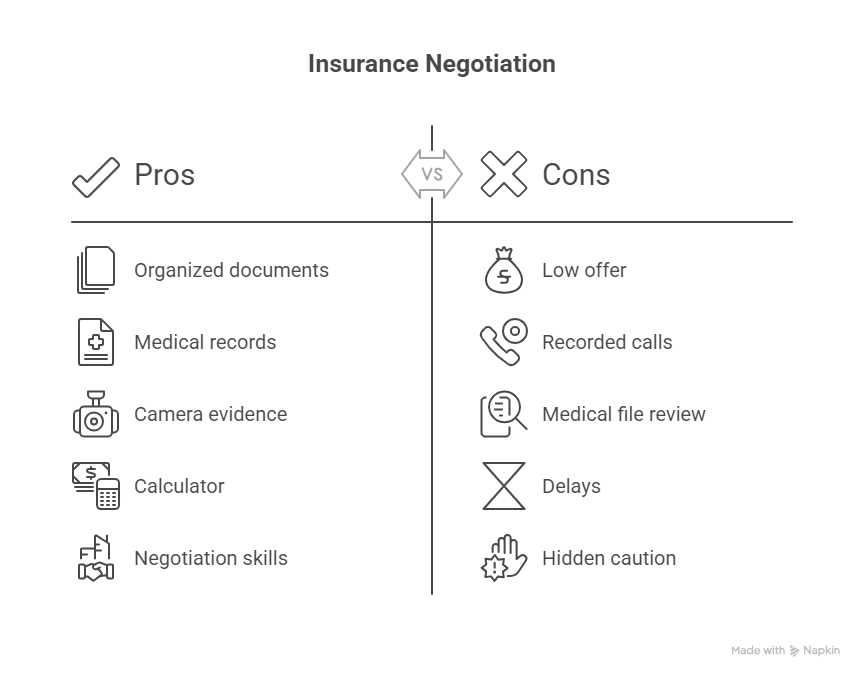
Recognizing these tactics is the first step. Countering them consistently over a multi-week negotiation, while managing your own recovery and financial pressures, is where self-representation becomes genuinely demanding for most people.
When Does a Self-Represented Claim Break Down in Ontario?
Settle car accident claim yourself is a realistic goal in low-complexity cases. In the following situations, however, self-representation consistently produces settlements below what the claim is actually worth.
Get legal advice before proceeding further if any of these apply to your situation:
- Your injuries are still being treated and you have not yet reached maximum medical improvement
- Your treatment has involved surgery, injections, or specialist care beyond a family physician
- The at-fault driver was uninsured or underinsured, which triggers your own UM/UIM coverage and adds significant procedural steps
- Multiple vehicles or insurers are involved, each holding different liability positions
- Your insurer is disputing whether your injuries exceed the MIG cap and has requested an IME
- Your OCF-18 treatment plan has been denied and you are facing a LAT application deadline
- An Independent Medical Examination report commissioned by your insurer contradicts your treating physician’s findings
- Liability is genuinely disputed and you are being assigned a share of fault under Ontario’s contributory negligence rules
Many Ontario insurers use claim valuation software to produce settlement figures calibrated against aggregate historical data. That software does not account for how your specific injuries affect your particular occupation, your family responsibilities, or your quality of life outside of work. Presenting those individual factors in a way that actually moves an adjuster’s offer requires knowing exactly what separates recoveries above $50,000 from claims that settle for a fraction of that, and where insurers tend to find the leverage to hold their numbers down.
The LAT process is also procedurally demanding in ways most self-represented claimants do not anticipate. Accident benefit disputes that reach the Licence Appeal Tribunal involve formal applications, mandatory disclosure, and case conferences. Missing a procedural step carries real consequences, and the outcomes in unrepresented LAT applications frequently reflect that.
Why Maana Law Is the Right Choice for Your Car Accident Claim
Settling a car accident claim in Ontario without legal support is a real financial risk when the amount at stake is significant. Maana Law gives accident victims in Mississauga the professional guidance they need to recover what they are owed, with no upfront fees and no financial risk to getting started.
Our team understands the SABS framework, the MIG dispute process, the LAT application requirements, and exactly how Ontario insurers approach claim valuations after a collision. Here is what makes working with us different:
- Contingency Fee Representation. You pay nothing unless we recover compensation for you. No retainer fees, no hourly billing, and no out-of-pocket cost to access qualified legal representation from day one.
- Free Initial Case Review. Before you accept any offer or submit any form, we give you a complete assessment of your claim, your legal options, and the realistic range of compensation your injuries and losses support.
- Proven Knowledge of Ontario’s Personal Injury System. Aman Kalra and the Maana Law team work exclusively within Ontario personal injury law, including SABS claims, MIG reclassification disputes, LAT applications, and tort threshold cases in Mississauga and across the GTA.
- Flexible Access for Every Client. We offer virtual consultations, home visits, and hospital visits. If your injuries prevent you from coming to the office, we come to you.
- Multilingual Service. Aman Kalra is fluent in both English and Hindi, which makes a genuine difference for many Mississauga families managing a legal process in a second language during an already stressful time.
- Clear, Consistent Communication. You will always know exactly where your claim stands. We explain every development in plain language and respond when you need answers.
Every claimant who comes to us after a failed self-represented settlement shares the same regret: they settled before they understood what their claim was genuinely worth, and signed a release they could not reopen.
Frequently Asked Questions
How long does it take to settle a car accident claim without a lawyer in Ontario?
Minor claims with fully healed injuries and uncontested liability typically resolve within three to six months. Claims involving disputed liability, ongoing medical treatment, or a LAT application can take one to three years. The most common and costly mistake self-represented claimants make is accepting a settlement before reaching maximum medical improvement, which locks in a final number before the true scope of recovery costs is known.
How much can I get for a car accident without a lawyer in Ontario?
The amount depends on your documented losses, injury severity, and whether your injuries meet Ontario’s tort threshold for pain and suffering. Soft tissue claims settled within the MIG often range from $10,000 to $30,000. Claims involving surgery, permanent impairment, or significant income loss can produce substantially higher recoveries, particularly when the individual impacts of the injury are properly documented and presented in negotiations.
What is the deadline to file a car accident claim in Ontario?
You have 7 days to notify your insurer of the accident and 30 days to file your OCF-1 Application for Accident Benefits. The general limitation period for a tort claim in Ontario is two years from the date of the accident under the Limitations Act, 2002. Missing accident benefits deadlines does not automatically end your claim, but it gives your insurer a documented basis to dispute or reduce your benefits through the FSRA dispute process.
Can I negotiate directly with the at-fault driver’s insurance company?
Yes. As a self-represented claimant, you have the right to negotiate directly with the at-fault driver’s insurer for your tort claim. That insurer’s adjuster is not working in your interest. They are trained to minimize the payout on behalf of their policyholder. Any statement you make, document you provide, or release form you sign creates a binding record. Read every document thoroughly before agreeing to anything, and do not accept verbal assurances as confirmation of any position.
What happens if the insurance company denies my claim in Ontario?
If your own insurer denies or limits your accident benefits, you can file an application with the Licence Appeal Tribunal (LAT) for dispute resolution under the FSRA’s oversight framework. For tort claims against the at-fault driver’s insurer, you would proceed through Ontario Superior Court of Justice. Both processes involve procedural requirements that are significantly more manageable with qualified legal representation, particularly at the LAT stage where timelines and disclosure rules are strict.
Conclusion
Settling a car accident claim without a lawyer in Ontario requires a level of preparation that most people underestimate when they start the process. Ontario’s two-track insurance system, the SABS deadlines, the MIG cap, the tort threshold, and the statutory deductible all create a framework that defaults in the insurer’s favour when a claimant does not know the rules well enough to push back.
The three things that most directly determine how much you recover are documentation quality from day one, the discipline to wait until maximum medical improvement before accepting anything, and setting your opening demand above your minimum to preserve negotiating room. These principles apply whether you have legal support or not, but they work best when you also understand exactly how the adjuster is calculating your claim value and where their real authority to increase an offer actually sits.
A signed release form is permanent. It closes your claim regardless of how your injuries develop afterward. If you have already received a settlement offer and are not certain it reflects the full value of your losses, that question deserves an answer before you sign.
Maana Law is a personal injury law firm in Mississauga, ON, serving accident victims across the Greater Toronto Area. Contact us at 905-696-0446 or visit maanalaw.com for a free, no-obligation case review. Tell us what the adjuster offered. We will tell you whether it is fair.
References
- Ontario Ministry of Transportation. Ontario Road Safety Annual Report 2021. https://www.ontario.ca/page/ontario-road-safety-annual-report
- Insurance Research Council. (2023). Paying for Auto Injuries: A Consumer Panel Survey on Auto Accident Experiences. IRC.
- Financial Services Regulatory Authority of Ontario (FSRA). Auto Insurance Dispute Resolution. https://www.fsrao.ca/consumers/auto-insurance/making-a-claim
- Licence Appeal Tribunal (LAT). Auto Accident Benefits Service. https://www.lat.gov.on.ca
- Law Society of Ontario. Find a Lawyer or Paralegal. https://lso.ca/public-resources/finding-a-lawyer-or-paralegal
- Insurance Bureau of Canada. After a Collision. https://www.ibc.ca/auto/claims
- Ministry of the Attorney General, Ontario. Courts and Lawsuits. https://www.ontario.ca/page/courts-and-lawsuits
- Limitations Act, 2002, S.O. 2002, c. 24, Sched. B.
- Statutory Accident Benefits Schedule, O. Reg. 34/10 (Ontario).