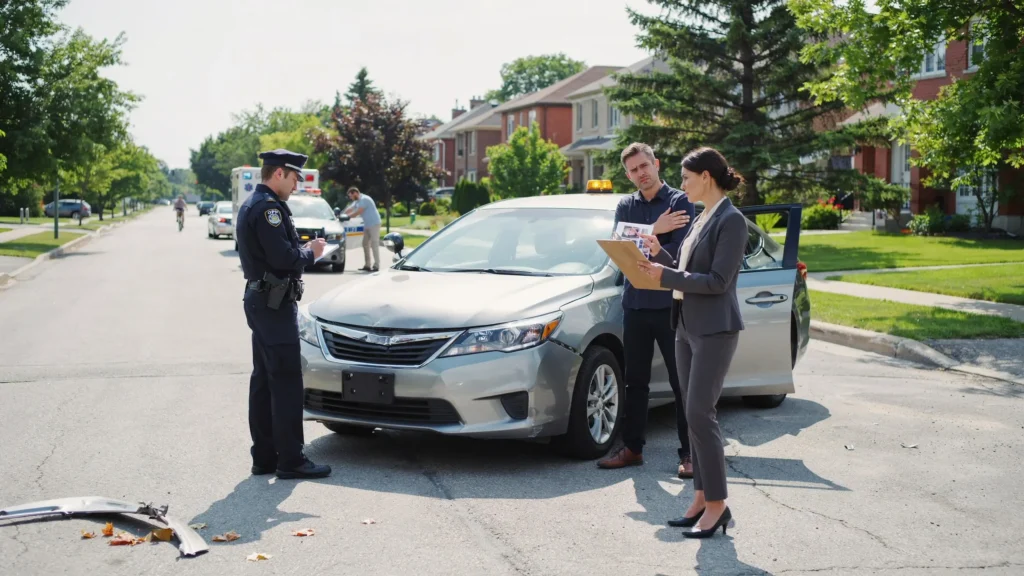
These seven mistakes can ruin your car accident claim in Ontario, and most injured drivers make at least one of them before they speak to a lawyer.
Ontario’s insurance system is not built to make claims simple. From the moment you report an accident, insurers have trained adjusters reviewing your case for any reason to reduce or deny your payout. One wrong word at the scene, a missed deadline, or a single social media post can seriously weaken an otherwise valid claim.
Every year, accident victims across Mississauga and the rest of Ontario lose compensation they had every legal right to collect. Not because their injuries were not real, but because they did not know the rules. Understanding how personal injury claims are built from the ground up, and where they most often fall apart can make a significant difference to your final outcome.
At Maana Law, our team has helped accident victims recover compensation across Mississauga for over a decade. These are the car accident claim mistakes Ontario drivers make most often, and exactly what you can do to avoid them. An experienced Car accident Lawyer Mississauga can assess these factors and help you understand your potential recovery.
Here is what this guide covers:
- Why saying “sorry” at the scene can be used against you
- The Ontario SABS deadlines most claimants miss
- What to never say to an insurance adjuster, and why
- Why the first settlement offer is almost always too low
- How a single social media post can sink your claim
- Whether hiring a lawyer makes sense, even for minor accidents
- Key Ontario laws every accident victim should know
You have 7 days to notify your insurer and 30 days to file your OCF-1. Has yours been done?
Missing either deadline gives your insurer grounds to deny your benefits. Call Maana Law now — it takes five minutes.
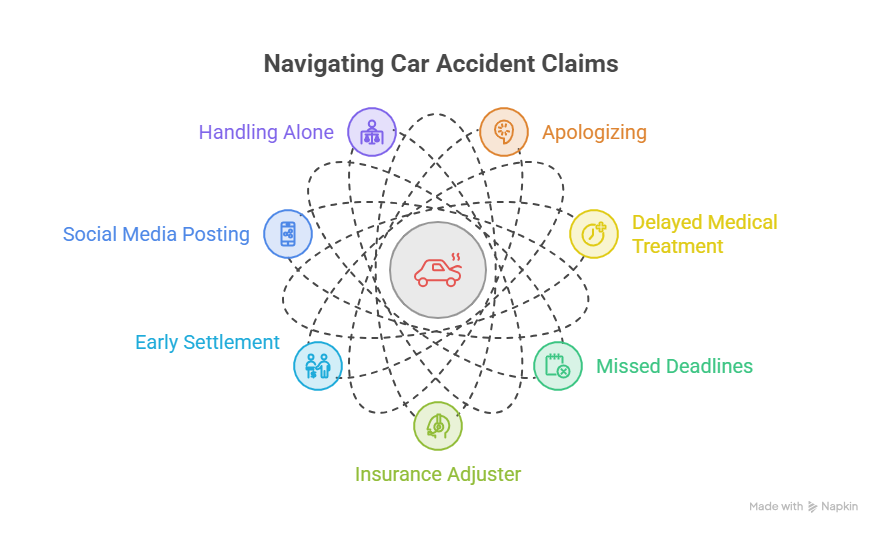
7 Car Accident Claim Mistakes in Ontario: At a Glance
| # | Mistake | Key Risk |
| 1 | Admitting fault or apologizing at the scene | Treated as admission of liability |
| 2 | Delaying or skipping medical treatment | Gaps in medical timeline used against your claim |
| 3 | Missing SABS and Limitations Act deadlines | Full claim denial without merit review |
| 4 | Giving a recorded statement to the adjuster | Inconsistencies used to reduce your payout |
| 5 | Accepting the first settlement offer | Permanently locks in a low figure |
| 6 | Posting on social media during your claim | Posts and photos submitted as injury evidence |
| 7 | Handling the claim without a lawyer | Settlements significantly below fair value |
What Happens to Your Car Accident Claim If You Make the Wrong Move?
One wrong move can cost you far more than most people expect. In Ontario, car accident claims run on two separate tracks: a Statutory Accident Benefits (SABS) claim filed with your own insurer, and a tort claim filed against the at-fault driver. Both carry strict deadlines, documentation requirements, and rules. Insurers monitor both closely.
According to the preliminary 2023 Ontario Road Safety Annual Report, 36,706 persons were involved in personal injury collisions on Ontario roads in 2023 alone. Each of those victims filed into a system where insurers have experienced adjusters, surveillance investigators, and legal teams actively working to limit payouts. Knowing what not to do from the first moments after a crash is your most practical form of protection.
Mistake #1: Does Saying Sorry at the Scene Hurt Your Car Accident Claim in Ontario?
Yes. Apologizing at the scene of a crash can be treated as an admission of liability, even if you were not responsible for what happened.
Fault in an Ontario collision is assessed by insurers using the Fault Determination Rules under the Insurance Act. Statements made at the scene (including casual apologies) can be referenced by the other party’s insurer to argue that you accepted responsibility for the accident.
How Do Insurers Determine Who Was at Fault in Ontario?
Insurers determine fault by applying the Fault Determination Rules, which consider the applicable traffic laws, witness accounts, police reports, physical evidence from the scene, and statements made by those involved. Under the Highway Traffic Act (Ontario), you are legally required to stop, remain at the scene, and exchange information with all parties. Beyond that, nothing you say is legally required, and any additional statement can be used against you.
Avoid saying any of the following:
- “I’m sorry, I didn’t see you”
- “It was my fault”
- “I was distracted”
- “I wasn’t paying attention”
Even a casual apology offered out of instinct or politeness can complicate your comparative negligence assessment. Stick to exchanging insurance details and contact information. Call police if required. Document the scene with photos and video. Collect witness names and numbers.
The right move: Say nothing about fault. Exchange the required information, document the scene thoroughly, and let the physical evidence and the official process determine liability. If you understand why the moments immediately after a crash shape the entire claims process, you will know exactly why this matters.
Mistake #2: Why Does Delaying Medical Treatment Damage Your Personal Injury Claim?
Delaying medical care after a car accident gives insurance companies a powerful argument to reduce or deny your claim: if you were truly injured, they will say, you would have sought treatment immediately.
This is one of the mistakes after car accident Ontario victims most commonly make, often because they feel okay in the hours right after the crash. Soft tissue injuries like whiplash-associated disorder, concussions, and psychological conditions such as post-traumatic stress disorder (PTSD) do not always show full symptoms right away. Adrenaline can mask pain for hours. Internal injuries may not be immediately apparent.
Every day you wait between the accident and your first medical appointment becomes a gap in your timeline. Insurers will use that gap to argue your injuries were pre-existing, unrelated to the crash, or far less severe than claimed.
See a doctor on the same day as the accident, or within 24 hours at the most. Keep all medical notes and clinical documentation organized. Start a recovery diary from day one, logging your pain levels, physical limitations, missed activities, and every out-of-pocket expense you incur.
One important Ontario-specific detail: if your injuries are classified as “minor” under the Minor Injury Guideline (MIG), your SABS treatment funding is capped at approximately $3,500. Insurers often try to apply the MIG to limit what they pay out. Timely and consistent medical documentation from your family doctor, a specialist, or a mental health professional is the most effective way to challenge a MIG designation if your injuries are more serious.
What Is the Hardest Injury to Prove After a Car Accident in Ontario?
Psychological injuries (PTSD, anxiety, and depression following a crash) are among the hardest conditions to prove in a personal injury claim. Unlike fractures, these conditions do not appear on X-rays or CT scans. Research consistently shows that approximately 25-33% of MVA survivors develop PTSD within 30 days of their accident, and a 2023 meta-analysis of 69 peer-reviewed studies found a pooled PTSD frequency of 26% among road traffic accident survivors. Despite how common these injuries are, insurers challenge psychological claims aggressively. Early, consistent treatment records from a mental health professional are critical. Soft tissue injuries and internal injuries that develop gradually are also frequently disputed without a clear medical timeline.
The right move: See a doctor the same day. Be honest and thorough with every symptom, both physical and psychological. Request referrals to specialists early. Document everything.
Already gave a recorded statement or received an offer? It’s not too late — but don’t sign anything yet.
Maana Law can still review your file and advise you on whether the offer reflects your actual damages before you commit.
Mistake #3: What Ontario Deadlines Can Kill Your Accident Benefits Claim?
Missing even one of Ontario’s statutory deadlines can result in your claim being denied entirely, without any assessment of the merits of your case. This is one of the most common car accident claim denied Ontario scenarios, and it happens to victims who simply did not know the rules.
Under the Statutory Accident Benefits Schedule (SABS), the following windows apply to every accident benefits claim:
| Deadline | Requirement |
| Within 7 days of accident | Notify your own insurer that the accident occurred |
| Within 30 days of receiving OCF forms | Return completed OCF-1 (Application for Accident Benefits) to your insurer |
| Within 2 years of accident | File a tort claim against the at-fault driver under the Limitations Act |
The 7-day insurer notification requirement under SABS is the one that catches the most people off guard. Accident shock, hospitalization, or simply assuming you have more time all contribute to missed notifications. Under Ontario Regulation 34/10, failure to report within this window gives your insurer grounds to dispute or deny your accident benefits.
Beyond SABS, the Limitations Act (Ontario) gives you two years from the accident date (or from the date you first discovered your injury) to initiate a civil lawsuit against the at-fault party. This is known as the discoverability doctrine, and while it offers some flexibility for injuries that surface later, it is not a loophole that protects indefinite delay.
If your insurer denies your SABS benefits, your dispute goes to the Licence Appeal Tribunal (LAT), Ontario’s dedicated adjudicative body for auto insurance benefit disputes. LAT applications have their own timelines and procedural rules, making early legal guidance even more important.
A car accident claim rejected Ontario decision based on a missed deadline is among the hardest outcomes to reverse. Report the accident, file your OCF-1, and speak with a personal injury lawyer as early as possible to protect every filing window in your case.
The right move: Put the 7-day SABS notification on your phone as a task immediately after any accident. Report, even if you feel fine. Filing costs nothing. Missing the deadline can cost you everything.
Mistake #4: What Should You Never Say to an Insurance Adjuster?
Never give a recorded statement to the opposing insurer without first speaking to a personal injury lawyer.It is one insurers actively count on.
Insurance adjusters are trained professionals. Their job is to protect the insurer’s financial interests, not to help you recover fair compensation. Their questions may seem routine, but many are designed to get you to minimize your injuries, inadvertently admit partial fault, or create inconsistencies that reduce your payout later.
Common adjuster tactics include:
- Asking how you are “feeling” early in your recovery, before your injuries are fully documented
- Requesting a blanket medical release that gives access to your full health history, including pre-existing conditions
- Asking you to walk through the collision in a way that subtly shifts blame in your direction
- Offering a quick settlement before the full extent of your injuries is known
- Referring you for an Independent Medical Examination (IME), where a doctor hired by the insurer assesses your injuries and often produces findings that favour the insurer’s position
You have no legal obligation to provide a recorded statement to the other driver’s insurer. Your duty to cooperate under Ontario law applies to your own insurer. Even then, you should have legal guidance before making any formal statement.
Keep a written log of every contact you receive from any insurance representative: the date, time, what was said, and who called. Do not sign any document before it has been reviewed by a lawyer.
The right move: Politely tell any adjuster who contacts you that you are seeking legal advice and will be in touch. Then contact a personal injury lawyer immediately.
If an insurance adjuster has already contacted you or you are uncertain about what to say next, Maana Law offers free consultations for accident victims across Mississauga. Get legal guidance before you say something that cannot be taken back.
Worried you’ve already made one of these mistakes? One free call could still turn your claim around.
Maana Law helps Mississauga accident victims recover what they’re owed — even mid-claim. No win, no fee.
Mistake #5: Why Should You Never Accept the First Car Accident Settlement Offer?
The first offer from an insurer is almost always lower than what your claim is actually worth. This is a well-documented car accident settlement mistakes Ontario pattern, and it works because many claimants do not know their full legal entitlements.
Insurers make early offers for one reason: to close the file before the full extent of your injuries becomes clear. A soft tissue injury that appears minor in week two may develop into a chronic pain condition requiring months of physiotherapy. A concussion sustained in the crash may cause long-term cognitive effects that limit your ability to work. A signed release or settlement agreement is permanent. Once you accept, you cannot return to claim additional compensation regardless of how your injuries progress.
Before accepting any settlement offer, you need:
- A complete picture of your medical prognosis from a qualified healthcare provider
- Full documentation of all out-of-pocket expenses, lost wages, and future care costs
- An independent legal assessment of whether the offer reflects the real value of your claim
- Sufficient time for delayed-onset injuries to be medically diagnosed and documented
How to protect your car accident claim in Ontario starts with resisting financial pressure. Medical bills and lost income create urgency, and insurers time their offers to take advantage of that pressure. A personal injury lawyer can assess whether the number on the table is fair and negotiate on your behalf if it is not.
A signed release is final. Never let urgency drive that decision.
The right move: Never sign any document from an insurer without a lawyer reviewing it first. If financial pressure is the issue, speak to Maana Law. Our contingency fee model means you pay nothing until your case is resolved.
Mistake #6: Can Social Media Posts Actually Hurt Your Car Accident Claim in Ontario?
Yes. A single post, photo, or tagged image on social media can be used as direct evidence to challenge the severity of your injuries. This is a growing what can hurt your personal injury claim Ontario concern, and one most claimants significantly underestimate.
If you post photos of yourself at a family gathering, playing sports, attending an event, or simply appearing healthy and active, insurers will use those images to argue that your injuries are not as serious as you claim. Even a post that seems completely unrelated to your accident can be taken out of context and submitted as evidence. Psychological and soft tissue injuries are particularly vulnerable to this tactic, because there is no visible cast or scar for a photo to contradict.
Insurance companies and their investigators routinely review public social media profiles. In disputed cases, they may seek access to private accounts through legal channels. This applies not just to your own accounts, but to accounts where family or friends may tag you.
The safest approach: do not post anything about your accident, your recovery, or your daily activities while your claim is active. Ask family members and close friends not to tag you in photos during this period.
What Happens If Insurance Finds Out You Lied or Misrepresented Your Claim?
The consequences are severe. Under the Ontario Insurance Act, providing false or misleading information to support a claim is grounds for your policy to be voided entirely. Your insurer may deny all benefits (including accident benefits you were otherwise legally entitled to) and you may face civil or criminal liability under the Criminal Code of Canada. Even minor exaggerations about how the accident occurred or the extent of your symptoms can be used to discredit your entire claim. Honesty with your insurer, your doctors, and your legal team is the only sustainable approach.
The right move: Go private on all social media platforms immediately after an accident. Set your profiles to the most restrictive privacy settings and inform family and friends not to tag or post about you.
Mistake #7: Is It Worth Hiring a Lawyer for a Minor Car Accident in Ontario?
Sometimes yes, sometimes no. Offering an honest breakdown is exactly the kind of car accident lawyer advice Ontario victims actually need. It is what separates genuine legal guidance from a sales pitch.
For very minor accidents with no injuries, no property disputes, and a resolution that both insurers agree on, you may not need legal representation. But if any of the following apply to your situation, a personal injury lawyer is worth serious consideration:
- You sustained any physical injury, even one that seems minor at first
- Your insurer is pushing back on your claim or moving quickly toward a settlement
- You have out-of-pocket medical expenses or missed time at work
- The other driver disputes who caused the collision
- You have a pre-existing medical condition the insurer might use to reduce your claim
- The crash involved a commercial vehicle, a municipality, or an uninsured driver
- You are unsure whether the Minor Injury Guideline (MIG) applies to your situation
Knowing how to avoid ruining a car accident claim in Ontario is valuable. But knowing how to build it correctly from the start is what actually protects your compensation. Insurers have in-house legal teams. Claimants who go it alone frequently accept settlements well below what they could have recovered with legal help.
The most consistent car accident insurance claim tips Ontario lawyers offer comes down to one principle: get a professional assessment before you decide you do not need one. Under Maana Law’s contingency fee model, you pay nothing unless your case is won or settled. There is no financial risk to a free consultation.
The right move: Book a free consultation before making any decisions. You are not committing to anything. You are simply getting the information you need to make the right choice.
Why Maana Law Is the Right Choice for Your Car Accident Claim in Ontario
Dealing with a car accident claim is stressful enough. Dealing with it without proper legal support puts you at a significant disadvantage from day one. Maana Law was built specifically to give accident victims in Mississauga and the surrounding communities the same calibre of legal representation that large insurers rely on.
Here is what sets Maana Law apart:
- Over a Decade of Ontario Personal Injury Experience Aman Kalra and the Maana Law team have spent more than ten years representing accident victims across Mississauga, from Erin Mills to Meadowvale to Churchill Meadows. That depth of local experience means your case is handled by someone who knows how Ontario’s insurance system operates and how to push back against it.
- No Win, No Fee: Zero Financial Risk Maana Law operates on a strict contingency fee basis. You pay nothing unless your case is successfully resolved. Anyone injured in a crash can access experienced legal help, regardless of their current financial situation.
- Free Consultations, Including Home and Hospital Visits You do not need to be well enough to visit an office. Maana Law offers free case consultations in-person, virtually, and at your home or hospital bedside, because legal access should not depend on your physical condition after an accident.
- Multilingual Legal Support Aman Kalra is fluent in both English and Hindi, making Maana Law a trusted choice for Mississauga’s diverse South Asian communities who want to discuss their case without language barriers.
- Proven Results with a Client-First Approach With a 5-star average across all Google reviews, Maana Law clients consistently highlight responsiveness, clear communication, and a commitment to getting real results. Every case is treated with individual attention.
- Full-Scope Representation, Start to Finish From SABS applications and OCF-1 filing to negotiations with adjusters and litigation when needed, Maana Law handles every step of the process so you can focus on recovery.
Trust your claim to a team that has seen every one of these mistakes before and knows exactly how to prevent them from costing you.
Frequently Asked Questions
What is the time limit for filing a car accident claim in Ontario?
Under the Limitations Act (Ontario), you have two years from the date of the accident to file a tort claim against an at-fault driver. For accident benefits under SABS, you must notify your insurer within 7 days of the crash and return a completed OCF-1 application within 30 days of receiving the forms. Missing any of these deadlines can result in partial or full denial of your claim without any review of its merits.
Can I still claim compensation if I was partly at fault for the accident?
Yes. Ontario uses a comparative negligence system, meaning your compensation is reduced in proportion to your share of fault, not eliminated. For example, if you are found 20% at fault, you would receive 80% of your calculated damages. An experienced personal injury lawyer can help minimize your assigned fault percentage during the negotiation process.
Do I need a police report to make a car accident claim in Ontario?
A police report significantly strengthens your claim but is not always legally required for every accident. Under the Highway Traffic Act, you must report collisions involving injury, death, or property damage over $2,000 to police. For lower-damage accidents, you may be directed to a Collision Reporting Centre (CRC). Always report the accident. A missing police report gives insurers grounds to question the circumstances of the crash.
How long does a car accident settlement take in Ontario?
Settlement timelines vary widely depending on case complexity. Minor claims with clear liability and limited injuries may resolve within several months. Complex cases involving serious injuries, disputed fault, chronic pain, or psychological trauma can take one to three years or longer. Accepting a fast settlement is rarely in your interest. The long-term impact of your injuries often becomes clear well after the insurer’s initial offer.
What should I do immediately after a car accident in Ontario?
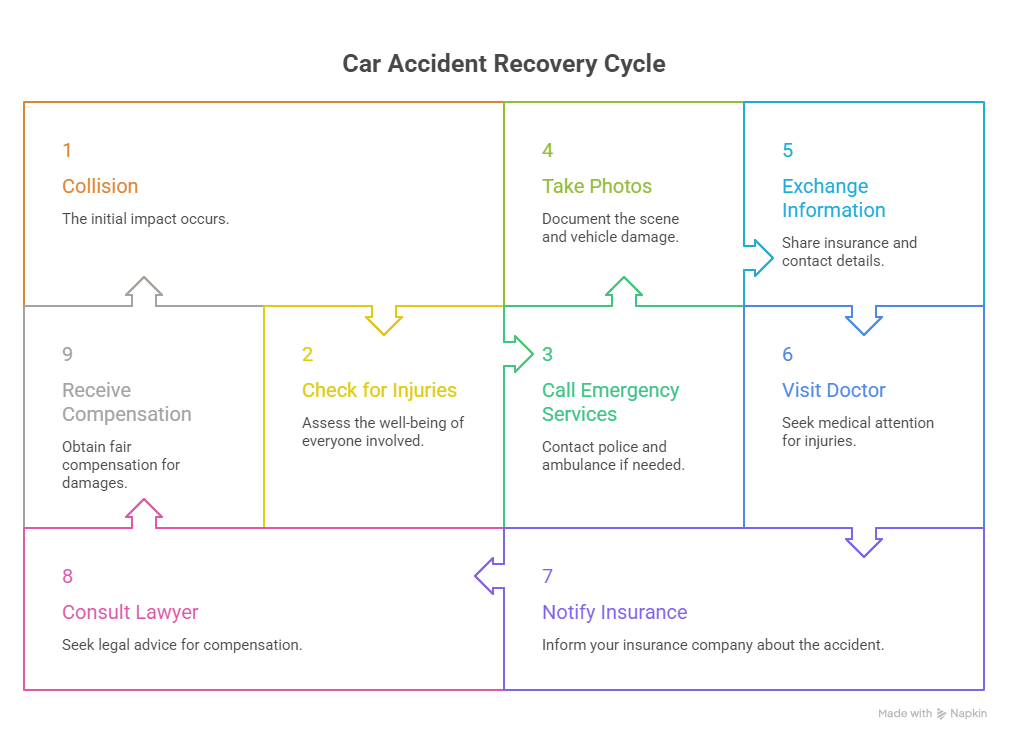
Call emergency services if anyone is injured. Exchange insurance information and contact details with all other drivers. Photograph and video the scene, vehicle damage, road conditions, and any visible injuries. Collect witness names and contact information. Report the accident to your insurer within 7 days. See a doctor the same day. Contact a personal injury lawyer before providing any statements to any insurance company.
Conclusion
The mistakes in this article are not edge cases. They happen across Ontario every day, and they cost accident victims real money, sometimes the full value of a claim they had every right to make.
Ontario’s deadlines under SABS and the Limitations Act do not bend for anyone. The insurers who contact you after a crash are protecting their own financial interests, not yours. And a free legal consultation carries no financial risk. Skipping one can be far more expensive than most people ever realize.
If you or someone you know was injured in a car accident in Ontario, do not navigate the claims process without proper guidance.
Maana Law is a personal injury law firm located at 90 Matheson Blvd W, Suite 101, Mississauga, ON. Led by Aman Kalra, the team represents accident victims across Mississauga and the surrounding region on a No Win, No Fee basis. Free consultations are available by phone, virtually, or in person, including home and hospital visits.
Call Maana Law today at 437-979-4878 to book your free consultation. You pay nothing unless we win.
References
- Ontario Road Safety Annual Report, Preliminary 2023: https://www.ontario.ca/document/ontario-road-safety-annual-reports-orsar/preliminary-2023-ontario-road-safety-annual
- Ontario Ministry of Transportation, 2021 ORSAR Data: https://data.ontario.ca/dataset/ontario-road-safety-annual-report
- Highway Traffic Act (Ontario): https://www.ontario.ca/laws/statute/90h08
- Limitations Act (Ontario): https://www.ontario.ca/laws/statute/02l24
- Statutory Accident Benefits Schedule (SABS), Ontario Regulation 34/10: https://www.ontario.ca/laws/regulation/100034
- Ontario Insurance Act, s. 267.8: https://www.ontario.ca/laws/statute/90i08
- Motor Vehicle Accident Claims Fund (MVACF): https://www.ontario.ca/page/motor-vehicle-accident-claims-fund
- Financial Services Regulatory Authority of Ontario (FSRA): https://www.fsrao.ca
- Transport Canada, Canadian Motor Vehicle Traffic Collision Statistics 2023: https://tc.canada.ca/en/road-transportation/statistics-data/canadian-motor-vehicle-traffic-collision-statistics/2023/canadian-motor-vehicle-traffic-collision-statistics-2023
- PTSD After MVA, peer-reviewed meta-analysis (ScienceDirect, 2025): https://www.sciencedirect.com/science/article/pii/S2590198225000533
- PMC, Assessment and Treatment of PTSD After a Motor Vehicle Collision: https://pmc.ncbi.nlm.nih.gov/articles/PMC2396820
- Compelling Counsel (Allan Snelling LLP), 7 Mistakes People Make After an Accident: https://www.compellingcounsel.com/articles/7-mistakes-people-make-after-an-accident