

Proving medical malpractice in Ontario is not about showing a bad outcome. It is about showing a specific legal failure and connecting it directly to your harm. The law sets a clear standard, and meeting it requires the right evidence, a qualified expert, and careful timing. Working with a personal injury lawyer who handles medical negligence is critical to getting each of these elements right. An experienced medical malpractice lawyer knows how to build a case that holds up against well-funded defence teams.
Here is what this guide covers:
- The four legal elements every claim must establish
- Which types of evidence carry the most weight
- The role expert witnesses play and why they are non-negotiable
- Time limits that apply to your claim in Ontario
- What damages you can recover if you succeed
Medical malpractice settlements in Ontario range from $60K to over $2.5M. Our lawyers will evaluate your specific case.
The Four Legal Elements of a Medical Negligence Case in Ontario
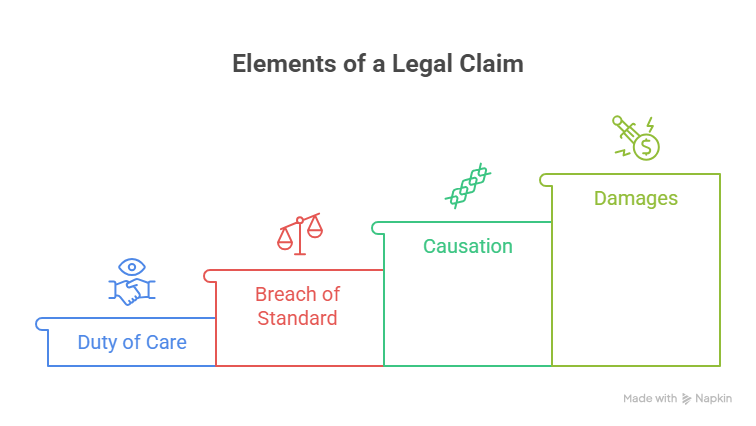
To win a medical negligence case in Ontario, you must prove four elements on a balance of probabilities. Each one must be established separately.
Duty of Care
A duty of care exists as soon as a licensed health professional accepts you as a patient. This applies to physicians, nurses, dentists, and any other regulated practitioner. Once that patient-health care practitioner relationship is formed, the provider is legally obligated to meet an appropriate standard of treatment.
This element is rarely disputed. The more complex questions come next.
Breach of Standard of Care
The standard of care is what a reasonable, competent practitioner in the same specialty would have done under the same circumstances. A breach occurs when the provider’s conduct falls below that standard.
Ontario courts do not require perfection. A clinical decision made in good faith, within the accepted range of options, is not a breach even if the result was poor.
The comparison is also specialty-specific. A family doctor is measured against other family doctors, not against specialists. A specialist is held to the higher standard of their own field.
Common examples of a breach:
- Misdiagnosis or failure to order appropriate tests
- Surgical error that a competent surgeon would have avoided
- Inadequate follow-up care after a procedure
- Failure to refer to a specialist when required
- Pathologist negligence in reviewing a tissue sample
Many of these failures produce injuries that are difficult to prove without the right legal strategy, which is why expert evidence is essential from the start.
Causation
Proving a breach is not enough on its own. You must also show that the breach directly caused or materially contributed to your injury.
Ontario courts apply the “but for” test: but for the provider’s failure, would the harm have occurred? Factual causation asks whether the breach was the actual cause. Legal causation asks whether the connection is close enough to justify liability.
Causation is often contested in delayed diagnosis cases. Consider a cancer misdiagnosis where a pathologist failed to identify appendiceal cancer during a tissue sample review. The question is not just whether the error occurred. It is whether the delay changed the outcome. Did the cancer progress from a treatable stage to metastatic disease? Did it reduce the five-year survival rate or increase recurrence risk in a way that earlier detection would have prevented? Expert evidence must answer those questions with specificity.
Defence teams frequently argue that a pre-existing injury or genetic condition explains the outcome. Your expert must address and rebut those arguments with medical evidence. In cases involving understanding chronic pain conditions, separating the malpractice-related harm from pre-existing symptoms requires particularly strong clinical documentation.
Damages
You must prove actual, measurable harm. Ontario courts award compensation for:
- Pain and suffering
- Lost wages and reduced future earning capacity
- Medical bills and ongoing care costs
- Emotional distress
- Permanent impairment
- Family Law Act claims by close family members for loss of care and companionship
Understanding the full range of medical malpractice settlement amounts in Ontario helps you evaluate what your specific losses may be worth.
Evidence Needed to Build a Strong Claim
Your evidence determines whether a claim survives or collapses. Gather and preserve these categories from the start.
Medical Records
Medical records as evidence in malpractice cases are the foundation of every claim. You have a legal right to your complete file. That includes physician notes, lab results, diagnostic imaging, operative reports, discharge summaries, nursing notes, medication logs, and pathology reports.
Request records as early as possible. Files can be altered or lost over time. A lawyer can send a formal preservation request to protect that documentation. Proper documentation from the outset strengthens every stage of your case.
Timeline Documentation
Dates determine liability and limitation. A delayed medical diagnosis claim depends on identifying exactly when the provider first had information that required action. Build a written timeline from your first appointment to the moment you discovered the error. Keep every receipt, referral letter, and follow-up record.
Imaging, Photos, and Physical Evidence
Post-surgical photographs, diagnostic scans, and any physical evidence of your condition before and after treatment show how the harm progressed. In a birth injury case, hospital monitoring records and delivery notes are particularly important.
Financial Records
Keep receipts for all medications, rehabilitation, assistive devices, and home care. Gather pay stubs and employment records if you missed work. Your lawyer uses this financial documentation to calculate both past and future loss of income. If the injury prevents you from returning to work entirely, this evidence may also support a long-term disability claim under a separate policy.
Don’t accept the injury. Ontario medical malpractice victims recover $60K to $2.5M+. Let Aman Kalra review your case today.
The Role of Expert Medical Evidence in Ontario
You cannot win a malpractice case in Ontario without qualified expert testimony. A judge is not a physician and will not independently assess whether a clinical decision was reasonable. Expert evidence is required by law.
Matching the Expert to the Claim
Your expert must practice or have recently practiced in the same specialty as the defendant. A medical malpractice expert witness Ontario opinion carries far more weight when it comes from someone with direct clinical experience in the relevant field.
For example, a family doctor whose failure to diagnose cancer is being challenged should be assessed by another family physician, not a specialist. The standard applied must match the role.
The expert must also be independent. Courts are skeptical of witnesses who work exclusively for one side. An opinion grounded in medical literature and offered without advocacy is more credible than one that appears to be outcome-driven.
What the Expert Report Must Cover
A complete expert report addresses:
- Whether a patient-physician relationship existed
- What the standard of care required in the circumstances
- How the defendant’s conduct fell below that standard
- Whether that breach, on a balance of probabilities, caused the injury
- The extent of the harm and any role played by pre-existing conditions
The report must also address whether the defendant exercised a reasonable degree of skill and honest exercise of judgement, the minimum threshold required to avoid liability. The role of evidence in building a strong personal injury case applies with even greater force in medical negligence claims.
Preparing for the Defence Expert
The defence will retain their own expert. That expert will typically argue that no breach occurred, that the breach did not cause the harm, or that a pre-existing injury accounts for the outcome. Your legal team must anticipate those positions and prepare rebuttal evidence before trial.
Time Limits: The Two-Year Limitation Period
In Ontario, the statute of limitations for a medical malpractice claim is two years. The clock starts from the date you knew, or reasonably ought to have known, that you had a potential claim. This is governed by the Ontario Limitations Act, 2002.
The two-year limitation period begins when you were aware of three things:
- That an injury occurred
- That the injury may have been caused by medical treatment
- That a legal claim may be appropriate
In delayed diagnosis cases, this date can be significantly later than the date of the original error. Special rules also apply for minors and for individuals who lack legal capacity at the time of the harm.
Missing the limitation deadline almost always ends the claim permanently, regardless of its merits. Do not wait to speak with a lawyer.
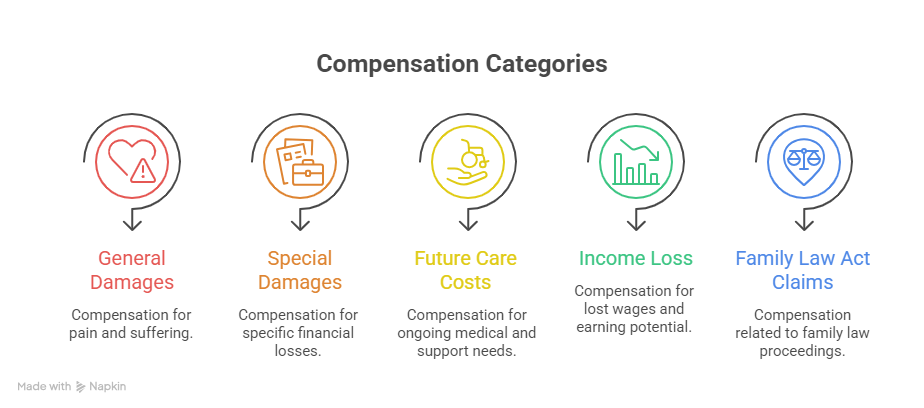
Damages: What Compensation Covers
Once you prove all four elements on a balance of probabilities, the court determines the appropriate compensation.
| Category | What It Covers |
|---|---|
| General Damages | Pain and suffering, loss of enjoyment of life |
| Special Damages | Medical bills, rehabilitation, out-of-pocket costs |
| Future Care Costs | Ongoing treatment, home care, assistive devices |
| Income Loss | Past lost wages, reduced future earning capacity |
| Family Law Act Claims | Loss of care, guidance, and companionship for family members |
In cases of permanent impairment, compensation may extend to maximum medical improvement, the point at which recovery has plateaued and future costs can be accurately calculated. Where the injury qualifies as catastrophic accident, the damages award increases significantly to account for lifelong care needs. For a detailed breakdown of how these awards compare, review civil litigation settlement amounts in Ontario.
Why Maana Law Is the Right Choice for Your Medical Malpractice Claim
Proving medical malpractice in Ontario takes legal experience, medical knowledge, and access to credible expert witnesses. Not every personal injury firm is equipped for this work.
At Maana Law in Mississauga, our team has spent over a decade representing injury victims whose cases required exactly this level of preparation and depth.
Medical-Legal Case Analysis: We work with qualified independent experts from the relevant specialty to build opinions that hold up against defence challenges.
Evidence Preservation from Day One: We act immediately to secure your medical records, protect your timeline, and prevent records from being lost or altered.
Clear Communication Throughout: Aman Kalra explains each step of your case in plain language, in English or Hindi, so you always understand where your claim stands.
No Win, No Fee: You pay no legal fees unless we recover compensation for you. Learn more about our legal fee structure. Free consultations are available by phone, virtually, or through home and hospital visits.
Family Law Act Claims Included: Where your injury affects your family, we assess whether your spouse or dependents have claims for loss of care and companionship under the Family Law Act.
Results across Mississauga: Maana Law has represented clients in Erin Mills, Cooksville, Churchill Meadows, Meadowvale, and City Centre.
If you are ready to find out whether you have a viable claim, contact our medical malpractice lawyer in Mississauga for a free, confidential consultation.
Frequently Asked Questions
Can I file a medical malpractice claim if the outcome was bad but the doctor tried their best?
A bad outcome alone is not malpractice. You must show the provider fell below the standard of care expected of a reasonable practitioner in their specialty. If the decision was within the range of acceptable medical judgment, a claim will not succeed even if the result was harmful.
Do I need a lawyer to pursue a malpractice claim in Ontario?
You are not legally required to retain a lawyer, but these cases are highly complex and almost always require expert medical evidence. Attempting to pursue a medical malpractice case in Ontario without legal representation significantly reduces the chances of success.
What if I signed a consent form before the procedure?
Consent forms do not protect a provider from liability for negligence. Informed consent covers the known risks of a procedure performed correctly. It does not excuse a breach of the standard of care in how the procedure was carried out or managed afterward. The College of Physicians and Surgeons of Ontario sets out the standards for informed consent that practitioners must follow.
The medical error involved a hospital, not just one doctor. Who is liable?
Hospital malpractice claims can name the institution alongside individual practitioners. Hospitals can be held responsible for systemic failures, staffing decisions, and the actions of their employees. Your lawyer will assess all responsible parties when building the claim.
What if I am partly responsible for the outcome?
Ontario follows contributory negligence rules. If you failed to follow medical advice or provided inaccurate information that affected treatment, damages may be reduced proportionally. This does not automatically defeat the claim, but it can affect the final amount awarded. Understanding how to settle a personal injury case versus going to trial can help you weigh your options when contributory negligence is a factor.
Conclusion
If you believe a healthcare provider’s failure caused your injury, the next step is a legal review of your case before the two-year limitation period closes your options.
Contact Maana Law, located at 90 Matheson Blvd W Suite 101, Mississauga, ON, for a free consultation. Call us or book a virtual appointment with Aman Kalra directly. If you have a viable claim, we will pursue it on a no win, no fee basis.