

Have you or someone you love suffered a brain injury in a car accident or slip and fall? You are probably asking the most pressing question right away: how much compensation can I actually get?
Settlement amounts for traumatic brain injuries in Ontario vary widely and without a brain injury lawyer in Mississauga fighting for your full entitlement, you risk leaving significant money on the table. A mild concussion case may settle for $50,000 to $150,000. A severe or catastrophic brain injury case can result in settlements of $1 million or more. Do not let an insurer decide what your case is worth. The right legal representation ensures every factor medical, financial, and personal is accounted for.
Maana Law has spent over 10 years helping injury victims in Mississauga and across Ontario pursue full and fair compensation. This guide explains exactly how TBI cases are valued, what you can claim, and what affects the final number.
Here is what this guide covers:
- How Ontario courts calculate brain injury compensation
- The difference between mild, moderate, and catastrophic TBI settlements
- What you can claim beyond pain and suffering
- How SABS accident benefits work alongside your tort claim
- What reduces your settlement and how to protect your case
Start your journey to smart investing.
How Much Is a Brain Injury Case Worth in Ontario?
There is no single fixed number. Ontario courts look at the specific facts of each case when determining compensation.
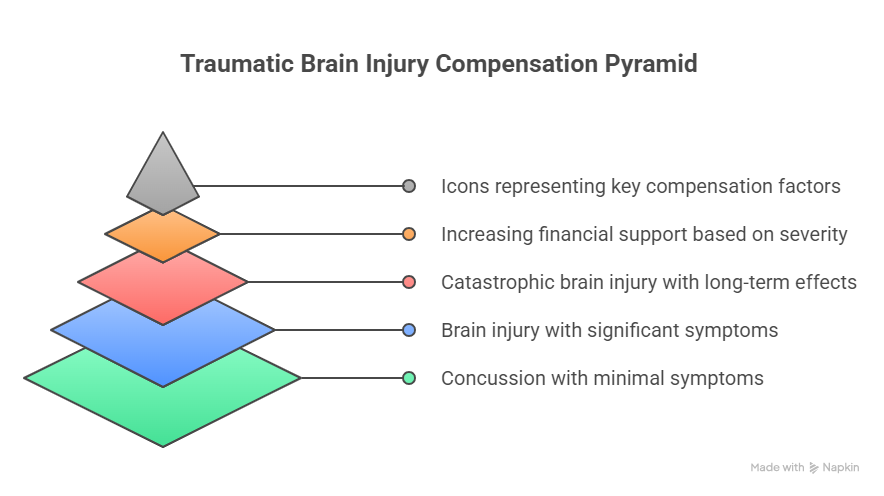
General settlement ranges based on injury severity are:
- Mild TBI (concussion): $50,000 to $150,000
- Moderate TBI: $150,000 to $500,000
- Severe or catastrophic TBI: $500,000 to over $2,000,000
These figures cover general damages only. Economic damages like lost income and future care costs are calculated separately and can significantly increase the total.
As of 2025, the national cap on pain and suffering damages sits at approximately $460,969, indexed for inflation each year from the Supreme Court of Canada’s 1978 trilogy of cases. For catastrophic injuries, courts can and regularly do award amounts close to or at that cap for general damages alone, before adding economic losses.
What Factors Determine Your TBI Settlement Amount?
Severity and Medical Documentation
Courts rely heavily on neuropsychological testing, CT and MRI imaging, and treating physician reports. A well-documented injury supported by objective medical evidence commands higher compensation.
Diffuse axonal injury, brain contusion, and anoxic brain injury typically result in larger settlements than a single concussion because the long-term consequences are more serious and better documented. These injuries can also be among the hardest injuries to prove without thorough specialist documentation, which is why building your medical record from day one is critical.
Cognitive and Functional Impairment
Permanent impairment that affects your ability to work, manage relationships, or perform daily tasks directly increases your damages. Vocational experts and life care planners are often retained to translate those deficits into dollar figures that courts can work with.
Your Age and Pre-Injury Income
A 35-year-old professional with 30 working years ahead faces far greater lost earning capacity than someone near retirement. Courts calculate annual income loss multiplied by remaining working years, adjusted for contingencies.
What Can You Claim in a Brain Injury Lawsuit?
Pain and Suffering and Loss of Enjoyment of Life
These are non-economic damages. They compensate you for physical pain, emotional distress, post-traumatic stress disorder, and the permanent loss of activities you used to enjoy. For catastrophic brain injuries, these awards regularly reach $300,000 to $460,969 in Ontario.
Lost Income and Lost Earning Capacity
If your brain injury has reduced or ended your ability to work, you can claim both past lost wages and future lost earnings. This requires payroll records, tax returns, and expert vocational testimony to quantify the full loss. Ongoing cognitive limitations can also develop into chronic pain injury conditions that further affect your earning capacity.
Future Care Costs
This is often the largest single head of damages in a severe TBI case. Future care cost claims cover rehabilitation, therapy, long-term care, home modifications, assistive devices, and attendant care for the rest of your life. Life care planners calculate these costs over your projected lifespan.
For a serious brain injury, lifetime care costs can reach into the millions depending on your age and care needs.
Family Law Act Claims
Under the Family Law Act, R.S.O. 1990, c. F.3, your spouse, children, parents, and siblings may also claim for loss of guidance, care, and companionship. These are separate from your personal injury claim but are typically pursued at the same time. As of 2025, the Family Law Act deductible threshold for motor vehicle accidents is $77,982.13. In the most serious cases, these losses can overlap with wrongful death claims where a brain injury has proven fatal.
Share Your Requirements via WhatsApp!
How Do SABS Accident Benefits Affect Your Claim?
If your brain injury resulted from a motor vehicle accident, you have two separate claims running in parallel.
The Statutory Accident Benefits Schedule (SABS) provides immediate income replacement, medical and rehabilitation benefits, and attendant care through your own auto insurer. These benefits are available regardless of fault.
For non-catastrophic injuries, the combined limit for medical, rehabilitation, and attendant care benefits is $65,000. A catastrophic injury designation unlocks up to $1,000,000 in those same benefits, payable for the lifetime of the insured person, under the current SABS rules for accidents from June 1, 2016 onwards.
Your tort claim against the at-fault driver is separate. Any accident benefits you receive may be deducted from your tort recovery in some categories. An experienced personal injury lawyer coordinates both claims to maximize your total compensation.
If you were injured in a motor vehicle accident or a slip and fall in Mississauga, speaking with a personal injury lawyer early protects your right to full compensation. Maana Law offers free consultations and will come to your home or hospital if needed.
What Reduces a Brain Injury Settlement in Ontario?
Comparative Negligence
If you were partly at fault for the accident, your award is reduced by your percentage of fault. If you are found 20% at fault on a $500,000 award, your recovery becomes $400,000. This is why how your lawyer builds the liability case matters from the start.
The Statutory Deductible
For motor vehicle accident claims, Ontario applies a statutory deductible to general damages awards that fall below a set threshold. As of January 1, 2025, the deductible is $46,790.05 and applies to awards below the threshold of $155,965.54. Awards above $155,965.54 are not subject to any deductible. This deductible does not apply to catastrophic injuries. Your lawyer must present strong evidence to push your award above the threshold.
Gaps in Medical Treatment
Insurers argue that gaps in treatment mean your injuries are not as serious as claimed. Consistent, documented medical care from the date of injury strengthens your position considerably.
How Is Catastrophic Brain Injury Compensation Different in Ontario?
Catastrophic brain injury compensation in Ontario cases follow different rules under both SABS and at common law.
To qualify as catastrophic under SABS, your brain injury must meet specific clinical criteria set out in section 3.1 of the Statutory Accident Benefits Schedule. For adults, a traumatic brain injury may be catastrophic if CT or MRI imaging shows intracranial pathology consistent with trauma and your condition meets specific functional impairment thresholds. Understanding the difference between a catastrophic and a standard personal injury designation is important because it directly determines the benefits available to you.
Once catastrophic status is confirmed, the statutory deductible does not apply. The full $1,000,000 in SABS medical, rehabilitation, and attendant care benefits becomes available for your lifetime. Courts also have significantly more room to award damages that reflect the true lifelong cost of your injury.
Cases involving diffuse axonal injury, severe cognitive impairment, or permanent loss of independence regularly settle or result in awards above $1.5 million in Ontario, with real examples including jury awards of over $3 million in particularly serious pedestrian hit by car average cases.
What Evidence Strengthens a TBI Claim?

Strong TBI claims are built on solid documentation. The importance of proper documentation in personal injury cases cannot be overstated, the sooner you begin building your record, the stronger your case becomes. The key pieces of evidence include:
- Emergency room records and imaging (CT scan, MRI)
- Neuropsychological testing results
- Treating physician reports and specialist opinions
- Rehabilitation records and therapy notes
- Employment records showing income before and after the injury
- Personal journals documenting daily functional limitations
- Witness statements from family, friends, and coworkers
- Life care planner and vocational expert reports
Why Maana Law Is the Right Choice After a Brain Injury
Brain injury cases require legal experience, medical coordination, and the resources to take on insurance companies. Maana Law has built that capability over more than 10 years of personal injury practice in Mississauga and Ontario.
Led by Aman Kalra, the firm provides personalized legal representation with consultations in English and Hindi. The team coordinates police reports, expert opinions, and witness statements to build the strongest possible file for each client.
- No Win, No Fee: You pay nothing unless Maana Law recovers compensation for you
- Free consultation: Your first meeting costs nothing, and home or hospital visits are available
- Proven results: The firm has secured millions in compensation for Ontario injury victims
- Local knowledge: Serving Mississauga communities including Erin Mills, Cooksville, Churchill Meadows, Meadowvale, and City Centre
- Languages spoken: English and Hindi, so you are never lost in legal language
- Accessibility: Virtual meetings and in-person consultations available to fit your situation
Maana Law’s 5-star Google rating reflects a client-first approach that puts real people first.
Frequently Asked Questions
How long does a brain injury settlement take in Ontario?
Most TBI cases in Ontario take one to three years from injury to settlement or trial. Catastrophic injury cases with complex future care assessments often take longer. Starting your claim promptly avoids delays caused by missed limitation periods. Learn about what to expect during a personal injury lawsuit in Ontario to prepare yourself for the process.
What is the limitation period for a brain injury claim in Ontario?
The general limitation period in Ontario is two years from the date you knew or ought to have known about your injury and its cause, under the Limitations Act, 2002, S.O. 2002, c. 24, Sched. B. Some exceptions apply for minors and those with cognitive impairment. Speak with a lawyer as soon as possible to protect your rights.
Can I claim for a mild TBI if I did not lose consciousness?
Yes. Loss of consciousness is not required for a valid TBI claim. Many mild TBI settlements in Ontario involve concussions where the injured person remained fully conscious. What matters is a documented medical diagnosis and the ongoing impact on your daily life.
What if the at-fault driver has no insurance or minimal coverage?
If the at-fault driver is uninsured or underinsured, you may be able to claim under your own auto policy’s uninsured and underinsured motorist provisions. The Financial Services Regulatory Authority of Ontario (FSRA) oversees insurance regulation in the province. you can review consumer guidance on auto insurance rights from FSRA to understand your coverage options. The process differs from a standard tort claim and requires careful handling from the start.
Do I need a lawyer to settle a brain injury claim in Ontario?
You are not legally required to have a lawyer, but brain injury cases involve complex medical evidence, SABS coordination, catastrophic designations, and experienced insurer adjusters. Represented claimants consistently recover more than those who negotiate on their own.
Conclusion
A traumatic brain injury changes everything. The financial consequences, from lost income to lifetime care costs, can be severe without proper legal recovery.
Three things to remember: the severity of your injury and the medical evidence behind it are the foundation of your claim; economic damages like lost earnings and future care often exceed general damages in serious TBI cases; and acting quickly preserves your right to full compensation under Ontario law.
You deserve honest advice about what your case is actually worth and a legal team prepared to fight for it.
Contact Maana Law’s brain injury lawyers in Mississauga today. Call or visit maanalaw.com to book your free consultation. Aman Kalra and the team are available in English and Hindi, with home and hospital visits available. There are no fees unless you recover compensation.