A collision with a tractor-trailer or commercial vehicle changes everything in an instant. The shock, confusion, and uncertainty that follow are overwhelming, and most people are left asking the same question: what now?
If you or someone you love has been injured in a truck accident in Ontario, the steps you take early can significantly impact your health, your rights, and your ability to recover fair compensation. Ontario’s truck accident compensation system has strict rules and deadlines that differ from standard car accident claims, making early guidance critical.
At Maana Law, our truck accident lawyers in Mississauga help truck accident victims and their families in Ontario understand their situation from the very beginning and move forward with clarity and confidence.
By the end of this guide, you will understand:
- The immediate steps to take at the accident scene to stay safe and protect your claim
- How and why to report a truck accident to police under Ontario law
- The difference between Ontario’s Statutory Accident Benefits and a tort claim against the at-fault truck driver or carrier
- What evidence is unique to truck accidents and why the clock starts running immediately
- Who else can make a claim if a family member was seriously injured or killed, including rights under the Family Law Act
- The specific Ontario deadlines that apply to different types of claimants, and what happens if they are missed
Truck accident settlements in Ontario range from $50K to over $1.5M. Our lawyers will evaluate your specific case.
What Should You Do Immediately After a Truck Accident in Ontario?
A fully loaded tractor-trailer can weigh up to 36,287 kg. The scale of a collision at that size creates unique dangers, including secondary collisions, cargo displacement, and fuel spills. Your first actions determine both your safety and the strength of any future claim. Understanding what to do after a motor vehicle accident in Ontario is a strong foundation, but truck accidents carry additional considerations.
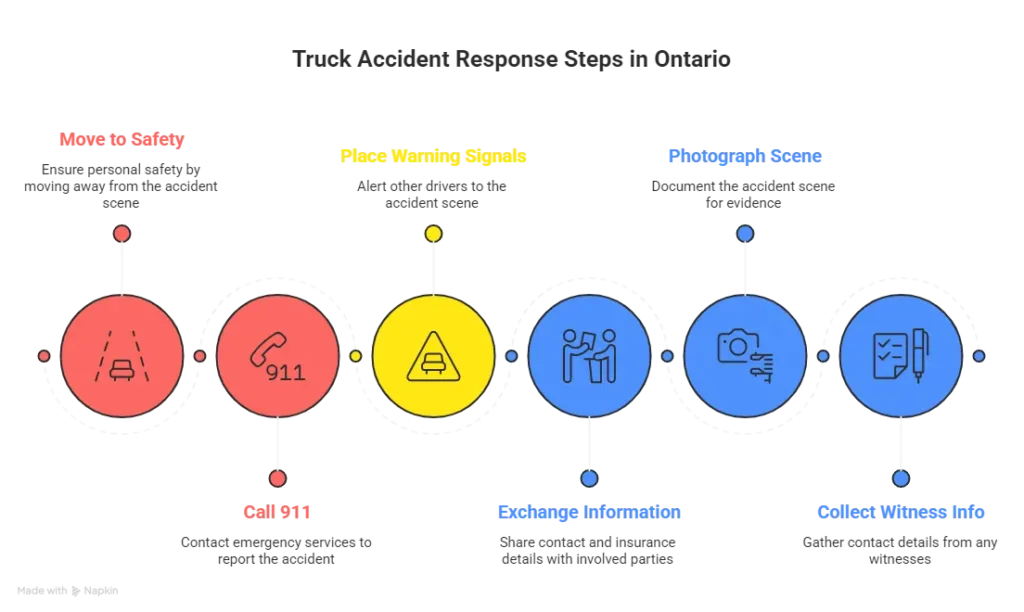
- Move to safety if you can do so without risk. If your vehicle is drivable, pull onto the shoulder.
- Activate your four-way flashers immediately to warn approaching traffic.
- Call 911 without delay. Request an ambulance and stay on the line until help is confirmed.
- Place warning triangles or flares behind your vehicle if safe to do so.
- Stay away from the truck’s cargo area. Loads can shift after impact.
- Exchange information with the truck driver once it is safe, but say nothing about fault.
Do not stand between vehicles or near the trailer. If you are too injured to move, stay buckled in and use your horn or phone to signal for help.
Move to Safety and Activate Your Hazard Lights Right Away
On a 400-series highway, your vehicle and the truck create a combined hazard zone that approaching drivers may not be able to avoid in time. Activating four-way flashers signals oncoming traffic before anyone can see the full scale of the collision. If you have warning triangles or flares and can place them safely, do so at a distance behind your vehicle.
Do not stand between vehicles, near the cab, or anywhere close to the trailer and cargo area. Even a truck that appears stationary can shift on an unstable surface. If emergency services have been called, stay visible, stay on the shoulder, and wait.
Call 911 Even If You Think You Are Not Injured
Ontario’s Highway Traffic Act, section 199, requires reporting any collision involving injury, death, or property damage over $2,000. A commercial vehicle collision will almost always exceed this threshold.
Serious injuries from truck accidents including traumatic brain injury, spinal cord and spinal fracture injuries, and internal bleeding, frequently produce no immediate symptoms at the scene. Adrenaline is a powerful pain suppressant. Request ambulance transport when you call 911. Declining transport is one of the most common and consequential mistakes truck accident victims make. It creates a gap in your medical timeline that insurers use to challenge the severity of your injuries.
Exchange Information and Avoid These Common Mistakes
Under Highway Traffic Act section 200, drivers must exchange names, addresses, licence numbers, vehicle registration, and insurance details. In a truck accident, also collect the driver’s commercial licence information, the carrier name, commercial vehicle registration, trailer identification numbers, and the carrier’s insurance information.
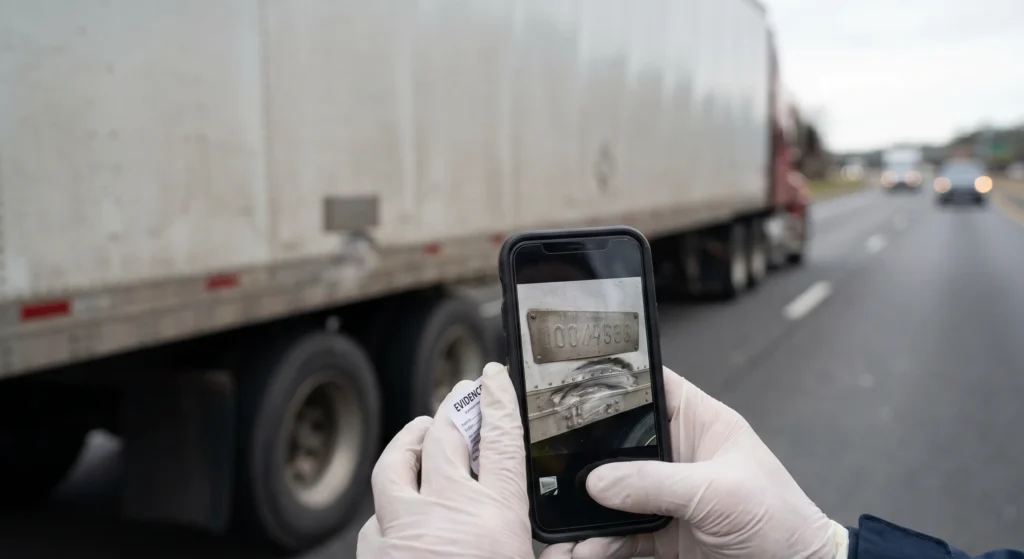
Photograph the licence plate, any company logos or DOT numbers on the cab, and all trailer identification numbers before vehicles are moved.
Do not say anything that could be interpreted as an admission of fault, including polite apologies. Do not discuss your speed, your visibility, or what you were doing before the collision. Your only obligation at the scene is to exchange identifying information and cooperate with police.
Why Does Collecting Evidence at the Scene Matter More in a Truck Accident?
A truck accident is a different category of collision from an evidentiary standpoint. Liability can extend beyond the driver’s conduct to include carrier maintenance practices, federal Hours of Service compliance, and electronic data systems. That evidence is time-sensitive and begins disappearing once the crash investigation ends. Understanding the role of evidence in personal injury claims is especially important in truck accident cases, where records are held by the carrier and can disappear quickly without legal action.
Photograph Everything at the Scene Before Vehicles Are Moved
Use your phone to photograph all four sides of both vehicles, any skid marks, road conditions including potholes or ice, traffic control devices, and your location using visible signage or kilometre markers. Time-stamped GPS metadata records when and where each image was taken.
If cargo has shifted or appears unsecured, document it carefully. Load securement violations are an independent source of liability against the carrier. Document trailer identification numbers and company markings before the truck is moved. Proper documentation in personal injury cases often determines the difference between a strong claim and one that is difficult to prove.
Speak with Witnesses Before They Leave the Scene
Independent witness statements are especially valuable in truck accident claims because carriers retain sophisticated accident reconstruction firms. Collect each witness’s full name and phone number, and if they are willing, record their account on your phone immediately.
Surveillance footage from truck stops, highway cameras, and nearby commercial properties may have captured the collision. Most systems overwrite footage within 72 hours. A lawyer can send legal preservation demands to these operators, but this must happen quickly.
Don’t navigate this alone. Ontario truck accident victims recover $50K to $1.5M+. Let Aman Kalra protect your claim and maximize your compensation today.
Truck-Specific Records Your Lawyer Will Seek to Preserve
Electronic logging device data records the truck’s operational status and establishes whether the driver was in compliance with federal Hours of Service regulations. Canada’s federal ELD mandate requires most commercial carriers to use certified devices. A driver who exceeded permitted driving hours creates the foundation of a negligence claim against the carrier directly.
Pre-trip inspections are legally required before each trip under Canada’s National Safety Code Standard 13. If the vehicle had known defects that were not repaired, that creates independent carrier liability. Maintenance logs for the specific vehicle can reveal a history of unresolved defects, including brake failures and steering deficiencies.
The truck’s event data recorder captures speed, braking force, throttle position, and other data in the seconds before impact. This data must be preserved before the vehicle is repaired or scrapped. A formal legal preservation demand requires a lawyer to act before the carrier’s data retention cycle overwrites the records.
How Do You Report a Truck Accident to Police in Ontario?
Reporting a truck accident is both a legal requirement and a practical necessity for your insurance claim, your Statutory Accident Benefits application, and any tort claim you may pursue.
When police attend the scene, they will collect identity and contact information for all parties, vehicle registration and insurance details, road and weather conditions, scene observations, and any charges laid. Request the collision report number and the officer’s name and badge number before leaving.
When Are You Legally Required to Call Police After a Truck Accident in Ontario?
Section 199 of the Highway Traffic Act requires any driver involved in a collision to report it to police when there is injury, death, or property damage over $2,000. Do not attempt to assess whether your accident meets the threshold. Call 911 and let the responding officers make that determination.
If police do not attend, you may be directed to a Collision Reporting Centre. Ontario has centres in Toronto, Mississauga, Brampton, Hamilton, Ottawa, London, and other major areas. Failing to report a reportable collision is an offence under the HTA and can also complicate your insurance claim.
Why the Police Report Is Critical for Your Truck Accident Insurance Claim
The police collision report is typically required when filing a Statutory Accident Benefits claim and when notifying your insurer as required under your policy. It records the responding officer’s direct observations of the scene, along with any charges laid against the truck driver.
Charges laid at the scene carry significant weight. A truck driver charged with careless driving, a carrier cited for Hours of Service violations, or a vehicle placed out of service for inspection deficiencies creates a documented record of regulatory non-compliance that becomes relevant in civil proceedings. The full written report can be obtained from the reporting police service for a fee currently ranging from approximately $65 to $90.
Your Legal Rights: SAB and Tort Claims
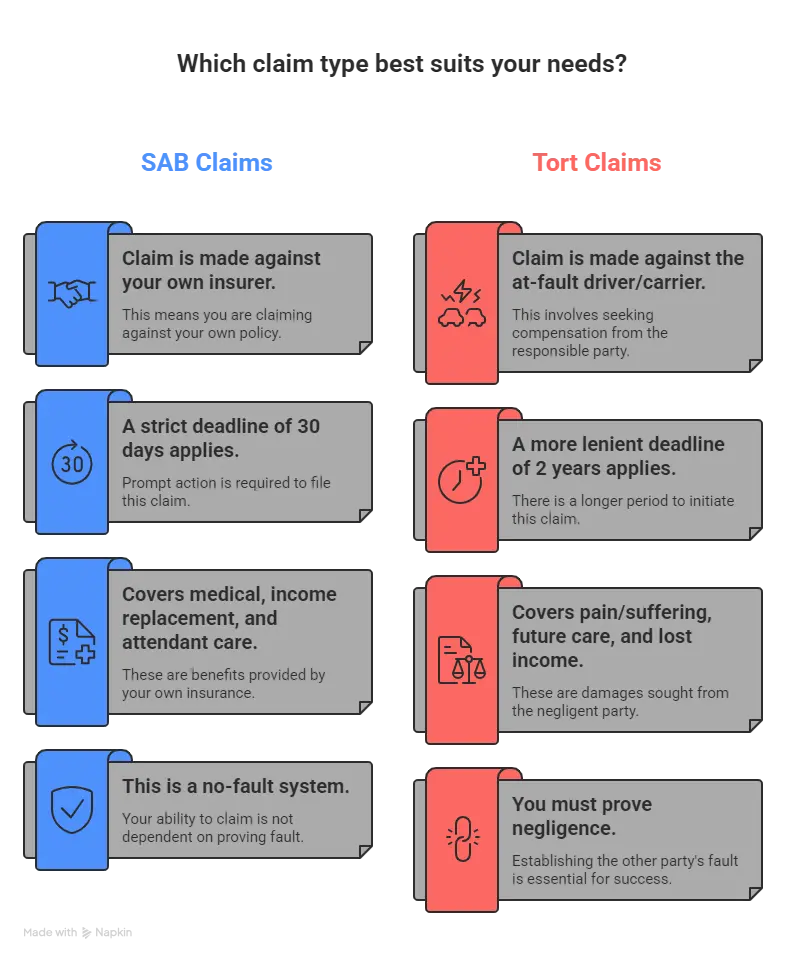
Ontario operates a dual-track system. You can pursue a Statutory Accident Benefits claim against your own insurer for accident benefits regardless of fault, and a separate tort claim against the at-fault truck driver and carrier for damages beyond those benefits. If you want to understand how compensation is calculated, our overview of truck accident settlements in Ontario explains the factors that influence what victims recover.
Under the doctrine of vicarious liability, the carrier can be held responsible for negligent acts its driver commits during the course of employment. Carriers may also face independent negligence claims for Hours of Service violations, failed inspections, or inadequate vehicle maintenance. Commercial carriers carry substantially higher liability insurance coverage than individual drivers, which matters when injuries are serious particularly in cases involving catastrophic injuries where lifetime care costs are at stake.
Family members of a seriously injured or deceased victim may have separate claims under section 61 of Ontario’s Family Law Act for loss of guidance, care, and companionship. In these cases, working with a wrongful death lawyer in Mississauga ensures that both the estate claim and the family member claims are pursued together, without deadlines being missed. Understanding how to file a wrongful death lawsuit in Ontario is an important early step for families navigating these circumstances. These rights exist independently of whatever claim the primary victim or their estate pursues.
Key Ontario Deadlines
There is not one deadline. There are several running at the same time. The Statutory Accident Benefits application must be submitted to your own insurer within 30 days of the accident under Ontario Regulation 34/10. The tort claim against the at-fault truck driver or carrier is subject to a two-year limitation period under the Limitations Act, 2002, running from the date you knew or ought to have known you had a claim. Family Law Act claims and estate claims following wrongful death each carry their own timelines and should be assessed by a lawyer as early as possible.
Missing any of these deadlines can permanently reduce what you recover. Missing any of these deadlines can permanently reduce what you recover. To understand what a successful truck accident claim can be worth, read our detailed guide on truck accident settlement amounts in Ontario.
Why Choose Maana Law After a Truck Accident in Ontario
Contingency Fee Representation (No Win, No Fee) You don’t pay any legal fees unless your case is successful. There are no upfront costs, so you can start your claim without financial pressure. You can learn more about our legal fee structure before making any commitment.
Free Initial Consultation You get a clear understanding of your rights, options, and potential claim value before making any commitment.
Ontario Truck Accident Legal Expertise (SABS & Tort System) Our truck accident lawyers understand Ontario’s dual-track system, federal trucking rules, and strict limitation deadlines, ensuring your claim is built correctly from the start.
Immediate Evidence Preservation Strategy Critical evidence such as black box data, electronic logging records, maintenance logs, and inspection reports is identified and preserved early to protect your case.
Frequently Asked Questions
Do I have to call the police after a truck accident in Ontario?
In most cases, yes. Section 199 of Ontario’s Highway Traffic Act requires reporting any collision involving injury, death, or property damage over $2,000. Virtually every collision with a commercial motor vehicle will meet that threshold.
Can I sue the trucking company as well as the driver?
Yes. Carriers can be held vicariously liable for a driver’s negligence and may face independent liability for regulatory violations, failed inspections, or inadequate maintenance. Our truck accident lawyers in Mississauga pursue all liable parties to maximize your recovery.
Will filing an insurance claim affect my rates?
Filing a Statutory Accident Benefits claim should not result in a rate increase when you were not at fault. Ontario Regulation 664 under the Insurance Act limits an insurer’s ability to penalize not-at-fault claimants on renewal.
Conclusion
A truck accident is not a standard car accident claim. The dual-track system of Statutory Accident Benefits and tort liability means at least two distinct legal paths are running simultaneously, each with its own deadlines. The evidence that matters most is held by the carrier and can disappear within days without timely legal action.
If you or someone you love has been injured in a truck accident, contact Maana Law’s truck accident lawyers in Mississauga today to schedule your free consultation. Visit maanalaw.com or call to speak with a member of the team about your situation.