

In Ontario, you have two years from the date of your accident or the date you discovered your injury to file a personal injury lawsuit. Miss this window and you lose the right to sue, no matter how strong your case is. Speaking with a Personal injury lawyer early is the single most effective way to protect your filing deadline and preserve your right to compensation.
Here is what this guide covers:
- The two-year limitation period and how it starts
- How the discoverability principle can shift your deadline
- Special notice requirements for car accidents, slip and fall, and municipal claims
- Exceptions for minors and incapacitated persons
- What happens if you miss the deadline
What Is the Limitation Period for Personal Injury Claims in Ontario?
You have two years to sue. Under the Ontario Limitations Act, 2002, most personal injury claims must be filed within two years of the date you discovered or reasonably should have discovered your injury.
This two-year clock usually starts on the accident date. The discoverability principle can push it later if your injury was not immediately obvious. A court will not hear your case if you file after this window closes, regardless of the merits.
For example, a client injured in a rear-end collision typically has until the second anniversary of that accident to file a statement of claim with the Superior Court of Justice. Understanding personal injury law in Ontario from the start helps you avoid costly mistakes with these deadlines.
Share Your Requirements via WhatsApp!
Does the Discovery Date Always Match the Accident Date?
No. Your two-year clock starts when you knew, or should have known, about the injury and its cause. The discoverability principle means the limitation period begins when three things are reasonably apparent:
- An injury occurred
- It was caused by another person’s act or omission
- A lawsuit would be an appropriate response
For most motor vehicle accidents, discovery happens on the day of the collision. But in cases involving steps to take if soft tissue injuries, understanding chronic pain, or neurological symptoms that appear weeks later, the date of discovery can shift.
Courts apply a reasonable diligence standard. You are expected to seek medical attention and investigate your situation promptly, not wait years before taking action.
Is There an Absolute Deadline Beyond Two Years?
Yes. Ontario sets a 15-year ultimate limitation period. No matter when you discover your injury, you cannot sue more than 15 years after the act or omission that caused the harm.
This ultimate limitation period rarely affects standard accident claims where injuries are apparent right away. It matters most in cases of latent harm such as delayed exposure injuries, product liability settlements, or negligence that was actively concealed.
What Special Notice Requirements Apply Before You Can Sue?
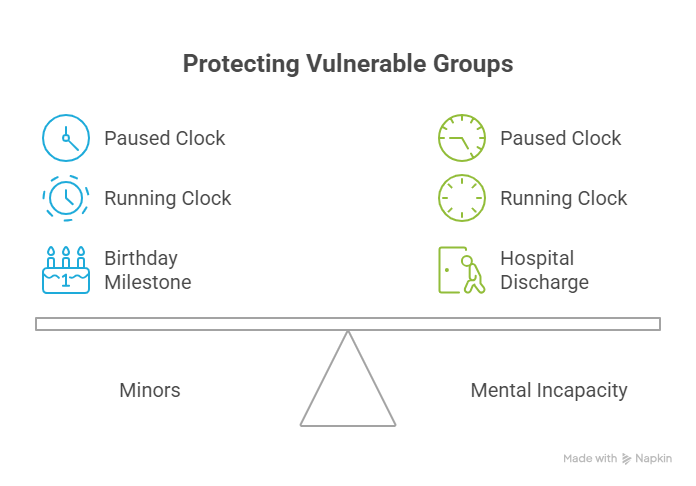
Several claim types require written notice well before the two-year filing deadline. Missing these shorter windows can end your case before it starts.
Motor Vehicle Accident Claims
You must notify your insurer promptly after an accident. Submit the OCF-1 form (accident benefits application) within 30 days. For accident benefits, a seven-day notice is required if you intend to apply. The tort claim against the at-fault driver follows the standard two-year period from the accident or discovery date. Knowing what to do after a car accident in Ontario helps you meet every notice requirement on time.
Slip and Fall on Municipal Property
If you were hurt on a municipally owned sidewalk, road, or public space, you must deliver written notice to the municipality within 10 days of the accident. For injuries caused by snow or ice, that window extends to 60 days. For a detailed breakdown of these rules, review the slip and fall limitation period in Ontario.
Failing to meet this notice requirement gives the municipality a strong legal defence. Courts have some discretion to excuse late notice, but only if the municipality suffered no prejudice from the delay.
Accident Benefits Disputes
If your insurer denies an accident benefits claim, you have two years from the date of denial to apply to the Licence Appeal Tribunal. This is separate from a civil lawsuit against the at-fault driver.
Do Limitation Periods Apply Differently to Minors and Incapacitated Persons?
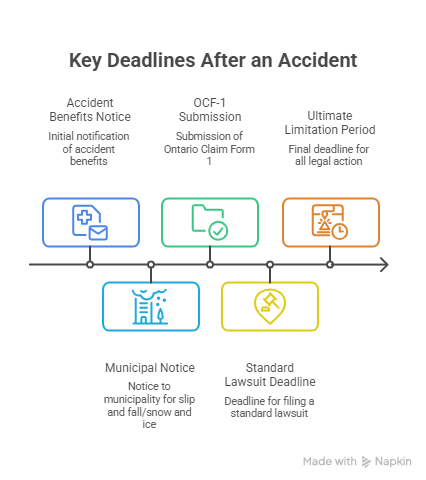
Yes. The two-year clock does not run while a claimant is a minor or mentally incapacitated. Ontario law protects vulnerable claimants who cannot reasonably pursue their own legal rights.
For a minor plaintiff, the limitation period begins on their 18th birthday. A child injured at age 12 has until age 20 to sue unless a litigation guardian files a claim on the child’s behalf sooner.
For a person with mental incapacity, the period is suspended until capacity is restored or a litigation guardian is appointed. In cases involving brain injuries, this suspension can last years.
One important exception: if a litigation guardian was already in place at the time the claim arose, the standard two-year period applies from that date.
What Damages Can You Claim in an Ontario Personal Injury Lawsuit?
You can claim compensation for financial losses, physical harm, and impacts on your quality of life. Ontario personal injury law recognizes several categories of damages:
- Medical expenses: past and future treatment costs
- Rehabilitation costs: physiotherapy, occupational therapy, assistive devices
- Lost wages: income lost during recovery
- Future care costs: for catastrophic injury compensation
- Pain and suffering (non-pecuniary damages): subject to the serious impairment threshold and statutory deductible
- Family Law Act claims: loss of care, guidance, and companionship claimed by close family members
To recover pain and suffering damages from a motor vehicle accident, your injury must meet the serious impairment threshold. It must be permanent and seriously affect an important physical, mental, or psychological function.
A statutory deductible (approximately $44,367 as of recent indexing) is applied to pain and suffering awards. Claims that fall below the threshold after deduction result in no payment for non-pecuniary damages. Understanding how much a car accident settlement is worth in Ontario helps you evaluate whether your claim clears this threshold.
Ontario accident victims have limited time to file. Settlements range from $30K to over $1M. Let Aman Kalra protect your claim today.
What Evidence Should You Preserve After an Accident?
Gather and protect your evidence as soon as possible, long before the two-year deadline. Evidence degrades, witnesses forget, and surveillance footage is overwritten within days.
Steps to take immediately after an accident:
- Get a police report if law enforcement attended the scene
- Collect witness statements and contact information on the spot
- Photograph your injuries, the scene, and any property damage
- Seek medical attention right away and keep all medical documentation
- Notify your insurer within the required timeframes
- Track every expense, missed workday, and how the injury affects daily life
Proper documentation is your strongest tool. Causation is often the most contested issue in personal injury claims. Consistent medical records from the date of the accident are critical. Defence counsel routinely use gaps in treatment to argue that injuries were minor, unrelated, or already resolved. Many legitimate injuries are classified among the hardest to prove in court, making early and thorough evidence collection even more important.
What Happens If You Miss the Deadline to Sue in Ontario?
In most cases, you lose the right to sue permanently. Once the personal injury lawsuit deadline in Ontario has passed, the defendant can raise the expired limitation period as a complete defence. The court will not consider your claim on its merits.
Narrow exceptions may apply in these situations:
- The discoverability principle genuinely delayed when the limitation period started
- The defendant’s conduct actively concealed the claim
- The claimant was a minor or mentally incapacitated at the relevant time
These exceptions are not easily won. Courts will not extend a deadline simply because a claimant was unaware of the law or delayed seeking legal advice. You must prove the exception applies to your specific facts.
If you think your deadline may have passed, speak with a personal injury lawyer right away. Some missed deadlines are recoverable but only if you act quickly.
Why Maana Law Is the Right Choice for Your Ontario Personal Injury Claim
Knowing your deadline is the first step. Navigating notice requirements, insurer negotiations, evidence gathering, and litigation is another matter entirely. At Maana Law in Mississauga, our team brings over a decade of personal injury experience to every case.
Limitation period expertise: We identify your exact filing deadline, account for the discoverability principle, and ensure no notice requirement is overlooked.
No Win, No Fee: You pay nothing unless we recover compensation for you.
Free consultations: Get a clear assessment of your case at no cost.
Home and hospital visits: We come to you if your injury makes travel difficult.
Multilingual service: Our team serves clients in English and Hindi across Erin Mills, Cooksville, Meadowvale, and the Greater Toronto Area.
Thorough case preparation: We review police reports, medical records, expert opinions, and witness statements to build the strongest possible claim.
Frequently Asked Questions
How long after a car accident can you sue in Ontario?
You have two years from the accident date or the date you discovered your injury was caused by negligence. This is the standard limitation period under the Ontario Limitations Act. Knowing when to hire a car accident lawyer helps you start the process well before any deadline approaches.
What is the discoverability principle in Ontario personal injury law?
It means the two-year period begins when you knew or reasonably should have known that an injury occurred, who caused it, and that a lawsuit was appropriate. It can delay the start of your limitation period when injuries are not immediately apparent. This is particularly relevant for injuries such as concussions or chronic pain, where harm may not surface for months or years.
Can I still sue if I missed the two-year deadline?
In most cases, no. The expired limitation period is a complete defence. Limited exceptions exist for minors, persons with mental incapacity, and cases where the claim was genuinely undiscoverable.
What is the notice requirement for a slip and fall on municipal property?
You must provide written notice within 10 days of the accident. For snow or ice injuries, the window is 60 days. Missing this notice can be fatal to your claim. Review slip and fall settlement amounts in Ontario to understand what your claim may be worth once notice requirements are met.
Does the two-year limitation period apply to accident benefits claims?
Not exactly. If your insurer denies a benefit, you have two years from the denial date to apply to the Licence Appeal Tribunal. This process is separate from a civil litigation lawsuit against the at-fault driver.
Conclusion
The two-year limitation period is a hard deadline. Once it passes, your right to sue is gone. Notice requirements for municipal claims and accident benefits are even shorter, some as brief as 10 days.
If you were injured in an accident in Ontario, do not delay. Contact a personal injury lawyer before your deadlines pass.
Contact Maana Law at 90 Matheson Blvd W, Suite 101, Mississauga, ON. Call us or book a free consultation online. We will review your case, confirm your deadlines, and help you take the right steps forward.