
INTRODUCTION
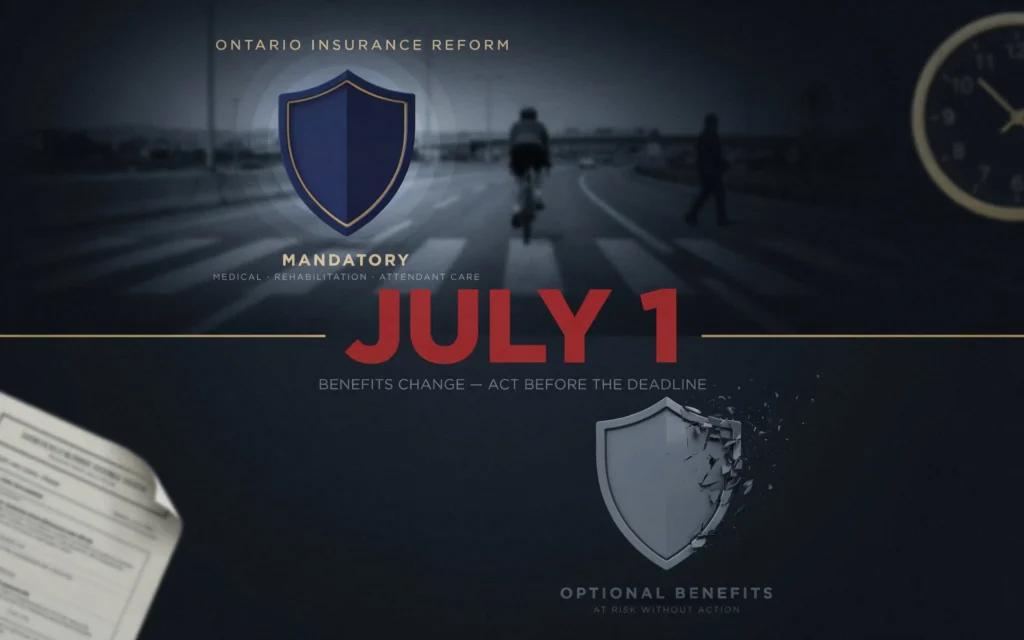
Starting July 1, Ontario’s automobile insurance rules change significantly. The change isn’t that accident benefits disappear. It’s that some accident benefits transition from mandatory to optional, pick-and-choose coverage. This distinction matters enormously.
Here’s what actually happens: Essential medical protections remain mandatory on all policies. You’re guaranteed coverage for medical treatment, rehabilitation, and attendant care if injured in an accident. That protection doesn’t disappear.
What changes: Financial and family support benefits become optional. Income replacement. Caregiver support. Death benefits. Housekeeping assistance. These now require you to actively choose and pay for them. Without selecting them, they don’t apply.
For Mississauga residents drivers, cyclists, pedestrians, and families, this creates a two-tier system. Mandatory essentials cover medical needs. Optional protections cover financial losses.
This guide explains exactly which benefits stay mandatory, which become optional, how the named driver rule affects who gets coverage, and what you must do before June 30 to protect yourself.
Ontario insurance changes can drastically impact your settlement. Get clarity on what you’re entitled to. Our lawyers will evaluate your specific case.
WHAT STAYS MANDATORY ON JULY 1?
Three essential accident benefits remain mandatory on every automobile insurance policy in Ontario:
Medical Benefits Covers hospital treatment, doctors, medications, and medical expenses following an accident injury. This cannot be removed. Every Ontario policy includes it automatically.
Rehabilitation Benefits Covers physiotherapy, occupational therapy, psychology services, and other recovery treatments. This is mandatory. You cannot opt out.
Attendant Care Benefits Covers nursing care and personal care assistance if you’re seriously injured and unable to care for yourself. Mandatory on all policies.
These three benefits protect everyone: drivers, passengers, cyclists, pedestrians. If you’re injured in an accident, these mandatory benefits apply regardless of how the accident occurred or who caused it.
This is the critical protection that remains unchanged on July 1. Essential medical coverage doesn’t disappear. It stays in place.
WHAT BECOMES OPTIONAL STARTING JULY 1?
All other accident benefits transition from mandatory to optional. You must actively choose these benefits. If you don’t select them during renewal, they disappear from your policy.
The optional benefits that now require you to pay extra:
Income Replacement Benefits (IRB) Previously: Full replacement of lost income (70-90% of pre-accident earnings, up to maximum limits) After July 1: Optional. Default amount drops to $400/week if you don’t purchase higher coverage. You can decline this entirely. Impact: If you’re injured and can’t work, you lose significant income protection unless you specifically purchase it.
Caregiver Benefits Previously: Automatic coverage if someone needs to care for you or your dependents After July 1: Optional. You must purchase it. If you decline, there’s no coverage. Impact: If you’re seriously injured, family members who become caregivers aren’t compensated for lost income or expenses.
Non-Earner Benefits Previously: Automatic for students, unemployed individuals, homemakers After July 1: Optional. Must be purchased. Impact: If a student is injured in an accident and can’t attend school, there’s no financial support unless you bought this benefit.
Housekeeping and Home Maintenance Benefits Previously: Automatic if injury prevents normal household tasks After July 1: Optional. Must be purchased. Impact: If you’re injured and can’t clean, maintain your home, or do yard work, you pay for these services personally unless you have this coverage.
Death Benefits and Funeral Expenses Previously: Automatic protection for families After July 1: Optional. Must be purchased. Impact: If someone dies in an accident, their family bears funeral costs and loses financial support unless this benefit was purchased.
Damage to Personal Items Previously: Automatic if personal property damaged in accident After July 1: Optional. Must be purchased. Impact: If your glasses, hearing aids, or clothing are damaged in the accident, you replace them at personal cost unless you purchased this benefit.
Lost Educational Expenses Previously: Automatic if accident prevents school attendance After July 1: Optional. Must be purchased. Impact: If an accident prevents you from completing education, you cover tuition losses personally.
Expenses of Visitors Previously: Automatic if family travels to visit you during recovery After July 1: Optional. Must be purchased. Impact: If you’re hospitalized far from home, family travel costs come from your pocket.
The pattern is clear: Financial and family-support benefits are no longer automatic. You must choose them. You must pay extra. If you decline, they don’t apply.
THE NAMED DRIVER RULE: WHO GETS COVERAGE FOR OPTIONAL BENEFITS?
The second major change on July 1: Eligibility for optional accident benefits narrows significantly. Even if your policy includes optional benefits, not everyone qualifies for payment.
After July 1, optional accident benefits apply ONLY to:
The named insured (policy owner) The spouse of the named insured Dependants of the named insured and/or spouse Persons specifically listed as drivers on the policy
Who LOSES coverage for optional benefits (even if the policy includes them):
Non-listed drivers who aren’t dependants Passengers who aren’t dependants or spouses Extended family members not meeting dependant definition Friends, coworkers, or third parties injured in your vehicle Pedestrians hit by your vehicle Cyclists hit by your vehicle Anyone injured by your vehicle who isn’t in the four eligible categories above
This creates a critical gap for Mississauga cyclists and pedestrians.
Don’t let policy changes cost you money. Mississauga injury victims still recover $30K to $1M+. Let Aman Kalra explain your rights under the new rules today.
HOW THIS AFFECTS MISSISSAUGA CYCLISTS AND PEDESTRIANS
Cyclists and pedestrians have mandatory protection. Medical, rehabilitation, and attendant care benefits apply to them after accidents. These essential benefits don’t disappear.
But here’s where the gap appears:
Cyclist hit by a car: Mandatory medical and rehabilitation benefits apply. The driver’s policy covers your treatment, therapy, and nursing care. This is guaranteed.
But: Optional benefits like income replacement don’t apply to you because you’re not a named driver on that policy. If the accident prevents you from working for three months, you lose income with no insurance backup. You bear that cost personally.
Pedestrian struck by a vehicle: Mandatory benefits apply. Treatment, therapy, attendant care are covered.
But: If the accident causes income loss, you’re not eligible for income replacement unless you carry your own auto insurance and purchased this benefit. Family’s income drops. You absorb those costs.
Cyclist without vehicle insurance: You still get mandatory benefits if hit by a car. Treatment is covered. Rehabilitation is covered.
But: You cannot access optional benefits (income replacement, caregiver support) because you’re not a named driver on any policy. If injured, your financial losses are personal responsibility.
The essential protection remains. You won’t go without medical treatment. But financial recovery protection depends on whether optional benefits were purchased by the at-fault driver’s policy or whether you own a vehicle and purchased these benefits yourself.
This is fundamentally different from saying “cyclists and pedestrians lose all coverage.” They don’t lose mandatory medical coverage. They lose access to optional financial protections.
INCOME REPLACEMENT BENEFITS: THE BIGGEST FINANCIAL IMPACT
Income replacement is the optional benefit most people need but often cut to save money on premiums.
Previously: Automatic coverage. If injured, you received 70-90% of pre-accident income up to policy limits while recovering.
After July 1: Optional. You must purchase it. Default coverage (if you don’t buy extra) is $400/week maximum.
Financial reality:
Scenario 1: Cyclist earning $60,000/year injured for 3 months Lost income: $15,000 Default optional benefit coverage at $400/week: $4,800 total Gap you pay personally: $10,200
Scenario 2: Parent earning $50,000/year unable to work for 4 months Lost income: $16,667 Default optional benefit at $400/week: $6,400 total Gap you pay personally: $10,267
Scenario 3: Freelancer earning $70,000/year injured for 6 months Lost income: $35,000 Default optional benefit at $400/week: $12,800 total Gap you pay personally: $22,200
The $400/week default is roughly $21,000 annually. For most people earning $40,000-80,000 yearly, this creates significant shortfalls.
Insurance companies designed the $400/week default to encourage people to purchase higher optional coverage. But many people simply cut the benefit entirely to reduce premiums.
WHAT SHOULD YOU DO BEFORE JULY 1?
Action required before June 30:
Step 1: Get your current insurance policy documents. Read the coverage section. Identify which benefits are included currently. Identify which are optional starting July 1.
Step 2: Call your insurance company. Ask specifically: “Which of my benefits remain mandatory after July 1?” Write the answer. Ask: “Which optional benefits does my policy currently include?” Write that list.
Step 3: Review who’s listed on your policy. Are you a named driver? Your spouse? Your teenage child? Family members who cycle regularly? Document this.
Step 4: Get a renewal quote. Ask your insurer: “If I remove [specific optional benefit], how much does my premium drop?” Get exact dollar amounts for each possible removal.
Step 5: Calculate true costs. If you remove income replacement but earn $60,000 yearly, a three-month injury costs you $15,000 in lost wages. Is your premium savings worth that risk? Likely not.
Step 6: Decide consciously. For each optional benefit, decide: keep or remove? Base this on your actual life circumstances. Are you employed? Do you have dependents? Do you cycle regularly? Do you own a home?
Step 7: Ensure key people are listed. If your adult child cycles everywhere and doesn’t own a car, consider adding them as a named driver on your policy. This ensures they access optional benefits if injured as a cyclist.
Step 8: Make changes before June 30. Policy changes before July 1 follow current rules. Changes after July 1 follow new rules.
MANDATORY VS. OPTIONAL: WHAT YOU CANNOT LOSE
You cannot lose mandatory benefits:
Medical benefits remain mandatory. Period. Rehabilitation benefits remain mandatory. Period. Attendant care benefits remain mandatory. Period.
Every policy in Ontario includes these on July 1. You’re guaranteed medical coverage if injured in an accident, regardless of circumstances.
What you CAN lose by not acting:
Income replacement (defaults to $400/week if you don’t upgrade) Caregiver support Financial help for students Death and funeral coverage Home maintenance assistance Personal item damage coverage Educational expense coverage Visitor expense coverage
If you don’t actively choose these optional benefits before June 30, they disappear from your policy July 1. You’re responsible for those costs if injury happens.
QUESTIONS TO ASK YOUR INSURANCE COMPANY RIGHT NOW
Before renewal, ask these specific questions:
- Which of my benefits are mandatory and which are optional after July 1? Answer: Get exact list. Mandatory = medical, rehabilitation, attendant care. Optional = everything else.
- If I keep all optional benefits, what’s my new premium after July 1? Answer: Get exact amount.
- If I remove [specific optional benefit], how much do I save? Answer: Get exact dollar savings for each benefit you consider cutting.
- If I’m injured and can’t work, what’s the maximum income replacement I’d receive? Answer: Under current policy vs. default $400/week after July 1.
- How does the named driver rule affect people injured while cycling or walking in my vehicle? Answer: Get clarity on whether passengers and injured non-drivers qualify for optional benefits.
- If my teenage child cycles everywhere but isn’t a licensed driver, can I list them as a named driver to protect them? Answer: Clarify how this works. It may be possible to add them.
- If someone hits me while I’m cycling, can I access their policy’s optional benefits? Answer: Most likely no. But confirm. If no, you need your own coverage.
- Does my homeowner’s insurance cover cycling injuries? Answer: Most homeowner’s policies exclude vehicle-related injuries. Clarify gaps.
Write these answers down. Review them. Then decide your coverage strategy.
THE REAL COST OF CUTTING OPTIONAL BENEFITS
Here’s why cutting optional benefits often backfires:
Scenario 1: Cut income replacement (saves $18/month, removes optional protection)
Annual savings: $216 Three-month injury, unable to work: $15,000 lost income Default $400/week benefit if you didn’t upgrade: $4,800 covered Your personal cost: $10,200 Net result: You saved $216 annually to face $10,200 loss. Loss exceeds savings by $9,984.
Scenario 2: Cut caregiver benefits (saves $12/month, removes optional protection)
Annual savings: $144 Six-week injury requiring 8-hour daily caregiver: $8,400 in caregiver costs Without optional benefit: You pay $8,400 or family loses income providing care Your personal cost: $8,400 Net result: You saved $144 to lose $8,400. Loss exceeds savings by $8,256.
Scenario 3: Cut housekeeping/home maintenance (saves $8/month, removes optional protection)
Annual savings: $96 Four-month recovery requiring 4 hours weekly home assistance: $3,200 total Without optional benefit: You pay $3,200 or home deteriorates Your personal cost: $3,200 Net result: You saved $96 to potentially face $3,200. Loss exceeds savings by $3,104.
These scenarios happen regularly in Mississauga, across Ontario, and the Greater Toronto Area. The insurance industry knows this math. They structure optional benefits to encourage people to cut coverage. Cheaper premiums today. Financial crisis after injury.
HOW MANNA LAW HELPS MISSISSAUGA RESIDENTS NAVIGATE JULY 1 CHANGES
Manna Law serves Mississauga and the Greater Toronto Area with personal injury legal services. We’ve helped hundreds of accident victims navigate insurance claims, coverage disputes, and benefit denials.
We offer free consultations to review your insurance situation before July 1. We explain exactly which benefits are mandatory (protected), which are optional (at risk), and how the named driver rule affects your household.
What we review in your consultation:
Which mandatory benefits protect you (medical, rehabilitation, attendant care) Which optional benefits you currently have and which you’re losing Which optional benefits you should prioritize based on your life circumstances Your named driver status and whether it should change Coverage gaps in your household (cyclist without auto insurance, family member without vehicle) Uninsured/underinsured motorist protection.
Why we do this: Insurance companies minimize payouts. We maximize protection for injured people. Our incentive is to ensure you’re covered when you need it, not to save you money on premiums today at the cost of protection tomorrow.
We serve drivers, cyclists, pedestrians, and families injured in accidents. If you’ve been injured, we handle those claims and fight insurance denials.
WHAT MANDATORY COVERAGE MEANS FOR ACCIDENT VICTIMS
Here’s what every Mississauga resident needs to understand: You cannot be denied essential medical care following an accident.
Hit by a car while cycling? Mandatory medical benefits cover your hospital treatment, doctors, medications, and rehabilitation therapy. This cannot be denied.
Injured as a pedestrian? Same protection applies. Treatment is covered.
Injured as a vehicle passenger? Mandatory benefits cover your medical needs.
This protection is guaranteed. It’s not optional. It cannot be removed. It doesn’t depend on named driver status or other eligibility rules.
What mandatory coverage doesn’t provide: Financial support if you lose income, compensation for caregivers, or funeral costs for your family. Those protections require optional benefits that you must choose and pay for.
But essential medical recovery? That’s guaranteed regardless of circumstances.
GET CLARITY ON YOUR COVERAGE TODAY
July 1 is approaching. Your current coverage structure changes. What’s mandatory shifts. What’s optional shifts. Who’s eligible shifts.
Don’t let this deadline pass without understanding your protection. Insurance companies aren’t incentivized to make these changes clear. You must take action.
Free consultation process:
Call us: +1 437-979-4878 Tell us: You have questions about July 1 insurance changes We’ll ask: Details about your household, employment, who drives, who cycles, who walks We’ll review: How Ontario’s changes affect your specific situation We’ll explain: Which mandatory benefits protect you and which optional benefits you should prioritize
We serve Mississauga residents and the surrounding Greater Toronto Area. Our office is located at 90 Matheson Blvd W Suite 101, Mississauga, ON L5R 3R3.
We help drivers, cyclists, pedestrians, and families understand insurance protection. If you’ve been injured in an accident, we handle those claims and fight insurance denials.
No upfront costs. No hourly fees. You only pay if we win your case.
Book your free consultation today. Understand your mandatory protections. Identify optional benefits you need. Make informed decisions before July 1.
Conclusion
On July 1, Ontario auto insurance changes. Here’s what actually happens:
What stays mandatory: Medical benefits, rehabilitation, attendant care. These protections never disappear.
What becomes optional: Income replacement, caregiver support, death benefits, housekeeping assistance, and other financial/family protections. These require you to actively choose and pay for them.
What changes for named drivers: Optional benefits apply only to named insureds, spouses, dependants, and listed drivers. Pedestrians and cyclists hit by vehicles cannot access optional benefits unless they own vehicles and purchased them.
What you must do: Review your policy before June 30. Understand what’s mandatory vs. optional. Decide which optional benefits to keep based on your life circumstances. Ensure key family members are listed appropriately.
The cost of ignoring this deadline: Potential loss of optional financial protections when you need them most. Loss of income coverage during recovery. Loss of caregiver support. Loss of death/funeral protection.
The cost of taking action now: A phone call and 20 minutes of your time to secure your family’s financial protection.
Essential medical care is guaranteed. Financial recovery protection requires your action before June 30.