
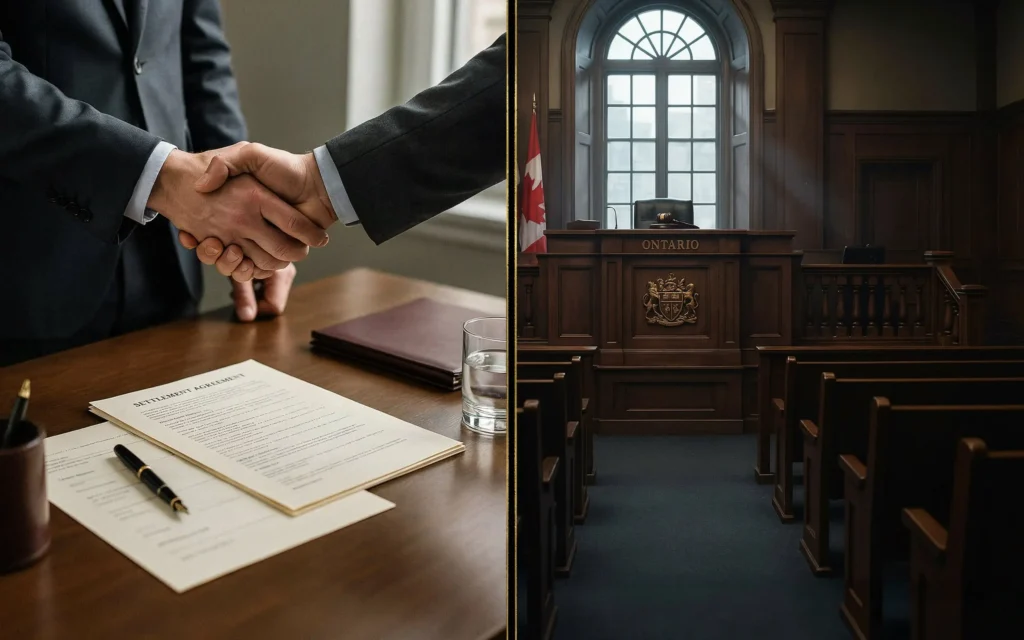
You were hurt in an accident. The insurance company has made an offer. Now you’re asking yourself: should I take it, or fight it out in court?
This is one of the most important decisions in your personal injury case, and there is no universal right answer. The best choice depends on your injuries, your evidence, your financial situation, and your risk tolerance.
Here is what this guide covers:
- How settlement and trial actually work in Ontario
- When settling makes sense and when it doesn’t
- What risks come with going to trial
- How to know when to reject a settlement offer
- What the personal injury process looks like in Ontario
Personal injury settlements in Ontario range from $20K to over $2M, depending on your claim. Our lawyers will evaluate your specific case.
Got a lowball offer that doesn’t cover your future medical costs or full income loss? Don’t sign until we review it.
Maana Law reviews settlement offers against the true value of your claim before you commit. Free, no-obligation assessment.
What Is a Personal Injury Settlement in Ontario?
A personal injury settlement is a private agreement between you and the at-fault party’s insurer. You agree to accept a fixed amount of money in exchange for releasing the other side from further liability.
Most personal injury Lawyer in Ontario resolve this way, before a trial ever begins. The settlement process typically involves negotiation through your lawyer, and often a formal step called mediation, where a neutral third party helps both sides reach a number.
Once you sign a release of liability, the case is over. You cannot go back and ask for more money, even if your condition worsens later.
Key point: Settlements are final. Make sure the offer fully reflects the long-term value of your claim, including future medical expenses, lost income, and the impact on your quality of life, before you agree.
What Happens When a Personal Injury Case Goes to Trial in Ontario?
If no settlement is reached, your case proceeds to trial. A judge, or in some cases a jury, hears the evidence and decides what compensation you receive.
In Ontario, personal injury trials can take years to reach. Justice system backlogs are a real factor. From the time of your injury to the day of a verdict, you may wait three to five years or longer, depending on the complexity of your case and court availability.
The trial process involves:
- Discovery, where both sides exchange evidence and examine witnesses
- Expert witnesses such as doctors, economists, or accident reconstructionists testifying on your behalf
- Cross-examination of you and your witnesses by the opposing side
- A final verdict that is binding, unless successfully appealed
Jury awards in Ontario can be higher than settlement offers in serious cases, but they can also be lower. The outcome is never guaranteed.
What Are the Pros and Cons of Settling a Personal Injury Claim?
When Settlement Makes Sense
Certainty-
You know exactly what you will receive. There is no risk of walking away with less or nothing.
Speed-
You receive compensation months or years sooner than a trial would deliver.
Lower legal costs-
A negotiated resolution avoids the significant costs of litigation, including expert witnesses, court fees, and extended legal hours.
Privacy-
Settlements are confidential. Trials become part of the public record.
Less stress-
Avoiding court appearances, cross-examination, and the emotional strain of litigation matters, especially when you are still recovering from serious or permanent injuries.
When Settlement May Not Be Right
Lowball offers-
Insurance companies routinely make first offers that are far below the actual value of your claim. If the offer does not account for future care costs, long-term income loss, or the full extent of your injuries, it is likely not enough.
Disputed liability-
If the insurer denies or minimizes fault, settling early locks in a compromised number. Building stronger evidence and pushing toward trial may produce better results.
Catastrophic or permanent injuries-
For severe injuries with lifelong impact, the financial difference between a low settlement and a fair jury award can be significant. The risk of trial may be worth it. Whether you’re dealing with spinal cord injuries or traumatic brain injuries, understanding the long-term implications is crucial before accepting any offer.
What Are the Risks of Going to Trial for a Personal Injury Case?
Trial carries real risk. Here is what you need to understand before choosing that path.
You could receive less-
Juries are unpredictable. Even with strong evidence, a jury may award less than the settlement on the table.
Shared fault can reduce your award-
In Ontario, if you are found partially at fault for the accident, your compensation is reduced by that percentage under contributory negligence rules.
Legal costs increase-
Going to trial is expensive. Expert witnesses, court preparation, and extended case management all add to legal costs. Even on a contingency fee arrangement, these costs affect your final payout.
Time-
Trials take years. If you are under financial duress from lost income or mounting medical bills, waiting is genuinely difficult.
Emotional toll-
Testifying, being cross-examined, and reliving the accident and your injuries in a public courtroom is stressful. For clients dealing with trauma or anxiety disorders related to the accident, this is a serious consideration.
Don’t fight this battle alone. Ontario injury victims recover $20K to $2M+. Let Aman Kalra review your claim and fight for the compensation you deserve today.
Thinking of rejecting the insurer’s offer? Get legal advice first — the risks of getting this wrong go both ways.
Maana Law gives you an honest comparison of your settlement vs trial position — including costs, timelines, and realistic outcomes.
When Should You Reject a Settlement Offer in Ontario?
You should seriously consider rejecting a settlement offer when:
- The offer does not reflect your full medical costs, including future treatment
- Your injuries are permanent and the long-term financial impact has not been fully calculated
- Liability is clear and your evidence is strong
- The defence has not yet seen all the medical evidence supporting your claim
- Your lawyer believes a significantly higher amount is achievable through mediation or trial
At Maana Law, we always give clients an honest legal opinion about whether an offer is fair. We do not pressure clients to settle quickly. We review the full picture, including medical reports, expert opinions, and the realistic range of outcomes, before advising on any offer.
How Does Mediation Work in Personal Injury Cases in Ontario?
Personal injury mediation in Ontario is a mandatory step in most cases before a trial can begin. Both parties meet with a trained mediator who helps find a resolution without a court decision.
Mediation is private. It is less formal than court. And it is often where cases that could not settle through direct negotiation finally reach an agreement.
If mediation fails, the case proceeds to trial. But most cases do resolve at or before mediation. This step gives you one more structured opportunity to reach a fair number without the uncertainty of a jury.
Your lawyer should prepare you thoroughly for mediation: knowing your case value, your best alternative to a negotiated agreement, and where the other side is likely to push back.
How Long Does a Personal Injury Trial Take in Ontario?
The short answer: a long time.
How long does a personal injury trial take in Ontario? From the initial accident to a trial verdict, the average timeline is three to five years. Some complex or multi-party cases run longer.
Here is a rough breakdown of the stages:
- Initial investigation and demand letter: 6 to 12 months post-accident
- Discovery process: 1 to 2 years
- Mandatory mediation: Typically before the 2-year mark in many jurisdictions
- Trial scheduling: 1 to 3 years after discoveries
- Trial itself: Days to several weeks, depending on complexity
Limitation periods in Ontario also matter. You generally have two years from the date of the accident to start a legal claim. Missing this deadline can mean losing your right to sue entirely. Understanding when to hire a car accident lawyer in Ontario can help you protect your rights from the start.
Why Maana Law Is the Right Choice for Your Personal Injury Case in Ontario
Making a decision about whether to settle or go to trial requires more than general information. It requires an honest assessment of your specific case from a lawyer who knows Ontario’s personal injury system.
- Over 10 years of personal injury experience in Ontario, with a proven track record of securing fair compensation through settlements and trial-ready advocacy
- Honest case evaluations, we tell you what your case is realistically worth, not what you want to hear
- No Win, No Fee, you pay nothing unless we recover compensation for you
- Free consultations available by phone, video, or in person at our Mississauga office
- Home and hospital visits for clients who cannot travel
- Multilingual support in English and Hindi, serving Mississauga communities including Erin Mills, Meadowvale, Cooksville, and beyond
Frequently Asked Questions
Is it better to settle or go to trial in Ontario?
It depends on your case. Settlement is faster, more certain, and less stressful. Trial may produce a higher award but comes with significant time, cost, and risk. The right choice depends on your injuries, evidence, and financial situation. Your lawyer should give you a clear comparison of both paths.
What is the average personal injury settlement in Ontario?
There is no true average because cases vary widely based on injury type, liability, and long-term impact. Minor soft tissue claims may settle in the tens of thousands. Catastrophic or permanent injury cases can reach millions. For example, car accident settlements in Ontario vary significantly based on severity. Your lawyer should calculate a realistic range specific to your claim.
How do I know if a settlement offer is too low?
If the offer does not cover your projected future medical costs, full income loss, and non-economic damages like pain and suffering, it is likely too low. Have your lawyer review the offer against the full calculated value of your claim before accepting anything. Whether you’re dealing with pedestrian accident injuries, motorcycle accidents, or other injuries, proper valuation is essential.
Can I negotiate after receiving a settlement offer?
Yes. A first offer is almost never final. Your lawyer will typically respond with a counter-demand backed by your medical evidence and damages calculation. Negotiation is a normal part of the process.
What happens if I reject a settlement and lose at trial?
If you go to trial and receive a verdict lower than the settlement offer, you may be responsible for the other party’s legal costs from the date of the offer onward. This is why having a realistic assessment of your case strength before rejecting an offer is important. According to the Ontario Ministry of the Attorney General’s Rules of Civil Procedure, Rule 49 offers can have significant cost consequences if not carefully considered.
How does the legal process differ for different types of accidents?
The settlement and trial process follows similar frameworks, but different types of personal injury cases have unique considerations. For instance, truck accident settlements often involve multiple liable parties, while brain injury cases require extensive neurological evidence. Understanding these nuances is critical to making informed decisions about settlement versus trial. The Law Society of Ontario provides resources to help individuals understand their legal rights and the court process in personal injury matters.
Never accept or reject a settlement offer without a lawyer’s honest opinion of what it’s actually worth.
Free consultation with Maana Law. In-person, virtual, or home visit available. No win, no fee — guaranteed.
Conclusion
Deciding whether to settle your personal injury case or go to trial in Ontario is not a decision to make lightly or alone. Settlement offers certainty, speed, and privacy. Trial offers the potential for higher compensation but comes with real risk, significant delay, and emotional cost.
The right choice comes down to three things: the strength of your evidence, the fairness of the offer on the table, and your personal circumstances.
Here are three things to take away from this article:
- Never accept a settlement without understanding the full long-term value of your claim
- Mediation in Ontario is a mandatory and often effective step before trial
- The personal injury lawsuit risk in Ontario is real. Get an honest legal opinion before deciding
If you are facing this decision right now, speak with a personal injury lawyer who will give you a straight answer, not just one who will push you toward a quick resolution.
Maana Law serves accident victims throughout Mississauga and Ontario. Call us for a free consultation at our office at 90 Matheson Blvd W, Suite 101, Mississauga, ON. Virtual appointments and home visits are available. We work on a No Win, No Fee basis. Reach out today to understand your options before you decide.