

Losing someone because of another person’s carelessness changes everything. On top of the grief, families in Ontario often face financial strain and a flood of unanswered legal questions. What can we actually claim? Who qualifies? How much could a settlement be worth?
Wrongful death lawsuit settlements in Ontario typically range from tens of thousands to over a million dollars, depending on who is claiming, what the deceased contributed to the family, and the specific circumstances of the death. Ontario’s Family Law Act governs these claims and gives eligible family members the right to recover both financial losses and the emotional loss of the relationship itself.
This guide covers what families in Ontario need to know before speaking to a wrongful death lawyer in Mississauga.
- Who can file a claim under the Family Law Act
- What types of damages are available and how they are calculated
- How estate claims differ from family-based claims
- What factors push settlements higher or lower
- Realistic settlement ranges by relationship type
- What motor vehicle deaths mean for accident benefits
Lost a loved one due to someone else’s negligence? Your family has legal rights under Ontario’s Family Law Act.
Wrongful death settlements in Ontario can reach well over $1 million. Let us assess your family’s claim for free.
What Is a Wrongful Death Lawsuit in Ontario?
A wrongful death lawsuit is a civil legal claim filed when someone dies because of another party’s negligent behaviour or intentional behaviour. In Ontario, these claims are governed by Part V of the Family Law Act, R.S.O. 1990, c. F.3. The claim belongs to the surviving family members, not the estate, and it compensates them for their own losses resulting from the death.
The claim is legally “derivative,” meaning it only succeeds if the deceased would have had a valid personal injury claim had they survived. If the deceased’s own right to sue was extinguished, such as by an expired limitation period, the family’s claim falls with it.
Common causes include motor vehicle accidents, medical malpractice, unsafe property conditions, workplace accidents, defective consumer products, nursing home negligence, drunk driving, and criminal acts such as manslaughter or homicide.
How a Civil Claim Differs from a Criminal Case
A civil wrongful death claim and a criminal negligence charge can run at the same time, but they are completely separate proceedings. The criminal case is brought by the Crown and focuses on punishment. The civil claim is brought by the family and focuses on financial compensation.
The standard of proof is also lower in a civil case. Criminal matters require proof beyond a reasonable doubt. Civil claims only require proof on a balance of probabilities, which is why families can sometimes recover damages even when no criminal conviction follows.
What the Estate Can Claim Separately
The deceased’s estate may also have a separate claim under the Trustee Act, R.S.O. 1990, c. T.23. This covers losses that occurred between the fatal injury and the moment of death, including the deceased’s own pain and suffering during that period, pre-death medical expenses, and income lost between the injury and death. The estate claim and the family members’ claim are legally distinct but often pursued together.
Who Can File a Wrongful Death Claim in Ontario?
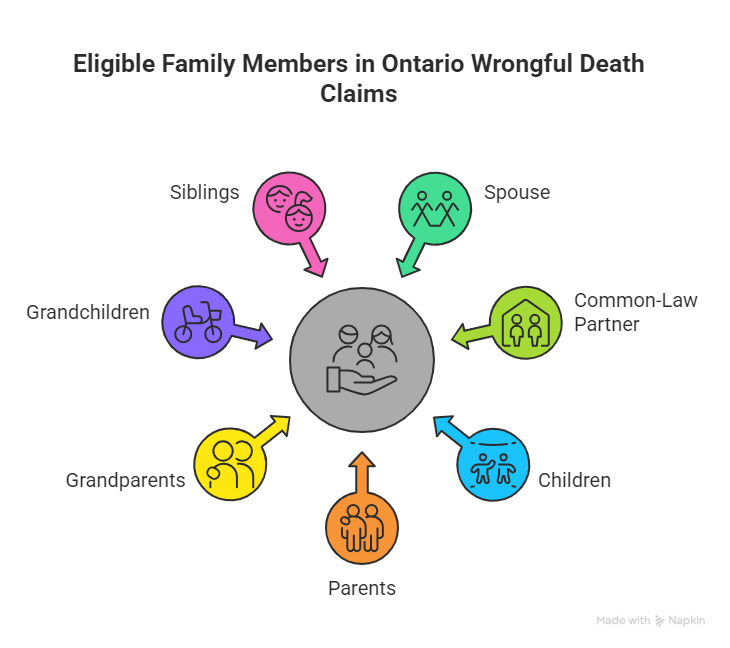
Only specific family members can bring a claim under the Family Law Act. Not every person connected to the deceased qualifies, regardless of how close they were.
Eligible claimants include:
- Spouse, including a legally married spouse
- Common-law partner, who has cohabited continuously for at least three years, or in a relationship of some permanence where there is a child together
- Children, biological and adopted
- Parents and grandparents
- Grandchildren
- Siblings
Extended relatives such as cousins, aunts, uncles, or close friends are not eligible, even if they were financially dependent on the deceased.
Special Rules for Minor Claimants
Minors cannot bring a legal claim on their own. They require a litigation guardian, typically a parent or trusted adult, to act on their behalf. If a settlement is reached involving a minor, a Superior Court judge must approve it to confirm the amount is fair. The two-year limitation period for a minor does not begin until they obtain a litigation guardian or reach the age of majority, which provides some added protection.
When a loved one is taken due to someone else’s negligence, families are often left wondering who can file a wrongful death lawsuit in Ontario and what rights they actually have. This guide for families clearly explains eligibility under the Family Law Act and the steps to pursue the compensation you deserve.
Your family’s claim may include lost income, funeral costs, and compensation for the loss of care and companionship.
Multiple family members can claim separately under the FLA. Maana Law ensures no one’s losses go unaccounted for.
What Types of Damages Can Families Recover?
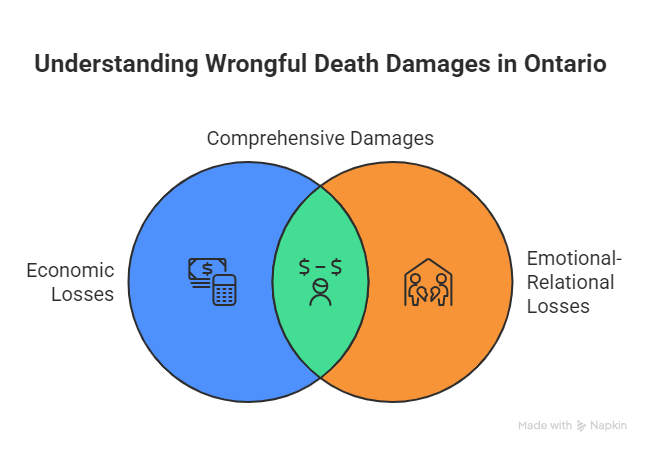
Wrongful death compensation Ontario falls into two categories: pecuniary damages, which are economic losses with a measurable dollar value, and non-pecuniary damages, which cover the emotional and relational loss.
Pecuniary Damages: Economic Losses
These are losses that can be quantified with evidence and expert analysis:
- Loss of income and financial support: The income the deceased would have earned and contributed to the household over their remaining working life
- Loss of household contributions: Cooking, cleaning, childcare, home maintenance, and other services the deceased regularly provided
- Medical expenses before death: Hospital bills, emergency care, and treatment costs between the injury and death
- Funeral and burial expenses: Reasonable funeral, burial, or cremation costs
- Child care costs: Ongoing childcare the deceased would have covered
- Travel expenses for dependents: Costs of visiting the deceased in hospital before death
Calculating these figures requires expert input. Economists and actuaries are typically engaged to project the deceased’s future earnings, apply inflation adjustments, and calculate the present-day value of future losses.
Non-Pecuniary Damages: Loss of Guidance, Care, and Companionship
Loss of guidance care and companionship is the emotional and relational loss each family member suffers. It captures the value of the relationship itself, not just its financial dimension.
A 2021 Ontario Court of Appeal decision, Moore v. 7595611 Canada Corp., confirmed there is no legislated cap on these damages under the Family Law Act. Courts now assess them case by case, looking at the depth of the relationship and the real impact of the loss on each claimant.
Factors courts consider include the age and health of the claimant, whether the deceased lived with them, the frequency and quality of contact, and whether the claimant has other emotional support networks.
We see this come up often with families who assume there is a fixed dollar limit on emotional loss. There is not. One family we supported had lost a parent who was deeply involved in daily life, and the guidance, care, and companionship claim reflected that closeness accurately once the relationship was properly documented.

How Do Motor Vehicle Deaths Affect Compensation?
If the death resulted from a motor vehicle accident, families have access to additional compensation through the Statutory Accident Benefits Schedule (SABS), O. Reg. 34/10, paid through the at-fault driver’s auto insurance policy.
Under SABS, the following statutory accident benefits apply:
- The deceased’s spouse receives $25,000 in death benefits
- Each dependant receives $10,000
- If there is no surviving spouse, dependants share an additional $25,000 equally
- A funeral benefit of up to $6,000 is available [VERIFY current SABS limits]
These benefits are paid separately from, and in addition to, any Family Law Act settlement or judgment. Families should notify the insurer of their intent to claim within seven days of the death, or as soon as practically possible, to protect those rights.
One important point: the statutory deductible that normally reduces non-pecuniary damages in car accident personal injury claims does not apply in wrongful death cases. Families recover the full non-pecuniary award without deduction.
If the death involved a hit-and-run or an uninsured driver, families may still have options through the Motor Vehicle Accident Claims Fund or their own uninsured motorist coverage. For families who lost a loved one in a pedestrian accident, Maana Law’s pedestrian accident outlines your specific legal rights and next steps.
If you are in Mississauga and want to understand what your family’s wrongful death claim could be worth, Maana Law offers a free consultation with no obligation to help you get clear on your options.
What Factors Determine Settlement Amounts?
There is no fixed formula for fatal accident settlement amounts in Ontario. Two cases with similar facts can produce very different results based on the specific circumstances of each family.
Factors That Tend to Increase a Settlement
- The deceased was the primary earner with many working years ahead of them
- Young dependent children are left behind with decades of support needs ahead
- The deceased contributed heavily to household services and daily caregiving
- The death involved gross negligence, drunk driving, or an intentional act
- Strong liability evidence makes the case hard for the defendant to contest
- Multiple eligible claimants exist, increasing the total payout across the family
Factors That May Reduce a Settlement
- The deceased was elderly or in poor prior health, limiting projected future earnings
- The deceased shared some fault for the incident; contributory negligence reduces the total award proportionally under Ontario law
- The relationship between the claimant and the deceased was distant or strained
- The defendant has limited insurance coverage or personal assets
The degree of negligence matters in two ways. It affects how defensible the case is and, in cases involving contributory negligence, how much the total award is reduced. A defendant found responsible for a drunk driving death or a workplace safety failure faces a much harder fight at the negotiation table than one involved in a shared-fault collision.
What Are Realistic Settlement Ranges in Ontario?
Wrongful death payout Canada cases vary widely. Past Ontario case law shows patterns by relationship type, but these are rough reference points only, not guarantees [VERIFY all figures against current case law].
| Relationship to Deceased | Guidance, Care and Companionship Range | Notes |
| Surviving spouse | $50,000 to $390,000+ | Higher for long, close marriages where deceased was in good health |
| Dependent minor child | $30,000 to $150,000+ per child | Higher for very young children who lose a parent early |
| Adult child | $15,000 to $50,000 | Depends on closeness and ongoing contact |
| Parent (losing adult child) | $20,000 to $80,000 | Courts consider financial and emotional dependency |
| Sibling | $10,000 to $30,000 | Generally lower without strong demonstrated dependency |
These figures cover only the non-pecuniary component. Economic losses such as loss of income, loss of household contributions, funeral costs, and medical expenses are calculated separately and added on top. A family where the deceased was a primary earner with young children could see total settlements well above $1 million when all heads of damages are combined .
Damage awards for surviving spouses in past Ontario cases have ranged from approximately $20,000 to $390,000 in inflation-adjusted figures [VERIFY], with results being highly fact-specific. No two cases produce the same outcome.
How Are Wrongful Death Settlements Paid and Distributed?
Settlements are paid either as a lump sum or as a structured settlement, which provides payments over time, often through an annuity. Structured settlements are common when minors are involved because they provide ongoing financial support as the child grows.
When multiple family members are claiming, the court determines how the award is divided based on each person’s individual losses and the closeness of their relationship with the deceased. The division is not automatic or equal. A spouse who relied on the deceased for both income and daily care will receive a larger share than a sibling who lived in another city.
Any settlement involving a minor claimant must be approved by an Ontario Superior Court judge to confirm the amount is fair to the child.
The Two-Year Limitation Period
Ontario’s limitation period gives families two years from the date of death to file a wrongful death lawsuit. Missing this deadline, in almost all cases, means losing the right to sue regardless of how strong the case is. For minors, the period does not begin until they obtain a litigation guardian or reach the age of majority.
Acting early also protects evidence. Surveillance footage, witness memories, accident reports, and medical records all become harder to preserve with time. A lawyer engaged early can secure that evidence before it disappears.
Why Maana Law Is the Right Choice After a Wrongful Death
Wrongful death claims in Ontario are among the most emotionally and legally complex cases a family can face. Maana Law has spent over a decade supporting families in Mississauga through personal injury and fatal accident claims with care and focus.
No Win, No Fee: You pay nothing unless we recover compensation for your family
Free consultation: Get clear legal advice with no pressure and no commitment
Home and hospital visits: You do not need to come to us if you are grieving or unwell
Hindi and English service: Aman Kalra leads the firm and is fluent in both languages, so families from Mississauga’s South Asian communities receive full support without language barriers
10+ years of personal injury experience: Your case is handled by a team that knows Ontario law and how insurance companies operate
5-star rated on Google: Clients consistently describe honest guidance, responsiveness, and results
We serve families across Mississauga, including Erin Mills, Cooksville, Churchill Meadows, Meadowvale, and City Centre, with virtual consultation options available for every client.
Grieving families shouldn’t have to fight insurance companies alone. Let us carry the legal burden.
Free, compassionate consultation with Maana Law. No win, no fee — guaranteed.
Frequently Asked Questions
How long does a wrongful death lawsuit take to settle in Ontario?
Most cases settle through negotiation within one to two years. Complex cases involving disputed liability or multiple claimants can take three to five years, particularly if they go to trial.
Does the estate receive money from a wrongful death claim?
Family Law Act damages go directly to eligible family members, not the estate. The estate has a separate potential claim under the Trustee Act for losses that occurred between the fatal injury and the moment of death.
Can I still claim if the deceased was partly at fault?
Yes. Ontario’s contributory negligence rules reduce the total award in proportion to the deceased’s share of fault. A 25% fault finding reduces the total family award by 25%, but the claim can still proceed.
What if the person responsible had no insurance?
Options may still exist through the Motor Vehicle Accident Claims Fund for road deaths, or through your own uninsured motorist coverage. A personal injury lawyer can identify which avenues apply based on your specific facts.
Can siblings claim wrongful death compensation in Ontario?
Yes, siblings are eligible claimants under the Family Law Act. Awards tend to be lower than those for spouses or dependent children unless strong financial or emotional dependency is shown.
Get Clear Answers for Your Family Today
Ontario law gives eligible family members the right to seek compensation for both the financial and emotional losses that follow a wrongful death. The limitation period is strict, the damages are broader than most families expect, and the outcome of each case depends heavily on how the losses are documented and presented.
Maana Law serves families across Mississauga with free consultations, a No Win No Fee policy, and over 10 years of personal injury experience. Call 437-979-4878 or text or messege to speak with our team. Tell us what happened, and we will tell you exactly where your family stands.