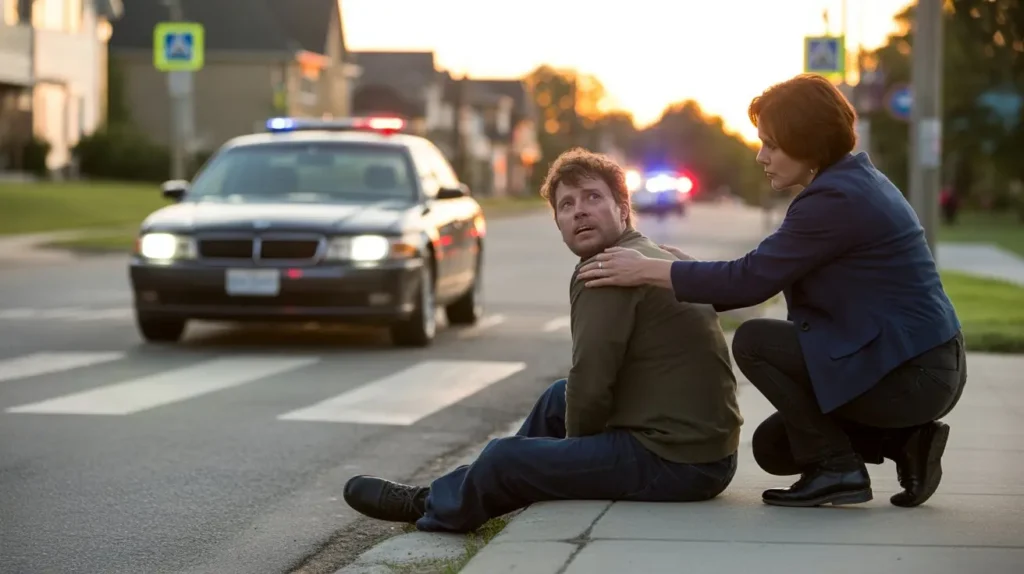
If a car hit you while you were walking, you want one number: what is this claim worth?
In Ontario, pedestrian hit by car average settlement amounts range from roughly $30,000 for minor injuries to over $1,000,000 for catastrophic ones, depending on how badly you were hurt, how much income you lost, and who was at fault. Maana Law has helped Pedestrian Accident Lawyer Mississauga understand exactly where their case falls in that range.
Here is what this guide covers:
- Settlement ranges by injury severity in Ontario
- How Ontario’s two-track insurance system affects your total payout
- How fault affects what you receive
- The factors that push settlements higher
- The evidence that protects your claim
Hit by a car while walking? Find out what your claim could be worth — for free.
Pedestrian settlements in Ontario range from $30K to over $1M. Our lawyers will evaluate your specific case.
What Are the Average Pedestrian Accident Settlement Amounts in Ontario?
There is no single average. Your settlement depends on your injuries, your income, and the strength of your evidence.
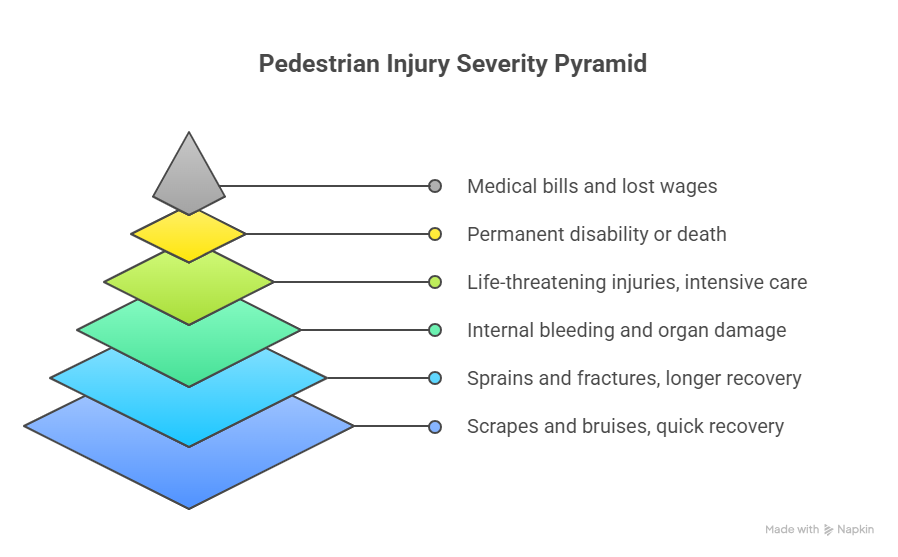
That said, Ontario cases follow predictable ranges based on injury type. Real Ontario court results and case outcomes show amounts from $125,000 for a pedestrian struck at a crosswalk with chronic pain, to $250,000 for a ligament tear requiring surgery, to over $1,000,000 in fatal cases. Even a pedestrian who was jaywalking when hit received a $500,000 combined settlement in a 2023 Ontario Superior Court case involving a traumatic brain injury (Brooks v. Culnan, 2023 ONSC 5415).
Settlement Ranges by Injury Type
| Injury Type | Typical Settlement Range |
| Soft tissue, road rash, minor fractures | $15,000 to $75,000 |
| Concussion or single fracture requiring surgery | $75,000 to $250,000 |
| Multiple fractures or serious concussion | $200,000 to $500,000 |
| Traumatic brain injury or spinal cord damage | $500,000 to $1,500,000 |
| Catastrophic injury or permanent disability | $1,000,000 and above |
| Wrongful death | $500,000 and above |
These figures reflect both the accident benefits and tort claim combined. Your actual amount depends on evidence, fault, and coverage limits.
How Does Ontario’s Two-Track Insurance System Work for Pedestrians?
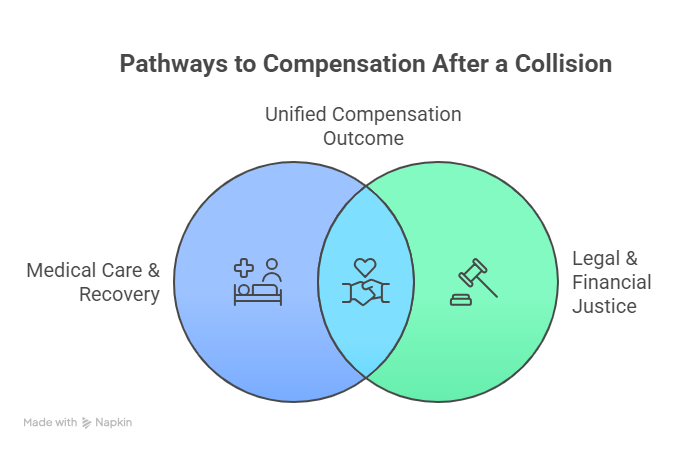
You have two separate compensation sources running at the same time. Both matter, and both affect your total.
Track 1: Statutory Accident Benefits (SABS). These are no-fault benefits paid by the at-fault driver’s insurer, regardless of who caused the accident. Under the current SABS rules, you may be entitled to:
- Medical and rehabilitation benefits up to $3,500 for minor injuries, $65,000 for non-catastrophic injuries, or $1,000,000 for catastrophic injuries
- Income replacement of 70% of your gross weekly pre-accident income, up to $400 per week (standard level)
- Non-earner benefits of $185 per week if you were not working before the accident and your injuries prevent you from carrying on a normal life
Important 2026 change: Effective July 1, 2026, the Ontario government is making income replacement benefits optional under the SABS. This means if the driver who hit you did not purchase optional coverage, you may lose access to weekly income support. Pedestrians who own a car or have their own auto policy may have some protection. If you do not, act before this change takes effect.
Track 2: Tort claim. This is a lawsuit against the at-fault driver for pain and suffering, future income loss, and long-term care costs not covered by benefits. To sue in Ontario, your injuries generally must meet the serious injury threshold: a permanent serious impairment of an important function. Most pedestrians struck by vehicles meet this test.
The pedestrian accident settlement your lawyer negotiates reflects both tracks combined.
For a complete explanation of your legal rights as a pedestrian including reverse onus, partial fault rules, accident benefits, and when you can sue read our companion guide: Legal Rights for Pedestrians Involved in Accidents.
How Does Fault Affect Your Pedestrian Accident Compensation in Ontario?
Your payout is reduced by your percentage of fault. A 25% fault finding on a $300,000 case leaves you with $225,000.
Ontario uses a contributory negligence system. Both sides share fault proportionally, not all or nothing. Even in Brooks v. Culnan, the court approved a substantial settlement for a pedestrian who was jaywalking, because the driver’s negligence still contributed significantly to the collision.
When pedestrian fault is commonly raised:
- Crossing mid-block outside a designated crosswalk
- Crossing against a signal
- Walking at night in dark clothing with no reflective gear
- Distracted walking (phone use at crossing)
When drivers typically bear full or majority fault:
- Failure to yield in a marked crosswalk
- Running a red light or stop sign
- Speeding in a school zone or community safety zone
- Distracted or impaired driving at the time of impact
Crosswalk accident compensation is directly tied to where the accident happened. Under Ontario’s Highway Traffic Act, drivers must yield to pedestrians in a crosswalk. If you were in a marked crossing with proper signals, establishing the driver’s liability is much more straightforward.
If you were hit by a car in Mississauga or the surrounding area, Maana Law offers a free case review with no obligation to proceed.
Even if you were partially at fault, you can still recover compensation in Ontario.
Don’t let the insurance company reduce your payout unfairly. Our pedestrian accident lawyers fight for what you’re owed.
What Factors Push a Pedestrian Injury Lawsuit Payout Higher?
The three biggest factors are injury severity, income loss, and evidence quality.
Injury severity.
A permanent impairment, chronic pain diagnosis, or catastrophic designation dramatically increases both your SABS benefits and tort claim. A soft tissue injury that fully heals within a year sits at the low end. A spinal cord injury or traumatic brain injury sits at the top.
Pre-accident income.
Future loss of earning capacity is often the largest component of a serious hit by car settlement amount. Someone in their 30s or 40s with significant income ahead of them has a much larger income claim than a retired person. Employment records, tax returns, and economic expert reports build this part of the case.
At-fault driver’s insurance.
A settlement can only reach as high as the available coverage unless you pursue personal assets. Most Ontario drivers carry $1,000,000 in third-party liability. If the driver was uninsured, Ontario’s Motor Vehicle Accident Claims Fund may provide coverage.
Aggravating conduct.
Distracted driving, impairment, or excessive speed at the time of impact strengthens the liability side of the case and can support a higher settlement.
What Evidence Protects Your Pedestrian Accident Claim?
Gather evidence immediately. What you do in the first 48 hours directly affects how much you receive.
- Call 911. The police report establishes the basic facts of the collision and any violations noted at the scene.
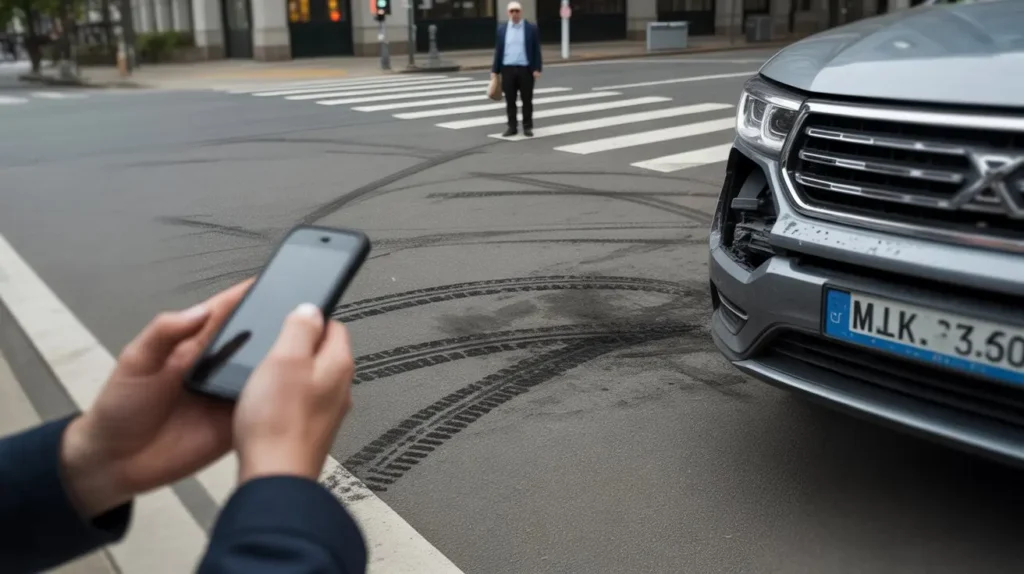
- Photograph the scene. Capture the crosswalk or road, the vehicle, your injuries, skid marks, traffic signals, and weather conditions before anything changes.
- Get witness contacts. Names and phone numbers from anyone who saw the accident.
- Preserve camera footage. Traffic cameras, business security cameras, and transit footage are often overwritten within days. A lawyer can send a preservation demand immediately.
- Seek medical attention right away. Every diagnosis and treatment note builds the medical foundation of your claim. Gaps in treatment are used by insurers to minimize your injuries.
- Keep an injury journal. Write down your daily pain levels, sleep disruptions, and physical limitations. This contemporaneous record is powerful evidence of real-world impact.
- Do not give a recorded statement to the insurer without speaking to a lawyer first.
Ontario’s limitation period for filing a tort claim is two years from the date of the accident. Missing that deadline typically ends your right to sue.
Why Choose Maana Law as Your Guide Through a Pedestrian Accident Claim
For over 10 years, we have helped pedestrians hit by cars in Mississauga recover the compensation they deserve. We are not just lawyers. We are your advocates who understand the fear, pain, and financial pressure you are facing right now.
Experienced Mississauga Pedestrian Accident Lawyers Fighting for Full Compensation
We focus exclusively on personal injury law in Ontario. Our mission is to handle every legal burden so you can focus on your recovery. With empathy at the heart of everything we do, we guide pedestrian accident victims through accident benefits, tort claims, and insurance negotiations with expertise and unwavering support.
Grounded in honesty, compassion, and results, our team has helped clients across Mississauga and the GTA recover millions in compensation. When you work with us, you are not a file number. You are a person with a story, a family, and a future, and we take the time to truly listen.
We Know Ontario’s Two-Track Pedestrian Claim System
Most pedestrian accident victims do not realize they have two separate compensation sources available at the same time. We know exactly how to file your Statutory Accident Benefits claim and your tort lawsuit together, meet every deadline, and prevent the insurance company from using one track to limit the other. That knowledge directly affects how much you recover.
We Handle Everything, Start to Finish
From preserving traffic camera footage before it is overwritten to negotiating with insurance adjusters and managing every filing deadline, we take care of the entire claims process. You focus on healing. We handle communication with opposing counsel, gather your medical records, document your income loss, and build the strongest possible version of your case.
We Work With the Right Experts to Prove What Your Injuries Are Worth
Settlement value in pedestrian accident cases depends on medical evidence, economic projections, and sometimes accident reconstruction. We work with trusted medical specialists, vocational experts, and economists who can document your injuries, quantify your future care costs, and demonstrate the full impact your injuries have on your earning capacity. That expert support is often what separates a fair settlement from an inadequate one.
No Fees Unless We Win
You pay nothing upfront. We only get paid if we recover compensation for you. Our interests are fully aligned with yours, to secure the maximum settlement possible. There are no hidden costs, and you never pay a legal fee unless we successfully resolve your case.
Frequently Asked Questions
What is the average settlement for a pedestrian hit by a car in Ontario?
It varies by injury severity. Minor injury cases often settle from $15,000 to $75,000. Severe or catastrophic injury cases regularly reach $500,000 or more. A case review with a lawyer is the most reliable way to estimate your specific amount.
Can I still get compensation if I was partly at fault?
Yes. Ontario uses contributory negligence, so your payout is reduced by your percentage of fault, not eliminated. Even pedestrians who were jaywalking have recovered significant settlements in Ontario courts.
How long do I have to file a claim in Ontario?
You have two years from the accident date to file a tort claim against the at-fault driver. You must also notify the insurer within seven days to start accident benefits. Missing these deadlines can cost you your claim.
What is the difference between accident benefits and a tort claim?
Accident benefits are paid by the at-fault driver’s insurer regardless of fault and cover medical costs, income replacement, and care. A tort claim is a lawsuit against the driver for pain and suffering and larger income losses. Both run at the same time.
How does the 2026 SABS change affect pedestrians?
From July 1, 2026, income replacement and several other benefits become optional under the SABS. Pedestrians who rely on the at-fault driver’s insurance may lose access to weekly income support if the driver did not buy optional coverage. Speaking to a lawyer now protects your options.
Conclusion
Pedestrian accident settlements in Ontario depend on three things: your injury severity, your income loss, and the quality of evidence behind your claim.
Ontario’s two-track system means you can pursue accident benefits and a tort claim at the same time. Fault reduces your award but does not eliminate it. And the upcoming 2026 SABS changes make acting sooner, not later, important.
You deserve to know what your claim is actually worth before you accept anything.
Maana Law in Mississauga offers a free, no-obligation case review for pedestrian accident victims across Mississauga and the GTA. Call +1 437-979-4878, visit maanalaw.com, or come see us at 90 Matheson Blvd W Suite 101, Mississauga, ON. Tell us what happened, and we will tell you what your case may be worth.
Don’t guess your settlement value — let a Mississauga pedestrian accident lawyer calculate it.
Free consultation. No fees unless we win your case.