

Cycling is part of daily life for thousands of people across Mississauga and the wider Peel Region. But Ontario’s roads carry real risk. In 2024, cyclist fatalities in Ontario rose by 100% compared to the previous year. The Peel Region alone recorded 42,733 total collisions in 2024, a 5.65% increase from the year before.
If you were injured in a bicycle accident, you are likely dealing with physical pain, mounting medical bills, time away from work, and real uncertainty about what comes next. Ontario law gives injured cyclists the right to seek compensation through more than one path. Understanding what you can claim, and how, is the first step toward protecting your recovery. For cyclists looking at their legal options, a bicycle accident lawyer in Mississauga can help explain what steps may apply to their case.
This guide explains every type of damage you may be entitled to claim and what you need to do to protect your rights.
Here is what this guide will help you understand:
- The two main ways to claim compensation in Ontario
- What economic damages cover and how to document them
- What non-economic damages are and when they apply
- The serious injury threshold, explained in plain language
- How long you have to file and why timing matters
Injured while cycling? You may be able to claim through two paths at once.
Accident benefits plus a tort claim can significantly increase your total compensation. Let us show you how.
What Are the Two Ways to Claim Compensation After a Bicycle Accident in Ontario?
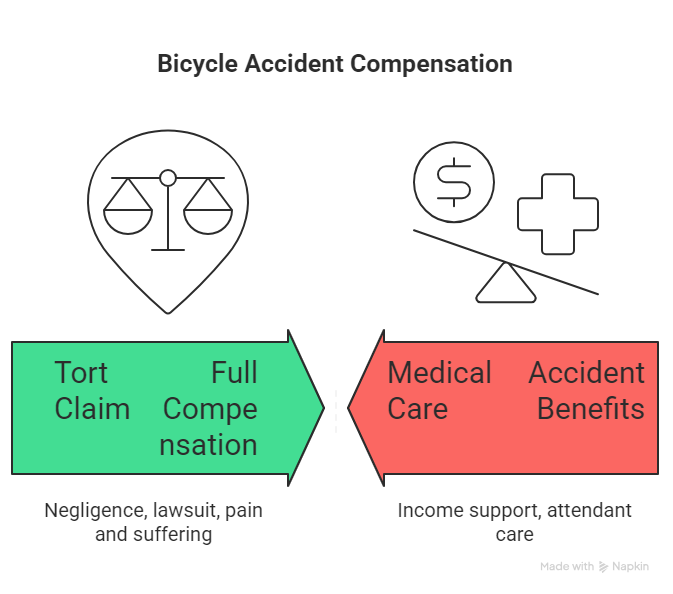
In Ontario, injured cyclists can claim compensation through statutory accident benefits, a tort claim, or both.
Accident benefits are available to you regardless of fault. Whether the driver was entirely responsible or fault is disputed, you are entitled to access these benefits through your own auto insurer, or through the at-fault driver’s insurer if you do not have auto insurance of your own.
A tort claim is a separate legal action filed directly against the negligent driver. It opens the door to full economic and non-economic compensation, beyond what accident benefits alone will cover. Both paths can run at the same time.
A cyclist hit by a driver who ran a red light on Hurontario Street in Mississauga could file an accident benefits claim immediately for medical costs and separately pursue a tort claim against the driver for lost wages and pain and suffering.
Two deadlines matter from day one:
- Notify your insurer within 7 days of the accident
- File the accident benefits application within 30 days of receiving it
- A tort claim must be filed within 2 years of the accident date
The table below shows how the two paths compare:
| Accident Benefits | Tort Claim | |
| Based on fault? | No, available regardless of fault | Yes, requires proving driver negligence |
| Who pays? | Your insurer or driver’s insurer | At-fault driver’s insurance |
| What does it cover? | Medical, income, attendant care | Full economic and non-economic losses |
| Key deadline | Notify insurer within 7 days | File lawsuit within 2 years |
What Economic Damages Can You Claim After a Bicycle Accident?
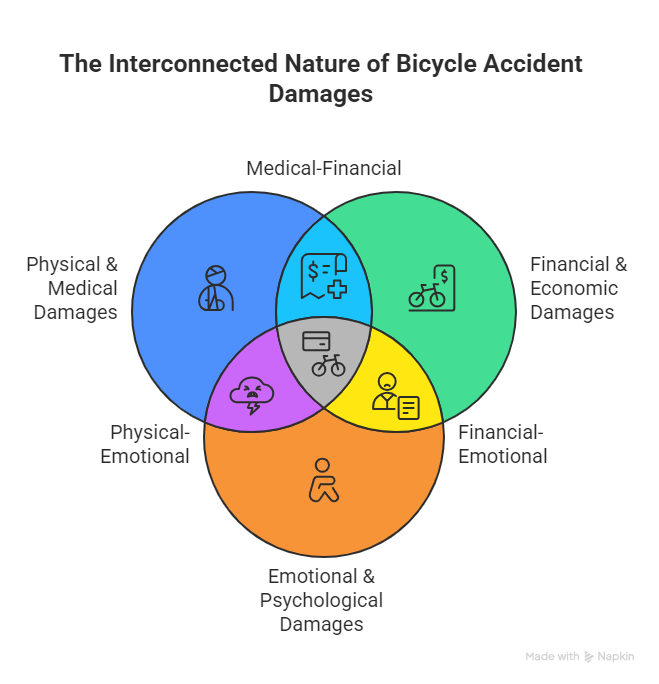
Economic damages are the measurable financial losses caused by your injury. They are documented through receipts, records, and professional reports.
Can You Recover Medical and Rehabilitation Costs?
Yes. Medical costs from the accident, including treatment OHIP does not cover, are claimable.
This includes emergency care, physiotherapy, massage therapy, prescription medication, mobility aids, and home adaptations. Accident benefits cover basic medical and rehabilitation costs. A tort claim can recover additional treatment expenses that exceed those limits.
If your injuries required three months of private physiotherapy at $100 per session, plus a prescribed knee brace and pain medication, every one of those costs forms part of your medical expenses claim. Gaps in treatment can be used by insurers to argue your injury was not serious. Staying consistent with care and keeping every receipt matters.
How Are Lost Wages Calculated, Including for Self-Employed Cyclists?
Lost wages are claimable under both accident benefits and a tort claim, and self-employed cyclists can claim too.
Accident benefits replace a portion of your pre-accident income, subject to a weekly cap set under Ontario law. There is no income replacement for the first week of missed work. For self-employed cyclists, tax returns, invoices, and client contracts replace a pay stub as proof of income loss.
A self-employed contractor in Mississauga who missed six weeks of work after a collision on Eglinton Avenue West could use two years of tax returns, client invoices, and a letter confirming cancelled contracts to document the income lost during recovery.
What Property Damage Can You Claim?
You can claim for your bicycle, gear, and any equipment damaged in the accident.
Keep repair estimates and receipts. Do not undervalue a high-end bicycle. Full replacement cost is claimable if the bike cannot be repaired. Common claimable property items include:
- Bicycle repair or replacement
- Helmet replacement
- Damaged electronics such as your phone, GPS, or lights
- Cycling gear and clothing
- Accessories destroyed in the collision

Cyclist fatalities in Ontario doubled in 2024. If you survived — fight for the compensation you deserve.
Medical bills, lost income, and pain & suffering — our bicycle accident lawyers recover every dollar owed.
What Non-Economic Damages Can You Claim After a Bicycle Accident?
Non-economic damages cover the personal and emotional losses that cannot be put on a receipt. They are just as real and just as claimable.
What Does Pain and Suffering Compensation Cover?
Pain and suffering compensation covers both the physical pain of your injuries and the emotional impact of living with them.
This includes ongoing physical discomfort, fear, loss of confidence on the road, and the psychological weight of a long recovery. Ontario law allows these losses under non-pecuniary damages. To claim them through a tort claim, your injury must meet the serious injury threshold, which is explained in the next section.
A cyclist in Cooksville who suffered a spinal injury and could no longer play recreational hockey with their children may claim not only the physical pain of their injury but also the emotional loss that came with it, the inability to do something that mattered deeply to them.
Can You Claim for Anxiety, Depression, or PTSD After a Bicycle Accident?
Yes. Psychological injuries are recognised and compensable under Ontario personal injury law.
Anxiety, depression, PTSD symptoms, sleep disturbance, and loss of confidence on the road are all claimable. They do not need to be visible to count. A medical report from a psychiatrist or psychologist supports these claims and shows that the psychological harm is connected to the accident.
A cyclist who develops anxiety about cycling on busy roads after being hit at an intersection in Erin Mills may claim for that ongoing psychological harm, even if no physical injury is visible at the time of the claim.
What Is the Serious Injury Threshold and Does Your Injury Qualify?
To claim pain and suffering through a tort claim, your injury must meet Ontario’s serious injury threshold. It must be permanent and must seriously impair an important bodily function.
This means the injury cannot be temporary. It must affect your ability to perform physical, mental, or daily functions in a meaningful way. Examples include chronic pain that prevents a return to work, needing legal support for a traumatic brain injury claim, pursuing compensation through our spinal cord injury legal services, or permanent facial scarring. A formal medical assessment is needed to establish this standard.
In the Ontario case St. Marthe v. O’Connor, a cyclist whose chronic back pain prevented him from returning to construction work was awarded general damages for pain and suffering, $80,990 for past income loss, $47,040 for future income loss, and $45,615.56 for future housekeeping expenses. All of this was possible because his injury met the permanent impairment standard.
What is the statutory deductible?
Ontario law reduces pain and suffering awards that fall below a set threshold amount. For minor injuries, this deductible can significantly reduce a payout. For serious injuries that exceed the threshold, the deductible does not apply. This is why the severity of your injury is so central to the value of your claim. A personal injury lawyer can assess where your injuries fall.
What Should You Do Right After a Bicycle Accident in Ontario?
Acting quickly after a bicycle accident protects both your health and your legal rights.
Most cycling injuries and deaths in Canada occur between 4 pm and 8 pm, during rush hour. Mississauga’s busy arterial roads, including Hurontario Street, Dundas Street, and Eglinton Avenue, are common collision points. If you are involved in a crash, these eight steps protect your ability to claim:
- Call 911 if anyone is injured, even if injuries seem minor at first
- Photograph everything, the scene, the vehicle, road conditions, and your injuries
- Collect driver details, including name, licence plate, and insurance information
- Get witness contact information, names and phone numbers before they leave the scene
- Notify your insurer within 7 days, even if you were not at fault
- See a doctor as soon as possible and start your medical record trail that same day
- Keep all receipts and records, every expense connected to the accident counts
- Contact a personal injury lawyer before giving any recorded statement to an insurance company
Adrenaline can mask serious injuries. What feels minor in the moment may not be. Consistent medical documentation from day one protects your claim.
If you are unsure what applies to your situation, speaking with a personal injury lawyer in Mississauga can clarify your options at no cost.

What Happens If You Were Partly at Fault for the Bicycle Accident?
Partial fault does not eliminate your claim. It reduces it by the percentage of fault attributed to you.
Does Partial Fault Stop You from Claiming Compensation?
No. Ontario courts apply contributory negligence as a percentage reduction, not a cancellation of your right to claim.
Under Ontario’s Highway Traffic Act, drivers carry a reverse onus. This means a driver must prove they were not negligent. The burden does not fall entirely on the injured cyclist. Even if you share some responsibility, meaningful compensation may still be available.
If a cyclist was not wearing a helmet and a court finds this contributed 20% to their head injury, their total award is reduced by 20%. The remaining 80% is still fully claimable. The defendant must prove that a helmet would have reduced the specific injuries before any deduction applies.
What Happens If a Cyclist Hits a Car in Ontario?
The same negligence rules apply. Fault is determined by who breached their duty of care on that specific road at that moment.
A cyclist who causes a collision may be liable for vehicle damage and injuries to the other party. Both parties may share fault. Drivers still carry the reverse onus provision under Ontario law. If you are a driver whose vehicle was struck by a cyclist, the same legal process, establishing fault and assessing damages, applies to your situation.
Why Choose Maana Law as Your Personal Injury Lawyers in Mississauga?
Decades of Legal Victories
With years of experience as Mississauga personal injury lawyers, our team has a proven track record of securing favourable settlements and verdicts for our clients. We know how Ontario personal injury law works and how to use it to your advantage.
Client-Centered Legal Service
We treat every case with personalised care. Working with a personal injury lawyer Mississauga clients trust means you receive direct attention, honest guidance, and results that reflect your specific situation, not a generic approach.
Pay Only If We Win
Our services follow a contingency fee model. If we do not win, you do not pay. Trust our personal injury lawyers in Mississauga to fight for your compensation without adding financial pressure during an already difficult time.
Dedicated to Maximum Results
We aim for the highest possible compensation. From medical bills to lost wages, pain and suffering to future care costs, we ensure you pursue everything you are entitled to with the help of a personal injury lawyer in Mississauga who knows how to build a strong case.
In-Depth Case Analysis
Our lawyers thoroughly investigate each case, gathering police reports, expert opinions, and witness statements. With an experienced personal injury lawyer in Mississauga, we build well-documented, evidence-backed cases that stand up to insurer scrutiny and courtroom challenge.
Always Keeping You Informed
We prioritise clear, timely updates throughout your case. You will never be left wondering what is happening. Our personal injury lawyers in Mississauga keep you confident and informed at every step of the process.
Frequently Asked Questions About Bicycle Accident Claims in Ontario
How much compensation can I expect after a bicycle accident in Ontario?
It depends on your injury severity, income loss, and treatment costs. There is no fixed amount. A free consultation helps assess what your specific case may be worth.
Can I still claim if I was not wearing a helmet?
Yes. Not wearing a helmet does not cancel your claim. It may reduce your award by a percentage only if the defendant proves a helmet would have reduced your specific injuries.
Can I claim for anxiety or depression after a bicycle accident?
Yes. Psychological injuries are compensable under Ontario law. You need medical documentation from a qualified health professional to support the claim.
What if I do not have car insurance, can I still access accident benefits?
Yes. You can claim through the at-fault driver’s insurer. If the driver was uninsured or fled the scene, Ontario’s Motor Vehicle Accident Claims Fund covers losses up to $200,000.
Do I need a bicycle accident attorney to make a claim?
You are not legally required to, but it significantly improves your outcome. A bicycle accident attorney protects your deadlines, handles insurer negotiations, and builds the strongest possible case on your behalf.
Taking the Next Step After a Bicycle Accident
After a bicycle accident in Ontario, you have two paths to compensation, statutory accident benefits and a tort claim, and in many cases both are available to you at the same time. The damages you can claim range from medical costs and lost wages to pain and suffering, psychological harm, and property loss. The two-year limitations period means acting sooner protects your options.
Dealing with insurers and legal timelines during recovery is hard. You should not have to manage it alone.
Contact Maana Law today for a free consultation. There are no fees unless your case is won. Call us +14379794878, book online, or request a home or virtual visit, whichever works best for you.
Not sure what your bicycle accident claim includes? We’ll break it down — no cost, no obligation.
Ontario has filing deadlines that can affect your claim. Contact Maana Law today.