

Every year, thousands of cyclists are injured on Ontario roads. In 2024, the Ontario Provincial Police recorded a 100% rise in cyclist fatalities compared to the previous year. Many survivors face the same pressing question: what is my bicycle accident Ontario damages claim actually worth?
The answer depends on your injury, your income loss, the type of accident, and which legal path you pursue. Ontario gives injured cyclists two ways to claim knowing both is the first step toward fair compensation.
Here is what this guide will walk you through:
- How Ontario’s two-track compensation system works
- What realistic settlement ranges look like by injury type
- How helmet use, road defects, and hit and run situations affect your payout
- Which documents protect the value of your claim
- When early legal advice makes a measurable difference
Wondering what your cycling injury claim is worth? Get a free case estimate today.
Ontario law favours cyclists in fault disputes. Our Mississauga lawyers know how to maximize your payout.
How Does a Bicycle Accident Settlement in Ontario Actually Work?
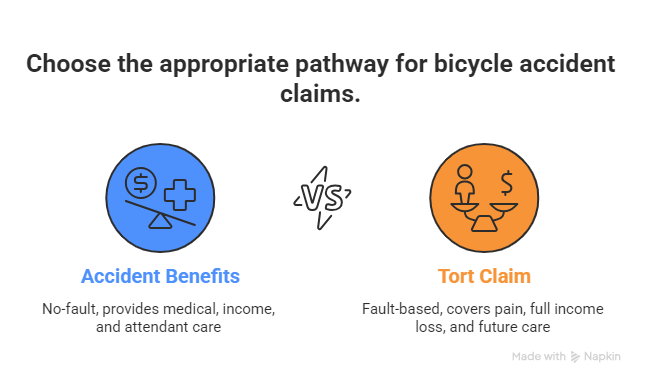
In Ontario, injured cyclists can claim through two paths at the same time accident benefits and a tort claim.
Accident benefits are no-fault. You receive them regardless of who caused the crash. Your own insurer pays first. If you have no insurance, you claim through the at-fault driver’s insurer. If neither applies, Ontario’s Motor Vehicle Accident Claims Fund (MVACF) steps in.
A tort claim is a lawsuit against the at-fault driver for losses beyond what accident benefits cover full income loss, future care costs, and pain and suffering. Fault matters here. Under the Ontario Highway Traffic Act, when a motor vehicle collides with a cyclist on a public road, the driver must prove they were not negligent. That reverse onus defaults in the cyclist’s favour.
A cyclist struck on Hurontario Street in Mississauga can file for accident benefits that same week and also speak with a bicycle accident lawyer in Mississauga to start a tort claim at the same time.
| Accident Benefits | Tort Claim | |
| Fault required? | No | Yes |
| Who pays? | Your insurer or driver’s insurer | At-fault driver’s insurer |
| What it covers | Medical, income, attendant care | Income loss, pain and suffering, future care |
| Key deadline | Notify insurer within 7 days | File lawsuit within 2 years |
| Hit and run covered? | Yes through MVACF | Yes up to $200,000 |
No helmet? Hit-and-run? Road defect? You may still have a strong claim.
Every case is different. Let our bicycle accident lawyers review the facts before you accept any offer.
What Settlement Ranges Can Cyclists Expect for Different Injury Types?
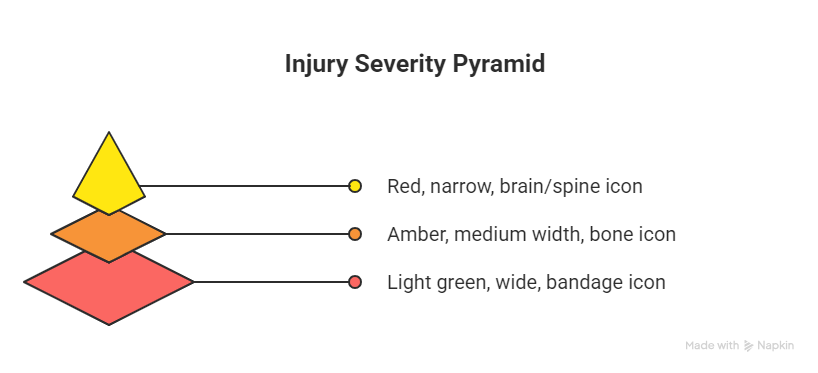
Settlement amounts vary widely from a few thousand dollars for minor injuries to over $2 million for catastrophic ones.
The key dividing line is whether your injury meets Ontario’s serious injury threshold. Minor injuries usually stay within the accident benefits system. More serious injuries can support a full tort claim. Catastrophic injuries open access to a higher benefit tier and larger court awards.
| Injury Level | Typical Ontario Range | Tort Claim Possible? | Key Notes |
| Minor (road rash, mild sprain) | $5,000 – $25,000 | Rarely | Statutory deductible often wipes out pain and suffering award |
| Non-Catastrophic (fractures, chronic pain, nerve damage) | $50,000 – $300,000+ | Yes | Must prove permanent serious impairment |
| Catastrophic (TBI, spinal cord injury, limb loss) | $500,000 – $2.5M+ | Yes | $1M lifetime benefit access plus full tort damages |
Two Ontario cases show what these numbers look like in practice.
In St. Marthe v. O’Connor, a cyclist with chronic pain who could no longer work in construction was awarded approximately $205,000 broken down as $32,000 for pain and suffering after the deductible, $81,000 for past income loss, $47,000 for future income loss, and $45,000 for future housekeeping costs.
In Sanson v. Paterson, the Ontario Court of Appeal upheld a $2.5 million award for a cyclist struck at a Toronto intersection who suffered catastrophic injuries.
What Factors Raise or Lower Your Bicycle Accident Settlement?
Several factors directly change how much compensation you receive.
What increases your settlement:
- Medical records from the day of the accident
- Expert opinions confirming permanent impairment
- Documented income loss: pay stubs, tax returns, invoices
- A police report establishing the driver’s fault
- Witness statements supporting your account
- Legal advice before giving any statement to an insurer
What reduces your settlement:
- Not wearing a helmet
- Riding without lights after dark
- Breaking traffic rules running a red light or cycling through a crosswalk
- Gaps in medical treatment after the accident
- Giving a recorded statement to the insurer without a lawyer
In Pelletier v. Ontario, a cyclist who rode through a crosswalk was found 40% at fault, significantly reducing their recovery. In another case, no helmet meant a 10% reduction in damages not elimination of the claim. Not wearing a helmet proportionally reduces your award. It does not cancel it.
Key documents to gather after any bicycle accident:
| Document | Why It Matters |
| Police report | Establishes the accident timeline and fault |
| Medical records | Proves injury severity and treatment needs |
| Photos of scene and injuries | Visual proof of damage and road conditions |
| Witness contact details | Independent support for your version of events |
| Pay stubs, tax returns, or invoices | Proves income loss for employed and self-employed cyclists |
| Expert medical opinion | Confirms permanent impairment for the threshold test |
Immediately after a bicycle accident, taking the right steps can make the difference between a successful claim and a denied one.

What Are Your Options After a Dooring, Hit and Run, or Road Defect Accident?
Three common accident types each carry their own legal rules in Ontario and all three support a compensation claim.
Dooring Accidents
The person who opened the car door is liable not the cyclist.
Under the Ontario Highway Traffic Act, any driver or passenger must confirm it is safe before opening a door on a roadway. Failing to check carries a $365 fine and three demerit points. A Mississauga cyclist riding in a bike lane along Dundas Street East, struck by a door opened without warning, has a strong tort claim. Ontario law does not expect cyclists to swerve into moving traffic to avoid the door zone.
Hit and Run Claims
You can access compensation even if the driver fled and was never found.
Ontario’s MVACF covers both accident benefits and up to $200,000 in tort compensation for cyclists hit by unidentified or uninsured drivers.
Coverage order after a hit and run:
- Your own insurer: if you carry auto insurance
- At-fault driver’s insurer: if the driver is identified
- MVACF: if the driver is unidentified or carries no insurance
A cyclist struck near Square One in Mississauga with no car insurance can still apply to the MVACF. Even partial details a vehicle colour, a partial plate, a witness description strengthen the claim. Report to police immediately before speaking to any insurer.
Road Defect and Municipal Claims
You can pursue a claim against a municipality for unsafe roads but you must act within 10 days.
Ontario municipalities must keep public roads and bike lanes in reasonably safe condition. Potholes, cracked pavement, and unmarked road works can all support a negligence claim. A cyclist injured on a poorly maintained stretch of Matheson Boulevard in Mississauga can pursue a municipal claim provided written notice is filed within 10 days and the defect is photographed before repairs are made.
Critical deadline: Municipal road defect claims require written notice within 10 days of the accident. Missing this window can end your claim entirely.
Not sure which situation applies to your case? Maana Law offers free consultations for injured cyclists in Mississauga no upfront fees, no obligation.
How Does the Ontario Statutory Deductible Affect Your Pain and Suffering Award?
Ontario law reduces pain and suffering awards by approximately $41,000 unless your award is large enough to escape it.
To claim pain and suffering, your injury must first pass the serious injury threshold proving either a permanent serious impairment of an important physical, mental, or psychological function, or permanent serious disfigurement. Chronic pain, traumatic brain injury, and significant permanent scarring typically qualify.
Once you pass the threshold, the deductible is applied. If your award exceeds approximately $137,000, the deductible falls away and you receive the full amount.
| Pain and Suffering Award | Deductible Applied | Cyclist Actually Receives |
| $35,000 | ~$41,000 | $0 falls below the deductible |
| $80,000 | ~$41,000 | ~$39,000 |
| $140,000 or more | None | Full amount awarded |
The deductible applies only to pain and suffering. It does not reduce income loss, medical expenses, or future care cost claims.
How Long Do You Have to File a Bicycle Accident Claim in Ontario?
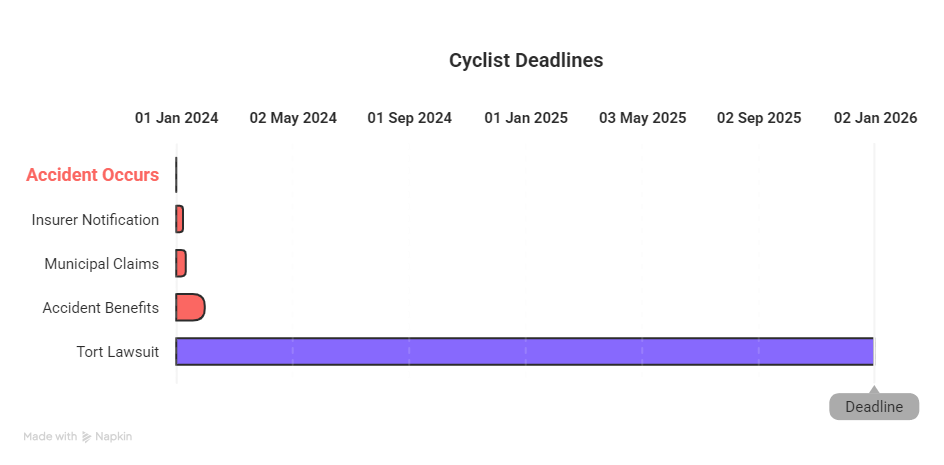
You generally have two years to file a tort claim but the clock does not always start on the accident date.
In St. Marthe v. O’Connor, the cyclist filed nearly four years after the crash. The court accepted the claim because the two-year period only began when he realised his injuries had permanently ended his career. The clock starts when you knew or reasonably should have known that you had a claim worth pursuing.
Key deadlines for Ontario cyclists:
| Required Action | Deadline |
| Notify your insurer | Within 7 days |
| Submit accident benefits application | Within 30 days of receiving the form |
| Municipal road defect written notice | Within 10 days |
| File tort lawsuit | Within 2 years of discovery |
Acting early still matters. Road defects get repaired within days. Witnesses forget details. The sooner documentation begins, the stronger your claim becomes.
Why Choose Maana Law as Your Bicycle Accident Lawyers in Mississauga?
Decades of Legal Victories
With over 10 years of experience as personal injury lawyers in Mississauga, the Maana Law team has a proven track record of securing favourable settlements and verdicts for cyclists and accident victims across Peel Region.
Client-Centred Legal Service
Every case receives personalised care. Maana Law works closely with each client whether injured in Erin Mills, Cooksville, or anywhere across Mississauga to make sure their recovery stays the priority throughout the entire legal process.
Pay Only If We Win
Maana Law works on a contingency fee basis. If they do not win your case, you do not pay. No upfront fees. No hidden costs. No financial risk.
Dedicated to Maximum Results
From medical expenses and lost wages to future care costs and pain and suffering, Maana Law pursues every available head of damages to make sure clients recover what they are genuinely owed.
In-Depth Case Analysis
Every case starts with a thorough investigation. Police reports, expert medical opinions, witness statements, and financial records are all reviewed from the first consultation. Strong evidence builds strong cases.
Always Keeping You Informed
We prioritize clear, timely updates. Stay confident and informed throughout the process with our personal injury lawyer near you in Mississauga, supporting you every step of the way
Questions Ontario Cyclists Ask About Accident Settlements
What is a typical bicycle accident settlement amount in Ontario?
Minor claims settle between $5,000 and $25,000. Non-catastrophic tort claims range from $50,000 to $300,000 or more. Catastrophic injuries can reach $1,000,000 and beyond. A lawyer can give you a realistic figure based on your specific injuries and losses.
Can I claim if I was partially at fault?
Yes. Your award is reduced by your percentage of fault not cancelled. If you were 25% at fault on a $100,000 claim, you receive $75,000.
Does not wearing a helmet reduce my settlement?
It can reduce your award but does not eliminate your claim. Courts treat it as a contributory negligence factor, typically resulting in a percentage reduction based on how the head injury contributed to your overall damages.
What compensation is available after a hit and run?
You can claim through your own insurer or Ontario’s MVACF, which provides accident benefits and up to $200,000 in tort compensation for unidentified or uninsured drivers. Report to police immediately.
Can I sue the city if a road defect caused my accident?
Yes. Municipalities must maintain safe roads and bike lanes. You must give written notice within 10 days of the accident missing this deadline can end your claim entirely.
Don’t settle your cycling claim without legal advice. Insurance first offers are almost always too low.
Free consultation. No fees unless we win. Serving Mississauga and the greater Peel Region.
Injured in a Bicycle Accident in Ontario? Here Is What to Do Next
Bicycle accident settlements in Ontario depend on injury severity, the claim track pursued, and how well the case is documented. Ontario law leans in favour of cyclists when a motor vehicle is involved but deductibles, thresholds, and limitation periods all affect the final number. Getting legal advice early is the most effective step you can take to protect your claim.
If you or someone you care about has been injured in a bicycle accident in Mississauga or anywhere across Ontario, Maana Law is ready to help. The consultation is free. You pay nothing unless we win.