

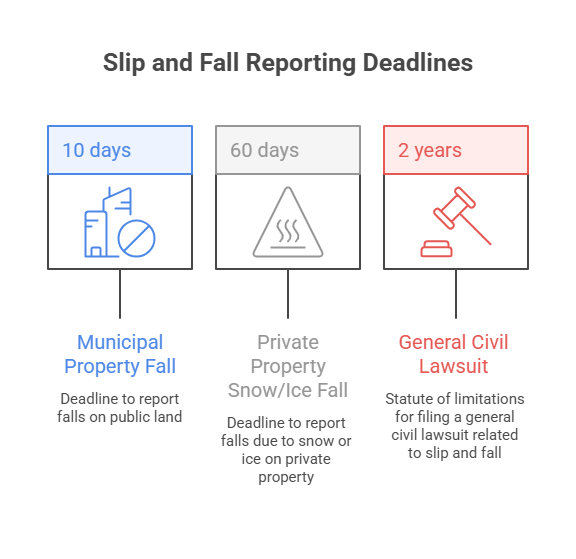
You’re usually safest if you report a slip and fall right away, but the legal deadlines in Ontario can be as short as 10 days, 60 days, or up to 2 years, depending on where you fell and what caused it.
If you’re reading this right now, chances are you’re worried about one thing: Did I already miss the deadline? I understand that feeling. After a fall, you’re dealing with pain, stress, medical appointments, and suddenly someone mentions “notice periods” and “limitation periods.” It can feel overwhelming.
Let me simplify this clearly for you. In Ontario, “reporting” a slip and fall can mean an incident report at the location, a written legal notice, or a lawsuit deadline. And depending on where and how you fell, the timeline could be 10 days, 60 days, or up to 2 years. The most important step is figuring out which rule applies to your situation so you do not lose options while you are still trying to recover.
By the end, you will understand:
- Municipal property falls may involve a very short notice period.
- Snow or ice claims often require written notice within 60 days.
- Most lawsuits must be started within 2 years from discovery.
- Verbal reporting alone is risky.
- Acting quickly protects evidence and your legal rights.
What does “reporting a slip and fall” mean in Ontario?
If you are feeling confused by the word “reporting,” let me simplify it for you.
In Ontario, “reporting” usually refers to one of three things: an incident report, a legal written notice, or starting a lawsuit. They are not the same, and mixing them up is where deadlines get missed.
An incident report is what you request at a store, building, or workplace. A written notice is a formal heads-up that may be required for certain types of falls or certain defendants. A lawsuit is the legal filing, and it typically comes later, but it still has a hard slip and fall time limit.
| Step | What it does | Typical timing | Proof you should keep |
|---|---|---|---|
| Incident report | Records the event with the property | Same day if possible | Photo of report, report number, staff name |
| Written notice | Preserves rights in special cases | Sometimes 10 days or 60 days | Copy of letter, date sent, delivery proof |
| Lawsuit | Starts the court action | Often months later | Filing confirmation |
A few days ago, someone came to us after falling in a condo parking area. They told security right away, but nothing was written down. When they later asked for footage, they were told it was overwritten. That is the risk of thinking “I reported it” when all you really did was speak to someone.

Verbal reporting vs written proof
You may already be wondering whether telling someone on-site is enough.
A verbal report helps, but it is rarely enough by itself. If there is no paper trail, it becomes your word against theirs later.
A safer approach is simple: tell staff immediately, then follow up in writing the same day. Even a short email can protect you.
Why reporting fast matters even if you are unsure about suing
Right now, you might be trying to relate this to your own situation.
Fast reporting protects the evidence that disappears first: surveillance footage, witness memory, weather conditions, and the exact state of the hazard.
It also protects your medical timeline. When someone waits a week to get checked, insurers often argue the injury was not serious, or it came from something else. Prompt care creates a cleaner record, which is vital when calculating Ontario slip and fall settlements.
Which deadline applies to your slip and fall in Ontario?
Before you decide anything, it’s important you understand this clearly.
The deadline depends on two things: where you fell (municipal vs private property) and what caused the fall (snow or ice vs other hazards). Once you know those two facts, you can usually spot the right rule fast.
If you fell on municipal property like a city sidewalk, road, public walkway, or municipal lot, a 10-day notice issue may apply in certain cases. If your injury was caused by snow or ice on private property like an icy condo path or parking lot, you may have a 60-day written notice requirement. If neither fits, you’re usually in the general civil timeline, including the 2-year limitation period, often tied to discovery.
| Situation | What “reporting” means | Why it matters |
|---|---|---|
| Municipal property fall | Written notice to the municipality | Missing it can weaken your claim fast |
| Snow or ice injury on private property | Written notice to occupier or contractor | Often required before a lawsuit can move forward |
| Other private property hazard | Incident report + evidence + medical records | Protects credibility and supports the timeline |
When do you have only 10 days to notify a municipality after a slip and fall?
If you’re feeling unsure about this part, you’re not alone.
You may have only 10 days in certain municipal situations because Ontario law can require prompt written notice to the municipality. Municipalities want early notice so they can investigate quickly and preserve records.
This is where people lose leverage. They think, “I have two years,” and do not realize a shorter notice rule may exist for the municipal side of the case.
Here is what your municipal notice should include:
- Date of the incident
- Time (even an approximate window helps)
- Exact location (address, intersection, landmark, and which side if relevant)
- What happened (short and factual)
- Injury basics (what body parts were impacted, and that you sought care)
- Your contact information
A client we spoke to fell near a curb cut by a public walkway. They only wrote “near the plaza” later. That can be risky because it is hard to investigate. A safer version is a pin-drop location, even if it feels overly detailed.
From my experience, this is where most clients want a clear answer.
Vague location details are one of the easiest ways for the city to argue they were not properly notified.
Examples:
- Not “outside the mall,” but “outside the main entrance doors of Building A, beside the accessible ramp.”
- Not “on the sidewalk,” but “on the west sidewalk of X Street, between Y and Z.”
If the 10-day window may already be missed
Let’s pause for a moment and look at this from your perspective.
Missing the window does not automatically mean you have no case, but it becomes more complex and fact-specific. At that point, timing and evidence matter even more, so it is important not to keep guessing.
When does the 60-day notice rule apply to snow or ice slip and falls on private property?
You’re probably asking yourself how this actually works in real life.
The 60-day rule is a special written notice requirement for injury claims caused by snow or ice on private property. It does not replace the 2-year lawsuit limitation period. It comes before it as an earlier step you may need to satisfy.
This rule can involve both the occupier (the person or company controlling the property) and an independent contractor hired for snow or ice removal.
| Who might get notice | When they matter | Safer ways to prove delivery |
|---|---|---|
| Occupier (owner, property manager, condo corporation) | They control the premises | Registered mail or personal service |
| Snow or ice contractor | If responsible for removal at that time | Registered mail or personal service |
If you want a simple way to reduce risk, this is a point where many people choose a quick deadline check. At Maana Law, a Personal Injury Lawyer Mississauga trusts, we can confirm whether snow or ice is legally in play, who the proper parties are, and what your notice should contain so you do not lose time on guesswork.
A client we helped last winter fell on an icy condo walkway. They assumed private property meant they had lots of time. What protected them was sending a clear written notice with the date, time, and exact location while the scene was still fresh.
Indoor falls vs snow or ice falls
If you were sitting across the table from me, this is what I’d explain.
No, the 60-day rule is designed for injuries caused by snow or ice. An indoor fall like a wet floor, aisle spill, or poor lighting issue is usually handled under general occupier liability rules without that snow or ice notice rule being the trigger.
Delivery and proof that actually holds up
Right now, you might be trying to figure out who to even send it to.
At a minimum, notice should reach a key party tied to the property or snow removal, and it must be delivered in a way you can prove later.
A practical approach:
- Identify the occupier (business, landlord, property management, condo corporation).
- Identify the contractor if one exists.
- Keep proof: delivery receipt, tracking, service confirmation, copy of the letter.
Late notice in simple terms
If this feels stressful to read, I understand why.
Late notice does not always end the claim, but it creates a “you must explain the delay” problem. In simple terms, it often turns on whether there was a reasonable excuse and whether the other side was actually harmed in their ability to investigate and defend.
What is the time limit to sue for slip and fall in Ontario?
Before you decide anything, let me make the core rule simple.
Most slip and fall lawsuits in Ontario must be started within a basic 2-year limitation period, and the clock is often tied to discoverability. That means it can depend on when you knew, or should have known, you had a legal claim.
This matters because “I feel fine today” can be misleading. Some injuries show up later or worsen over time, and your documentation helps establish when the injury became clear.
| Timeline marker | What it means for you |
|---|---|
| Day 0 | The fall happens |
| Day 10 or Day 60 (in some cases) | Short notice rules may apply first |
| Up to Year 2 (often from discovery) | The lawsuit limitation period may apply |
Discoverability explained in plain language
You may already be wondering which date actually matters.
It is not always “two years from the fall date” in a simple calendar way. Discoverability usually focuses on when you knew, or should have known, your injury was meaningful, connected to someone else’s fault, and that a legal claim was appropriate.
How short notice rules and the 2-year limit fit together
If you’re thinking “so I have 2 years, I’m fine,” let me stop that mistake early.
Short notice rules can apply even when the 2-year limitation period has not run out. You can be within two years and still lose ground if a required notice was not sent in time for municipal or snow or ice situations.
What should you do in the first 24 hours after a slip and fall?
If you’re feeling shaken or embarrassed about what happened, that’s normal.
In the first 24 hours, focus on your health first, then protect the evidence before it changes. You do not need to decide about suing on day one, but you do need a clean, provable record of what happened.
Here is a practical checklist:
- Get medical attention the same day if you can.
- Take photos of the hazard and the full area around it.
- Save your footwear and clothing in the same condition.
- Get witness names and phone numbers if anyone saw it.
- Ask for an incident report and photograph it, or document the refusal.
- Request that surveillance footage be preserved in writing.
A client once told us, “I didn’t take photos because it felt dramatic.” Two hours later, the area was salted and cleared. Nobody could see what caused the fall. Photos would have changed the entire evidence picture.
Medical documentation that protects you
From my experience, this is where people unintentionally hurt their own case.
Get checked the same day if symptoms are meaningful, and document symptoms even if they feel mild. Many injuries evolve over 24 to 72 hours.
Evidence that disappears first
Right now, you might be thinking, “What evidence even matters?”
Collect what will not exist later: the hazard, the context, and proof of conditions.
Preserving surveillance footage properly
If this feels confusing at first, let me make it practical.
Assume video can be overwritten quickly, so request preservation immediately and in writing. Keep a copy of what you sent and any reply.
What should an incident report or written notice include in Ontario?
You may already be wondering what you are supposed to say without messing it up.
The safest reporting is factual, specific, and consistent with your medical record. You do not need dramatic language, you need clarity and proof.
Use this simple structure:
- Date and time
- Exact location with landmarks
- What happened (brief hazard description)
- Injury basics (honest, short)
- Request to preserve incident reports, logs, and surveillance footage
This is also where incident report requirements ontario matters most: clarity, location precision, and proof of who received the report.
If the property refuses an incident report
If you’re worried the property owner will not cooperate, you’re not overthinking it.
If they refuse, document the refusal, write your own record immediately, and email it to yourself so there is a timestamp. Then send a short follow-up email to the business or property confirming you reported the fall.
From my experience, this is where people leave out must-have details.
At minimum, include the date, time, exact location, what happened, and injury basics. Avoid opinions. Stick to facts.
Proof that you reported it
Proof is everything, and it is usually simple:
- Follow-up email confirming the report
- Photos of completed forms, or proof they refused
- Witness confirmation message
- Delivery receipts for written notice
- Notes of names, dates, and times
When should you talk to a slip and fall lawyer in Mississauga?
If you’re trying to decide whether this is serious enough, I understand that hesitation. You should consult a Slip and Fall Lawyer Mississauga when deadlines are unclear, the property type is confusing, the injury is significant, or evidence is at risk. The goal is not to rush into a lawsuit. The goal is to protect your options and avoid a preventable deadline mistake.
This is especially true if you are dealing with slip and fall reporting requirements that might involve municipal property or snow or ice.
Common signs you need help quickly
From my experience, these triggers justify quick advice:
- Snow or ice was involved
- The fall may involve municipal property or joint maintenance
- Serious injury (head injury, fracture, serious back or neck symptoms)
- Unclear property ownership or occupier identity
- The business refused an incident report
- Footage may be overwritten soon
- You think a notice window may already be running
Why choose Maana Law for slip and fall cases
Before you decide anything, it’s fair to ask what makes one firm different.
- No Win, No Fee: You do not pay legal fees unless compensation is recovered.
- Free consultation: Quick clarity on which deadline applies and what to do next.
- 10+ years of experience: Practical handling of evidence, notice letters, and insurer pushback.
- 5-star client feedback: Clients often mention clear communication and responsiveness.
- Accessible support: Virtual meetings plus home or hospital visits when needed.
- Language comfort: Support available in English and Hindi for many clients.
Frequently Ask Questions
What is the statute of limitations on slip and fall in Ontario?
Usually, the lawsuit limitation concept is two years from discovery. Short notice rules can still apply first in municipal or snow/ice cases.
What is the notice period for a slip and fall in Ontario?
It depends. Municipal falls can involve very short notice. Snow or ice injuries can trigger a 60-day written notice rule.
Does the 60-day notice rule apply to every slip and fall?
No. It generally applies to snow or ice injury claims, not indoor hazards like spills or wet floors.
How long after a fall can you make a claim?
Report immediately. You may still have time to sue later, but early reporting protects evidence and options.
What happens if you do not report a fall right away?
Evidence disappears, timelines get questioned, and claims become harder to prove.
Can you sue someone after 2 years in Ontario?
Usually not, unless a narrow exception applies. Do not rely on exceptions.
If I fell on municipal property, do I have only 10 days to notify the city?
Some municipal situations involve very short notice expectations. Treat municipal falls as urgent until confirmed.
Conclusion
If you take one thing from this guide, take this: Ontario slip and fall timing is not one single deadline. You may be dealing with a municipal notice issue, a snow or ice 60-day notice rule, and a separate limitation period for filing a lawsuit. Waiting can cost you options, even when you think you “still have time.”
If you are unsure which rule applies, a quick review can help you avoid missing a notice deadline. Contact Maana Law, at 437-979-4878, email info@maanalaw.com, or visit 90 Matheson Blvd W Suite 101, Mississauga, ON L5R 3R3, Canada.