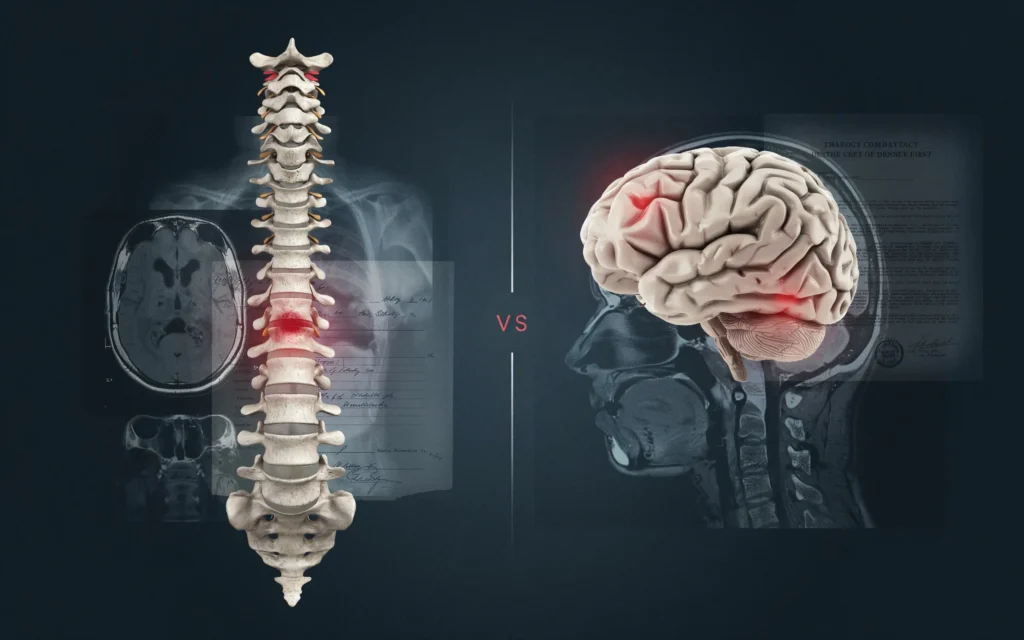
After a serious accident in Ontario, two of the most devastating outcomes are a spinal cord injury vs traumatic brain injury. Both can permanently change how you live, work, and function. But under Ontario law, these injuries are treated differently, and that difference can directly affect how much compensation you receive and what benefits you can access.
If you are dealing with either injury, consulting a spinal cord injury lawyer in Mississauga who understands both the medical complexity and the legal framework is essential. At Maana Law, we have helped accident victims in Mississauga and the surrounding area navigate these complex claims. whether you are dealing with paralysis, cognitive impairment, or both.
Here is what this guide will help you understand:
- How Ontario’s SABS classifies spinal cord and brain injuries differently
- What catastrophic impairment means for each injury type
- How tort claim compensation differs between SCI and TBI
- What happens if you have both injuries at the same time
- What legal steps to take to protect your claim
Spinal cord and traumatic brain injury settlements in Ontario range from $50K to over $2M. Our lawyers will evaluate your specific case.
What Is a Spinal Cord Injury Under Ontario Law?
A spinal cord injury (SCI) happens when trauma damages the nerves running through the spine, disrupting signals between the brain and the body. The most common causes in Ontario are motor vehicle accidents, falls, and acts of violence.
Under Ontario’s Statutory Accident Benefits Schedule (SABS), SCI is divided into two main categories:
- Complete injury – full loss of movement and sensation below the injury site
- Incomplete injury – partial loss, where some function remains
The legal significance of this distinction is significant. Paraplegia (loss of lower limb function) and tetraplegia or quadriplegia (loss of all four limbs) automatically qualify as catastrophic accident under the SABS without requiring a lengthy assessment process. This is known as a “deemed catastrophic” designation, and it immediately opens access to up to $1,000,000 in accident benefits for medical care, rehabilitation, and attendant care.
Incomplete spinal cord injuries may still qualify as catastrophic, but they require formal assessment using the American Spinal Injury Association (ASIA) scale and the Spinal Cord Independence Measure (SCIM). If the scores fall within specific thresholds, catastrophic status is granted.
What Is a Traumatic Brain Injury Under Ontario Law?
A traumatic brain injury (TBI) results from a sudden blow, jolt, or penetrating injury to the head that disrupts normal brain function. TBIs range from mild concussion to severe injuries causing permanent cognitive, behavioural, or physical impairment.
Under the SABS, traumatic brain injury catastrophic impairment classification works differently than it does for SCI. TBI does not automatically receive a CAT designation. Instead, it must meet defined criteria based on medical imaging and a validated outcome assessment tool.
For adults (18 and over), a TBI qualifies as catastrophic impairment if:
- CT or MRI imaging confirms intracranial pathology caused by the accident, and
- The Glasgow Outcome Scale (GOS) shows one of the following:
- Vegetative state, at least one month after the accident
- Upper or Lower Severe Disability, at least six months after the accident
- Lower Moderate Disability, at least one year after the accident
For children under 18, separate criteria apply based on neurological outcome scales used in pediatric rehabilitation settings.
This timing-based test is one of the key differences between SCI and TBI claims. With a spinal cord injury, catastrophic status can often be established early. With a brain injury, you may have to wait months or more than a year before the assessment can legally be completed.
How Does the Catastrophic Injury Designation Affect Your Benefits?
Understanding catastrophic injury accident benefits Ontario is one of the most important aspects of either an SCI or TBI claim.
Under Ontario auto insurance, accident benefits are divided into three tiers:
| Tier | Injury Type | Medical and Rehab + Attendant Care Maximum |
|---|---|---|
| Minor | Sprains, strains, whiplash | $3,500 (MIG cap) |
| Non-Catastrophic | Serious but not CAT | $65,000 combined |
| Catastrophic | CAT designation | $1,000,000 combined |
The difference between $65,000 and $1,000,000 is enormous, especially when you consider that serious SCI or TBI cases can involve lifetime care, home modifications, assistive devices, and round-the-clock attendant care.
For SCI involving paraplegia or tetraplegia, catastrophic status is typically established faster because the injury is visible and measurable from the start. For TBI, insurers often challenge the CAT application because cognitive and behavioural symptoms can be harder to document objectively and take longer to stabilize.
This means TBI claimants need strong early documentation, including neuropsychological testing, specialist reports, and evidence of how cognitive impairment affects daily function.
TBI vs SCI Compensation: How Tort Claims Differ in Ontario
Beyond accident benefits, injured people in Ontario can pursue a tort claim against the at-fault party when negligence caused the accident. This is where TBI vs SCI compensation Ontario can differ most significantly.
For spinal cord injury tort claims:
A spinal cord injury tort claim Ontario tends to produce some of the highest personal injury awards in Canadian courts. This is because the losses are clear, permanent, and measurable. Damages typically include:
- Past and future medical expenses
- Future care costs, including attendant care, equipment, and home modifications
- Loss of past and future income
- Pain and suffering (subject to Ontario’s cap for general damages in auto cases)
- Loss of enjoyment of life
Courts and juries understand paralysis. The injuries are visible, the prognosis is often definitive early, and life care planners can produce detailed future cost assessments. This clarity often leads to more straightforward negotiations with insurers. For more details on settlement amounts, read our guide on spinal cord injury settlements in Ontario.
For traumatic brain injury tort claims:
TBI cases can be more complex to value. Mild to moderate TBI may not produce obvious physical symptoms, making it harder to establish the full extent of impairment to the insurer, jury, or court. Cognitive symptoms like memory loss, personality changes, emotional dysregulation, and difficulty concentrating are real and devastating, but they require expert neuropsychological evidence to prove.
Severe TBI cases, particularly those meeting catastrophic criteria, can produce awards and settlements comparable to SCI cases. However, the path to proving the case is often longer and more contested.
The spinal cord vs brain injury settlement amount difference generally comes down to two things: how clearly the long-term impairment can be established and how strong the future care cost evidence is. Strong medical documentation and experienced legal counsel are essential in both cases.
Both injuries demand serious settlements. Ontario victims recover $50K to $2M+. Let Aman Kalra assess your injury and maximize your claim today.
What Happens When You Have Both Injuries?
Research shows that approximately 60% of people with cervical or thoracic spinal cord injuries also sustain a traumatic brain injury in the same accident. This is called a dual diagnosis, and it creates unique legal and medical challenges.
A dual diagnosis of SCI and TBI means:
- Each injury compounds the other in rehabilitation. TBI can interfere with the cognitive tasks needed for SCI rehab.
- The combined impairment is assessed across multiple SABS criteria, potentially making catastrophic designation easier to establish.
- Future care costs increase significantly because both cognitive and physical support is needed long-term.
- Legal claims are more complex and require coordination between multiple medical experts.
If you or a loved one has received a dual diagnosis, it is even more important to retain a personal injury lawyer who understands catastrophic injuries and how they interact under Ontario’s legal framework.
Why Maana Law Is the Right Choice for SCI and TBI Claims in Ontario
Choosing the right legal team after a catastrophic injury changes your outcome.
Deep catastrophic injury experience.
Aman Kalra and the Maana Law team have over a decade of experience handling complex personal injury claims, including spinal cord and brain injury cases across Mississauga and the GTA.
No win, no fee.
You pay nothing unless your case is successful. There is no financial barrier to accessing experienced legal representation.
We come to you.
If you are recovering in hospital or at home, we offer home and hospital visits so you do not have to travel while you heal.
Bilingual service.
Our team serves clients in English and Hindi, making legal guidance more accessible to diverse communities across Mississauga.
Full case preparation.
We build your file with police reports, specialist opinions, life care planner reports, and witness statements to support maximum compensation.
If you are ready to speak with a personal injury lawyer about your spinal cord or brain injury claim, contact Maana Law today for a free consultation. We serve accident victims in Mississauga, Erin Mills, Cooksville, Churchill Meadows, Meadowvale, and across Ontario.
Call us or visit our office at 90 Matheson Blvd W, Suite 101, Mississauga, ON.
Frequently Asked Questions
Does a spinal cord injury automatically qualify as catastrophic impairment in Ontario?
Paraplegia and tetraplegia (complete or incomplete) automatically qualify as catastrophic under the SABS without requiring a formal assessment. Other incomplete SCI cases are assessed using the ASIA scale and SCIM scoring tool. If you have paralysis, a catastrophic designation is typically established early in your claim. Understanding the difference between catastrophic and personal injuries can help clarify your legal options.
How long does it take to establish catastrophic impairment for a traumatic brain injury?
It depends on the severity. Under the SABS, catastrophic TBI designation for adults requires a Glasgow Outcome Scale rating that can only be assessed at specific time intervals after the accident, ranging from one month to one year. This delay often means TBI claimants access higher benefits later than SCI claimants. According to Ontario’s Financial Services Regulatory Authority guidelines on catastrophic impairment, these timelines are strictly defined to ensure accurate medical assessment.
Can I make both an accident benefits claim and a tort claim for a spinal cord or brain injury?
Yes. In Ontario, you can pursue accident benefits through your own auto insurer under the SABS and a separate tort lawsuit against the at-fault driver or party. Both claims can run at the same time, and a lawyer can help coordinate them to maximize your total recovery.
What if I have both a spinal cord injury and a brain injury from the same accident?
A dual diagnosis strengthens your overall claim in most cases. You may qualify for catastrophic impairment through multiple criteria, and your future care costs will be higher. You need a lawyer who understands both injury types and can build a coordinated legal and medical case. Learn more about what to do after a catastrophic accident.
How is pain and suffering compensation calculated for brain and spinal cord injuries in Ontario?
Ontario auto accident claims for pain and suffering are subject to a statutory deductible and cap for general damages in cases where the injury does not meet the threshold for serious and permanent impairment. Catastrophic injuries typically exceed this threshold. The actual amount depends on the nature, severity, and permanence of your specific impairment, supported by medical and functional evidence. For more information on how Ontario courts assess damages in serious injury cases, the Ontario Superior Court of Justice publishes case law that provides insight into settlement ranges.
What are the key things to know before hiring a brain injury lawyer?
Choosing the right lawyer for a traumatic brain injury claim requires understanding their experience with catastrophic cases, their approach to medical evidence, and their track record with insurers. Read our guide on 5 things to know before hiring a brain injury lawyer in Ontario to make an informed decision.
Conclusion
Both spinal cord injuries and traumatic brain injuries are life-altering. But under Ontario law, they follow different legal pathways, come with different timelines for catastrophic designation, and require different evidence strategies to prove full compensation.
Maana Law is ready to guide you through every stage of your claim, from the first consultation through settlement or trial. We serve accident victims across Mississauga and Ontario with a no-fee-unless-you-win commitment and a team that treats every client with care and respect.
Call Maana Law today or book your free consultation online. Our office is located at 90 Matheson Blvd W, Suite 101, Mississauga, ON. We offer virtual consultations and home visits for clients who cannot travel.