Yes, you may be entitled to significantly higher benefits and compensation after a catastrophic injury in Mississauga, but only if your impairment is properly documented and recognized under Ontario’s rules.
If you came here after searching catastrophic injuries Mississauga rights compensation, you’re likely asking one urgent question: Do I actually qualify for real long-term support, or will my benefits run out before my life stabilizes?
Ontario’s system typically involves two paths that work side by side: no-fault Accident Benefits under the Statutory Accident Benefits Schedule (SABS), and a tort claim against the at-fault party when negligence is involved. What makes “catastrophic” different isn’t the label, it’s the impact. A catastrophic designation can open the door to much higher medical, rehabilitation, and attendant care funding, and it often strengthens the civil claim because your long-term losses are easier to prove and harder to minimize. If you are navigating this complex legal landscape, a Personal Injury Lawyer Mississauga can provide the guidance you need.
If you read this guide, you’ll understand:
- What Ontario actually considers a catastrophic impairment, including physical and psychological criteria
- How the OCF-19 process works, and what insurers typically look for in medical evidence
- The real difference between $65,000 and $1,000,000 in available benefits, and why it matters in daily life
- How future care costs (attendant care, equipment, home modifications) are supported through planning and documentation
- When you can still sue for pain and suffering and other tort damages
- Why some catastrophic cases reach seven figures, and what factors typically drive higher settlements
I’m going to explain this the same way I would explain it to one client sitting across from me in Mississauga, clearly, practically, and without legal fluff.
What Exactly Qualifies as a Catastrophic Injury in Ontario?
A catastrophic impairment is defined by specific criteria in Ontario’s accident benefits rules, not by how painful or disruptive the injury feels day to day. Understanding the catastrophic injury vs personal injury distinction is vital for securing the right level of medical funding.
In practical terms, the system looks at whether the injury causes severe, lasting loss of function. Some injuries qualify automatically; others require assessment methods and detailed medical evidence.
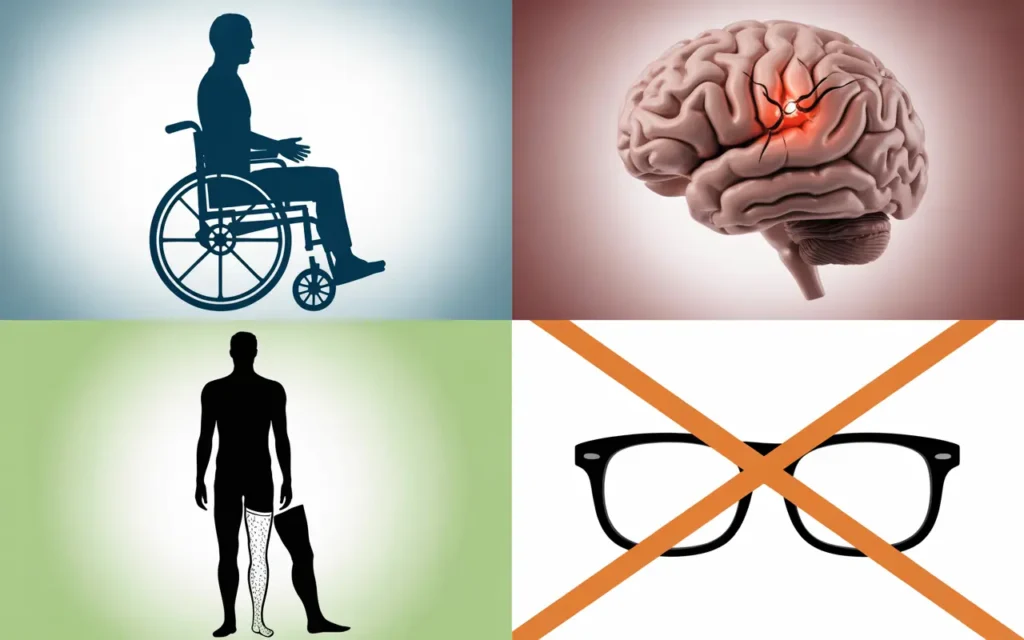
Here are common qualifying categories, explained simply:
| Category | Examples you may recognize |
|---|---|
| Spinal cord injury with major paralysis | Paraplegia, tetraplegia |
| Severe brain injury | Traumatic Brain Injury (TBI) with lasting impairment |
| Major limb loss or loss of use | Amputation, severe loss of use of an arm or ability to walk independently |
| Loss of vision | Loss of vision in both eyes |
| Whole Person Impairment threshold | Physical impairment of 55% or more |
| Severe mental or behavioural impairment | Marked or extreme impairment criteria |
What we see often is a serious crash where the hospital discharge looks “stable,” but the person cannot safely manage daily life due to cognitive decline, balance issues, or supervision needs. Catastrophic status is built on function, not appearances. For these cases, working with an experienced Catastrophic Injury Lawyer Mississauga is the best way to ensure your file is built correctly.
When Psychological Conditions Support a Catastrophic Designation
Psychological injuries can qualify when the mental or behavioral impairment is severe enough to prevent useful functioning. This is where conditions like PTSD or major depressive disorder may become legally significant, especially when the impairment is “marked” across multiple areas or “extreme” in one area.
The key is not the diagnosis alone. The key is proof of how the condition affects memory, attention, emotional control, social function, or the ability to complete basic daily activities consistently.
How Do You Apply for Catastrophic Designation in Ontario? (OCF-19 Explained)
If this feels confusing at first, let me simplify it for you.
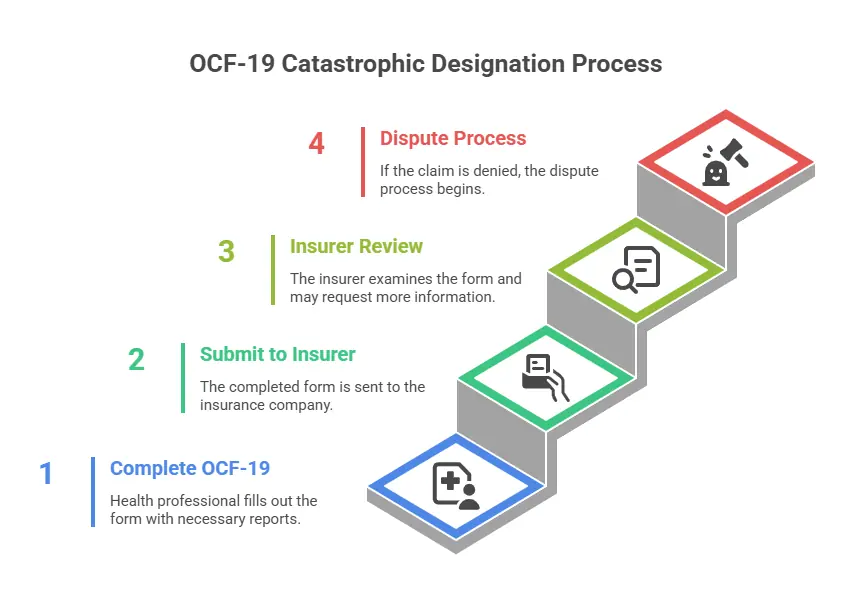
The main application document is the OCF-19: Application for Determination of Catastrophic Impairment, which is submitted to the auto insurer with supporting medical evidence.
A clean, typical process looks like this:
- A qualified health professional completes the OCF-19 and attaches relevant reports and assessments.
- The form is submitted to the insurer, who reviews it and may request more information.
- The insurer may schedule insurer examinations, especially in contested cases.
- If denied, the dispute can move into the accident benefits dispute process (often involving tribunal steps).
Most denials happen because the evidence is incomplete, inconsistent, or focused on symptoms instead of functional loss. If your injury involves neurological damage, a Brain Injury Lawyer Mississauga can help ensure the OCF-19 accurately reflects cognitive deficits.
A catastrophic injury changes everything. Your legal team should understand that from day one.
Accident benefits, tort claims, and long-term care planning — Maana Law handles every piece of your case.
What’s the Real Difference Between $65,000 and $1 Million in Benefits?
Before you decide anything, it’s important you understand this clearly.
Under standard Ontario auto coverage, the combined maximum for medical, rehabilitation, and attendant care is often $65,000 for non-catastrophic impairments, compared with $1,000,000 for catastrophic impairments.
Here’s the difference in one glance:
| Benefit pool (standard coverage) | Non-catastrophic | Catastrophic |
|---|---|---|
| Medical + rehab + attendant care (combined) | $65,000 (time-limited) | $1,000,000 (lifetime) |
There are also optional coverages that can increase catastrophic protection beyond $1M, depending on the policy.
A simple example: if you need ongoing rehab, psychological care, mobility supports, and meaningful attendant care, $65,000 can be used up quickly. The designation is what protects the long-term plan. For those suffering from paralysis, a Spinal Cord Injury Lawyer Mississauga is essential for securing the $1M funding necessary for specialized equipment and home modifications.
How Are Future Care Costs and Life Care Plans Covered in Catastrophic Claims?
In catastrophic cases, the biggest financial risk is not the first month, it’s the next decade.
A strong catastrophic claim is built around future care costs, often supported by life care planning. This is how treatment, equipment, home supports, and attendant care are projected in a way insurers and courts can understand.
Common future care items include:
- Attendant care hours and supervision needs
- Mobility equipment and replacement cycles
- Long-term rehab and therapy plans
- Home modifications for safety and accessibility
- Vehicle modifications or specialized transportation
Ontario also sets different maximum monthly attendant care amounts for non-catastrophic versus catastrophic impairment, which is one reason the designation matters so much when you need ongoing support.
One client situation we often see is a TBI case where the person looks “fine” for short conversations, but cannot safely manage daily routines without supervision. A life care plan makes that reality visible on paper.
Can You Still Sue for Pain and Suffering in a Catastrophic Case?
Yes. Accident Benefits help regardless of fault, but a tort claim is how you pursue compensation from the at-fault party when negligence caused the loss.
In catastrophic cases, tort claims often focus on:
- Pain and suffering (non-pecuniary damages)
- Past and future income loss
- Loss of earning capacity
- Future care costs not fully covered by benefits
- Loss of housekeeping ability and lifestyle impact
Canada also has an inflation-adjusted upper cap concept for general damages in the most severe cases, commonly discussed in the low-to-mid $400,000 range depending on the year and jurisdiction.
Why Do Some Catastrophic Cases Settle for Millions in Ontario?
If you’re looking up catastrophic injury settlement mississauga, you’re usually trying to understand what drives high-value outcomes.
Catastrophic files can reach seven figures because the damages are long-term and measurable: future care, lifetime income loss, and permanent functional limitations. When those numbers are supported by credible evidence and experts, the claim value can grow quickly.
What typically moves the value upward:
- Permanent disability and level of independence lost
- Age, career path, and long-term earning potential
- Strength of medical documentation and functional assessments
- Clear life care planning and cost projections
- Strong liability evidence and reconstruction where needed
- How disputes, delays, and insurer tactics are handled
Timelines vary. Some cases resolve sooner, but catastrophic files can also take years because the long-term picture must be proven carefully.
What Should You Look for in a Catastrophic Injury Lawyer in Mississauga?
This is usually the point where clients want clarity on their severe injury legal rights, and they want to avoid choosing the wrong fit too early.
A catastrophic case is not a “paperwork” file. It needs a plan for medical evidence, accident benefits disputes, and tort litigation working together.
Good signs to look for:
- The lawyer explains evidence, experts, and process in plain language
- They understand both SABS benefits and tort claims, and how they interact
- They talk about future care planning early, not after a denial
- They communicate consistently, because catastrophic cases are long and detailed
- They do not pressure you into early settlement before needs are understood
Paralysis, brain injury, or amputation? Your claim could be worth over $1 million in Ontario.
Catastrophic cases unlock the highest benefit limits under SABS. Let our Mississauga specialists fight for you.
Why Choose Maana Law for Your Catastrophic Injury Claim in Mississauga?
At Maana Law, we handle catastrophic cases with a simple mindset: protect your long-term care and your long-term compensation, not just the next step in the file.
Here’s what clients typically care about most:
- Clear guidance: you understand what is happening and why
- Evidence-first strategy: medical proof, functional impact, and planning come early
- Access and convenience: virtual meetings, and home or hospital visits when needed
- No Win, No Fee: you can pursue a claim without adding financial pressure
- Local support: we regularly assist clients across Mississauga and nearby GTA communities
Frequently Asked Questions About Catastrophic Injuries in Mississauga
How long does catastrophic determination usually take?
It depends on the injury type and how quickly the required assessments and reports can be completed. Some cases are clear early; others need time to prove functional loss. The OCF-19 must be supported with the right medical evidence.
What if my catastrophic designation is denied?
A denial is not the end. It usually means the insurer disputes the evidence or wants more assessment. The next step is tightening documentation and using the dispute process where appropriate.
Can psychological injuries qualify without major physical injuries?
Yes, when the mental or behavioural impairment meets the marked or extreme threshold and prevents useful functioning. The focus is functional impact, supported by strong clinical evidence.
What are the most important catastrophic injury benefits in Ontario?
For most families, the biggest impact is higher combined funding for medical care, rehabilitation, and attendant care, plus different monthly attendant care maximums in catastrophic cases.
Does catastrophic status guarantee a million-dollar payout?
No. It increases access to benefits and supports larger damages, but settlement value depends on evidence, future care costs, income loss, liability strength, and long-term impairment impact.
No Win, No Fee — guaranteed. Focus on healing while we fight for your future.
Over 10 years helping catastrophic injury victims in Mississauga. Free consultation with Maana Law.
Conclusion
If you’re researching catastrophic accident compensation Ontario, the main thing to know is this: catastrophic cases succeed when your impairment is classified properly and your long-term needs are proven clearly, early. Ontario’s rules recognize catastrophic impairment as a distinct category, and that designation can unlock dramatically higher benefit funding and strengthen the tort claim where negligence is involved.
You do not need to have every document perfectly organized before you ask for help, but you do want to avoid delays that give insurers room to minimize the real impact.
If you need help understanding your options and protecting your future, contact Maana Law in Mississauga for a free consultation. Call 437-979-4878, email info@maanalaw.com, or visit 90 Matheson Blvd W Suite 101, Mississauga, ON L5R 3R3.